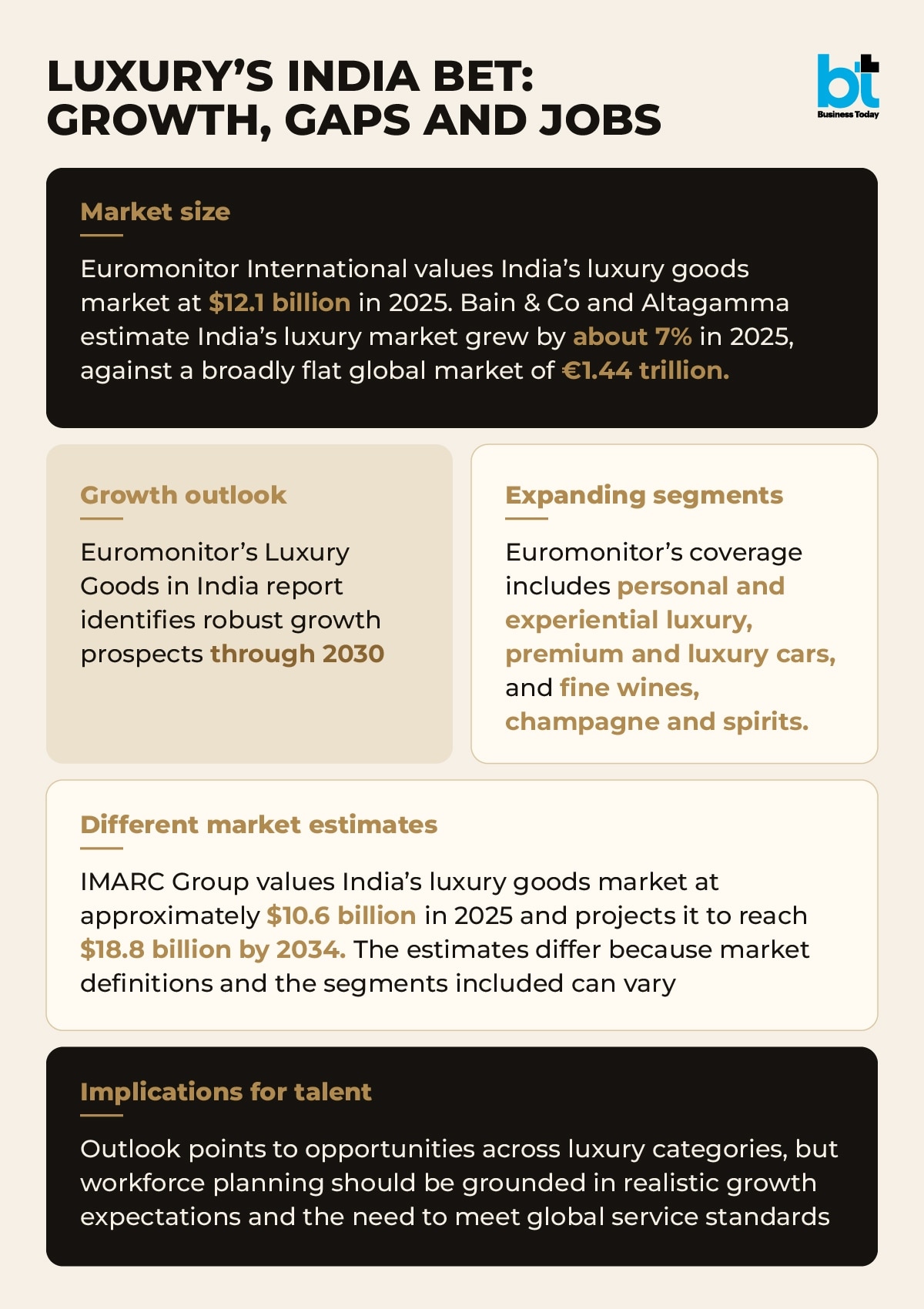
The shift in perspective reflects a broader change in how the luxury industry is understood. Beyond fashion and design, luxury spans hospitality, travel, beauty, retail and premium experiences, creating opportunities in areas such as brand management, merchandising, client relations and digital commerce.
As India’s luxury market evolves, the challenge is not simply to find people who admire luxury brands but to also build a workforce that understands the business behind them and knows how to translate a brand’s promise into an experience for which people are willing to spend.
Beyond fashion and design
Gianluca Tedaldi, Director at POLIMI Graduate School of Management, says the luxury industry is at a turning point. While Europe has historically been its centre of gravity, he sees markets such as India playing an increasingly important role in its future growth. The industry needs more than designers and creative professionals, he says. It requires managers who understand a brand’s heritage and can translate it for different markets, he adds.
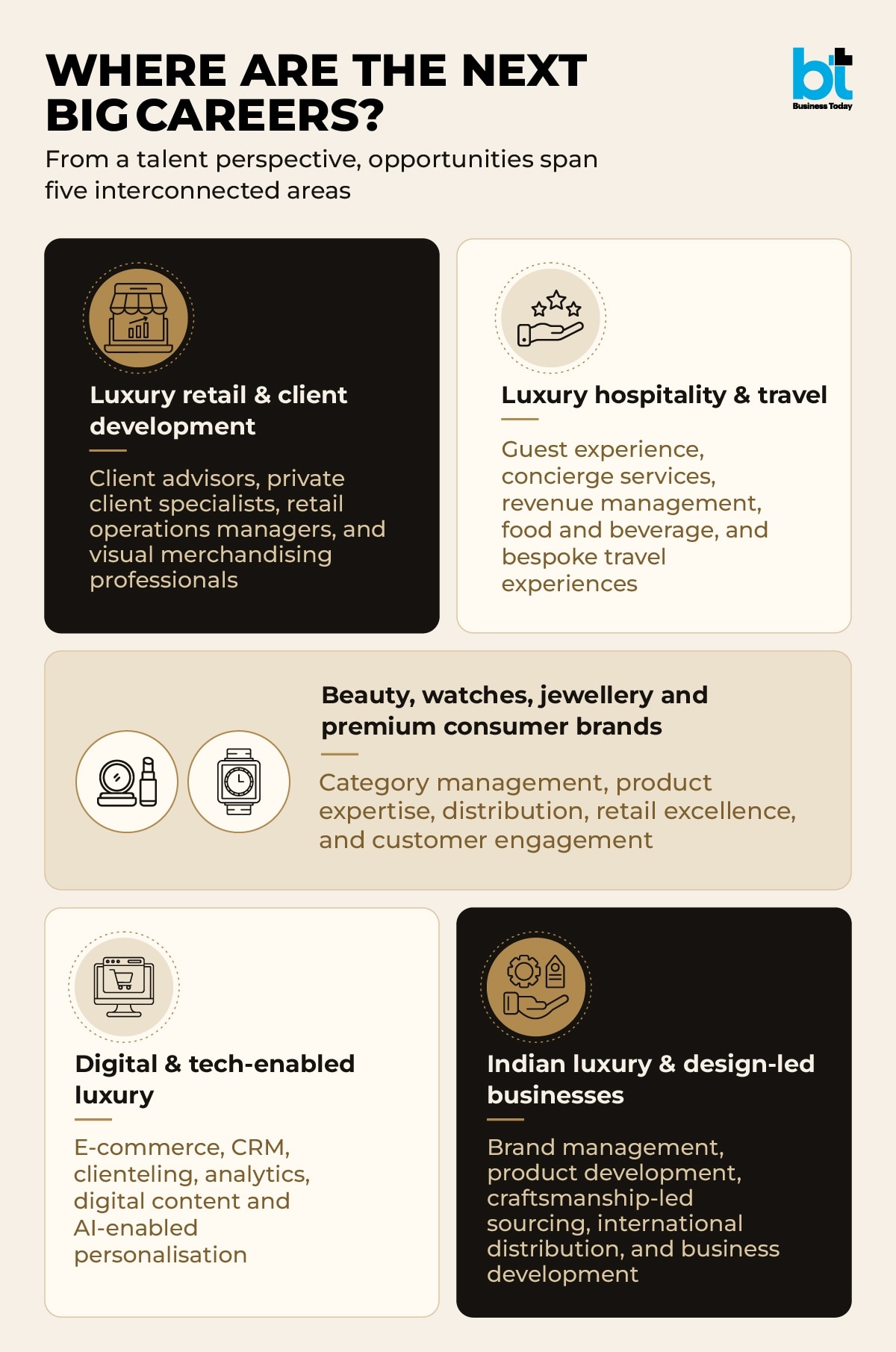
Beyond fashion and design, opportunities span retail and client experience, brand management, market development, merchandising, luxury hospitality, and the business of craft and manufacturing. The common thread, says Tedaldi, is cultural fluency: understanding the history and codes of luxury while helping shape its future.
Nitish Jain, Founder and President of S. P. Jain School of Global Management, sees the range of careers expanding as luxury becomes less about the product alone and more about the experience, aspiration, and emotion attached to it.
“The number of careers is galloping and not just expanding. Luxury is emotion, experience and storytelling, and these can apply to almost any product. You can even sell something as ordinary as a pencil or a pen as a luxury product,” he says.
The growing role of digital channels is adding another dimension. Elite Associates’ Salary Insights 2026 points to the importance of personalised customer engagement. Building relationships with customers is no longer confined to the boutique; digital channels and customer relationship management tools can help brands maintain connect with their potential customers.
Brand is not enough
India’s expanding luxury market raises a question that goes beyond job creation: Will there be enough professionals with the capabilities to fill them?
Abhay Gupta, Founder and Chairman of Luxury Connect and Luxury Connect Business School, says the institute earlier assessed that India could need 5.6 million skilled luxury professionals. The figure was derived from a projection by the National Skill Development Corporation that India’s retail workforce would reach about 56 million by 2022, with Luxury Connect assuming that 10% would be associated with luxury. It was a broad estimate of potential talent demand, not a count of actual vacancies.
The underlying capability challenge, however, remains relevant. In a 2012 survey of luxury company heads and brand owners conducted by Luxury Connect, 69.2% said they wanted to hire people trained specifically for luxury. The most frequently cited problem on the shop floor, identified by 34.9% of respondents, was a lack of understanding of luxury standards. A lack of dedicated training and a lack of a luxury outlook were each cited by 23.3%, while 18.6% pointed to inadequate product knowledge.
Gupta’s assessment is that the gap goes beyond knowing the products or being able to describe a brand. “The gap is not product knowledge; it is judgement,” he says. Digital fluency is becoming relevant, too.
Customer relationship management, digital clienteling, analytics, omnichannel retail and AI-assisted personalisation can support the customer experience, but they do not replace the judgement required to use these tools appropriately.
There is, however, an important limitation in measuring the gap. India does not yet have a comprehensive, publicly available luxury-specific workforce dataset that establishes the number of people employed in luxury-related sectors, the additional jobs being created or the number of appropriately skilled professionals available to fill them.
Building a homegrown brand
The talent question is not limited to international luxury houses. As Indian brands seek to build stronger identities and reach wider markets, they need professionals who can combine an understanding of local consumers with the business capabilities required to scale.
Vaibhav Karnavat, Founder of House of Quadri—a premium lab-grown diamond jewellery brand—says homegrown brands are not necessarily facing a shortage of craftsmanship, products or supply-chain capabilities. The harder task is building the customer experience, brand identity and sophisticated presentation needed to compete with established international players.
Building a homegrown brand also differs from bringing an established international brand into India.
Karnavat sees an opportunity in consumers’ interest in products and services that originate in their own country or hometown, and in the pride that can accompany that connection. Understanding what Indian consumers want is a significant opportunity for homegrown businesses, he says.
But he cautions against making craftsmanship and storytelling the answer to every challenge. Both need to be balanced with innovation, price competitiveness and customer service, he says.
Gupta sees the management layer as a critical constraint in the development of Indian luxury businesses. He identifies opportunities in craft management, product development, brand management, international distribution and business development. These roles can translate craftsmanship into repeatable product categories and take design-led businesses into new markets.
For young professionals, this means that an interest in fashion or design is only one possible entry point. Understanding the commercial and operational side of a brand can be equally important.
Customer engagement
Another area where the demands of luxury become particularly visible is buyer experience. Karnavat believes the product business has much to learn from hospitality, where service is treated as an essential part of the offering rather than an additional feature. Luxury businesses need to develop customer service and bring hospitality into the way they sell and deliver products.
That calls for human skills as well as technical knowledge. Patience is another quality, he emphasises.
For luxury businesses, the challenge is to ensure that the experience matches the promise made by the brand. For employees, it is to understand how their decisions, communication and attention to detail contribute to that experience.
Learning the business
As the range of luxury careers expands, specialised education is one route through which students can build the necessary understanding. But the value of a programme depends on whether it prepares students for the commercial realities of the industry, rather than simply introducing them to prominent brands.
Jain says the aim is to prepare students for the industry, as it is likely to evolve, rather than merely reflect current practices. “Our students need to be trained to think about where the industry will be three years from now and prepare for that standard today,” he says.
S. P. Jain School of Global Management offers a Global Luxury Goods & Services Management programme. Students spend the first six months in Mumbai building foundations in general management, including strategy, marketing, finance and operations. The next six months in Milan apply those tools to luxury, covering areas such as brand strategy, retail, customer experience and innovation.
Tedaldi says students learn from academics, industry professionals and consultants, while also experiencing luxury businesses in their operating environments. The programme includes study tours in France, Switzerland and Italy’s Emilia-Romagna region, exposing students to areas including haute couture, perfumery, watchmaking, hospitality, automobiles and food.
“An MBA teaches you to manage a business. It rarely teaches you why a Swiss watch, a bottle of champagne or a Pagani is worth what it is,” says Tedaldi. Jain also stresses the importance of learning outside the classroom.
Yet specialised education is not the only route into the industry. Gupta argues that client-facing roles in a boutique or luxury hotel can provide valuable early experience. These jobs may offer modest starting pay but they expose employees to customers, commercial decisions, and the standards expected in luxury.
At Luxury Connect Business School, recent graduate starting salaries have been reported at Rs 8–11 lakh a year. This is an institute-reported figure, not an independent industry-wide benchmark.
For aspiring professionals, the choice between a specialised luxury qualification, a general management degree, and entering the workforce directly depends on their career goals, the experience they already have, and how certain they are about the sector.
Whatever the route, the question is whether the candidate can translate knowledge into performance.
What the work looks like
For Aadya Sharma, who works in luxury brand marketing at Magnanimous Group, the career took shape through a combination of previous marketing experience, specialised education, and an internship with Lamborghini.
But the reality of the work, she says, is different from the glamour often associated with the sector. It involves deadlines, multitasking, and coordination across time zones.
Sathe’s experience at BlackCab Agency Network offers another view of the work. Previous internships helped him speak about actual campaigns during the selection process rather than relying only on classroom learning.
The programme gave him a foundation in brand positioning, customers and experience. The day-to-day skills, however, developed on the job: turning a rough client brief into something workable, responding calmly when plans change, and keeping several teams aligned.
Sathe sees the country’s growing luxury, lifestyle and hospitality markets as places where he can learn and take on responsibility while the sector continues to develop.
Sharma offers similar advice to students considering an international start. Although Europe can be an attractive destination, she says, competition for suitable roles can be intense, particularly for South Asian applicants. Building professional grounding in India before seeking opportunities abroad may be a more practical route.
India or overseas?
International exposure can help students understand how established luxury markets operate, but it does not guarantee an international career.
Tedaldi says graduates from the programme have joined major fashion and hospitality groups, but he stresses that opportunities in Europe depend on more than a qualification. Language can be a significant barrier.
For Sharma, the decision about where to begin should also take account of the opportunities available and the experience a young professional needs to build. For Sathe, India offered the prospect of taking on responsibility in a market still developing its luxury businesses. The choice is, therefore, not simple.
As luxury expands into new categories, the industry needs professionals who can combine commercial acumen, cultural understanding, and customer experience. A strong brand promise may attract customers, but it takes the right people to turn that promise into lasting value.















 India’s luxury sector seeks skilled workforce to boost brand experiences

 Nvidia shares plunge after CEO Jensen Huang admits to affair, board launches spy probe
 PM Modi speaks with Zelenskyy, says India ready to help end Russia-Ukraine war
 HDFC Mutual Fund gets IRDAI nod to increase Star Health stake to 9.99%
 India's aviation boom faces its first reversal in a decade
 'Nothing but a smear campaign': China denies spy claims after Nvidia CEO Jensen Huang admits affair
 Exclusive | CM Yogi Adityanath Accuses SP Of Leaving UP With A ‘Law And Order Crisis’
 Who Is Alice Huang? The Woman At The Centre Of Jensen Huang-Nvidia Controversy
 Govt Slashes Prices Of 137 Cancer Drugs By Up To 96%: What Patients Need To Know?
 PSU Banks Set For Re-Rating? Deven Choksey Explains Two Key Triggers For Samvat 2083
 FIIs May Return To India: Which Sectors Could Attract Fresh Foreign Investor Buying Next?

 Honasa Q2: CLSA retains 'Hold' call, check target price post Q2 earnings
 NBCC shares up 19% since October 23; worth buying?
 Sansera Engineering shares rise up to 7%; Nomura, Goldman Sachs on future outlook
 Jubilant FoodWorks: CLSA cuts target price after Q2 results; stock tanks 5%
 Who could be Nvidia's next CEO? Jensen Huang reveals where he hopes to find his successor
 Dubai-inspired work from park project coming to Cyberabad, pilot launch expected in Jan 2027
 Can Nvidia survive without Jensen Huang? Bernstein flags major succession risk amid China spy controversy
 Mahatma Gandhi's global legacy: India has 278 streets named after him, Italy follows with 259
 Financial Horoscope Today, November 10, 2026: Libra Signs Will See an Increase in Income, Know the Situation of All 12 Signs