












 Delhi Airport issued an advisory warning of “operational challenges” and urged travellers to check their flight status before leaving for the terminal.
 India’s largest airline IndiGo is grappling with one of its worst operational disruptions in recent years, triggering nationwide cancellations, hours-long delays, passenger chaos at major airports, and an unprecedented spike in domestic airfares across key metro routes.
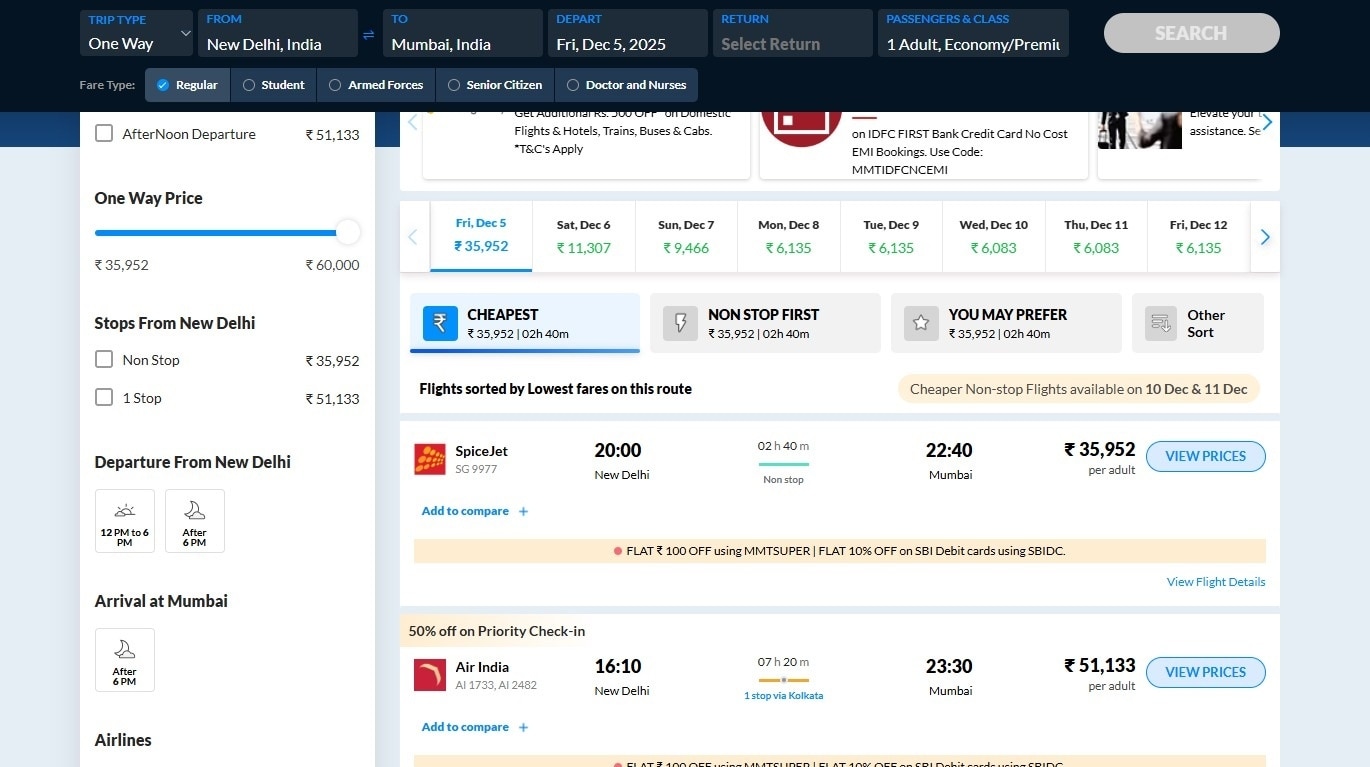
With IndiGo’s cancellations rippling across the system, fares on several trunk routes touched record highs. Data reviewed from booking platforms on December 5 showed:
On the heavily congested Delhi-Mumbai sector, the cheapest non-stop fare available on December 5 was ₹35,952 (SpiceJet, 20:00-22:40). A one-stop option on Air India for the same day cost ₹51,133.
The Delhi-Bengaluru sector — already hit hard due to crew shortages — saw fares soar past ₹40,000 on multiple flights. Even the cheapest option was around ₹27,000, while alternatives on Air India and Air India Express exceeded ₹36,000.
In a striking comparison, international travel became cheaper than flying within India:
Flight cancellations leave airports overwhelmed
On Friday, more than 589 IndiGo flights were cancelled nationwide, leading to massive queues and crowding across airports.
Delhi Airport issued an advisory warning of “operational challenges” and urged travellers to check their flight status before leaving for the terminal.
IndiGo has attributed the meltdown to revised Flight Duty Time Limitation (FDTL) rules introduced for pilot fatigue management:
These changes, combined with IndiGo’s massive network scale, triggered what CEO Pieter Elbers described as a “cascading effect” across operations.
IndiGo CEO acknowledges failure, promises fix
In a letter to employees, CEO Pieter Elbers admitted the airline had failed to deliver on its service promise, stating: “Our immediate goal is to normalise our operations and bring punctuality back on track… Given the size, scale and complexity of our network, these disruptions grow large immediately and require interventions on multiple levels.”
He added that the airline had apologised to customers and was working around the clock to stabilise schedules. “We have faced tough moments before… Together, as one team, we will overcome this challenge and emerge even stronger.”
While IndiGo expects gradual improvement, executives privately acknowledge that full normalisation could take days, possibly stretching longer if crew availability doesn’t stabilise.

 Third round of talks: CJP ends 49-day-long protest, says govt accepted 'key demands'
 Dharmendra Pradhan resigns, says decision taken to protect students' future amid NEET row
 All about Dharmendra Pradhan's educational qualification, wealth, assets and more
 India's first REIT mutual fund is here. Can it change how Indians invest in real estate?
  1997 paper leak protest to Education Minister: The extraordinary political journey of Dharmendra Pradhan
 FDs vs Markets: Where Should You Keep Your Short-Term Money?
 Why Term Insurance Is Essential for Every Earning Member | Sum Assured & Coverage Explained
 Pakistan's Alleged Terror-Politics Nexus: Lashkar Links Spark Questions Over Fazlur Rehman
 Think Life Insurance Is Optional? Here's Why Every Indian Family Needs It Today
 FD Vs Arbitrage Fund: Which Is Better For High Taxpayers?
 Adani Power: 45 GW target, Rs 2 lakh crore capex plan among conference call highlights
  ITC Hotels, Chalet, Ventive, IHCL, SAMHI: Hotel stocks to buy despite travel disruptions
 ITC shares: Rs 307 a key short-term level to watch; here's target price
 Mphasis shares: FY27 guidance maintained; brokerages keep 'Buy' after Q1; check target price
 Should you buy every IPO? Research suggests patience may be the smarter strategy
 Houthis target Saudi Aramco sites in Jizan and Yanbu as Red Sea tensions take a new turn
  Lifestyle inflation, delayed investing, high-interest debt: 3 biggest money mistakes young professionals makeThird round of talks: CJP ends 49-day-long protest, says govt accepted 'key demands'FDs vs Markets: Where Should You Keep Your Short-Term Money?
 ED targets gangster Atiq Ahmed’s Noida syndicate as henchmen push secret sale of benami assets