









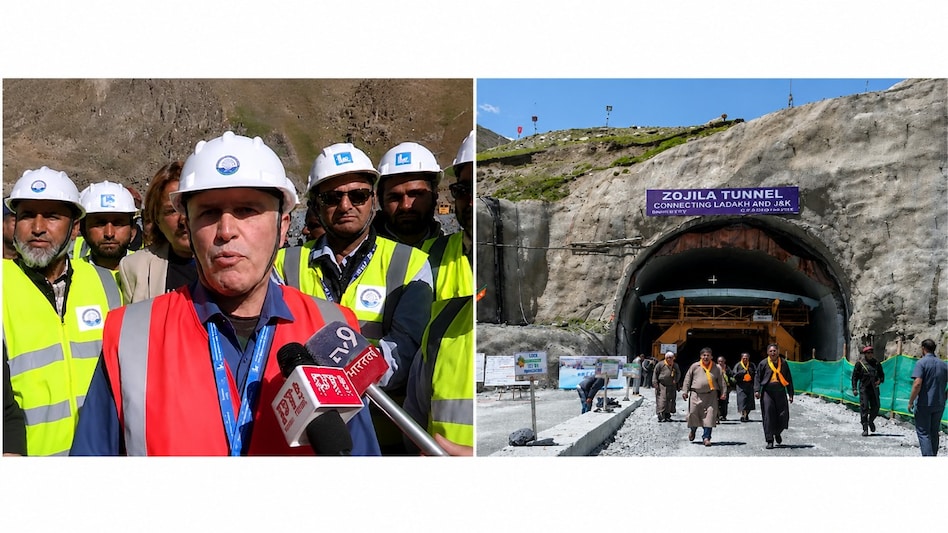
 Rahimabadi serves as the authority engineer for the project, overseeing design reviews, construction supervision and quality checks.
 Rahimabadi serves as the authority engineer for the project, overseeing design reviews, construction supervision and quality checks.
As India achieved a major breakthrough in the construction of the strategically important Zoji La tunnel on Tuesday, one of the key figures behind the project was an engineer from Iran overseeing the work deep inside the Himalayas.
Yousuf Es'haghpour Rahimabadi, an Iranian engineer serving as the authority engineer for the Zoji La tunnel project, has been supervising the design and construction of the tunnel since January 2022.
His role came into focus as Union Minister for Road Transport and Highways Nitin Gadkari remotely triggered the final breakthrough blast near the eastern portal at Minamarg in Ladakh, linking both ends of the tunnel.
The breakthrough marks a major step towards providing all-weather connectivity between Kashmir and Ladakh through one of India's most challenging infrastructure projects.
Don't Miss: Planning to fly from Jewar? Air India Express pulls out. What changes for you
Jammu and Kashmir Lieutenant Governor Manoj Sinha and Chief Minister Omar Abdullah were present at the event.
What is Yousuf Es'haghpour's role?
Rahimabadi serves as the authority engineer for the project, overseeing design reviews, construction supervision and quality checks.
Explaining his responsibilities, he said, “Our job is supervision, making the design and drawing; supervising and correcting; commenting; and designing and checking the design drawing. We also monitor each and every activity of the contractor inside the tunnel.”
Around 1,200 engineers, technicians, mechanics and labourers are currently engaged in the construction work.
World's longest bi-directional road tunnel
Built at an altitude of 11,500 feet, the Zoji La tunnel is the world's longest single-tube bi-directional road tunnel.
Stretching 13.150 kilometres beneath the Zoji La Pass in the Himalayas, the tunnel will connect Ganderbal district in central Kashmir with Drass in Kargil district of Ladakh.
The project is expected to provide year-round connectivity to Ladakh, which remains cut off from the Kashmir Valley during winter because of heavy snowfall.
Travel time to drop from two hours to 30 minutes
Once operational, the tunnel will significantly improve travel on the Srinagar-Leh National Highway.
The journey between Sonamarg and Minamarg, which currently takes around two hours, will be reduced to just 30 minutes.
The tunnel is being built at an estimated cost of ₹2,600 crore and is designed as a 7.57-metre-high horseshoe-shaped, single-tube, two-lane structure.
Gadkari calls breakthrough a testament to India's engineering strength
Calling the breakthrough a landmark achievement, Gadkari said:
“This breakthrough in the main tunnel is not just a sign of progress in construction but also a testament to India’s technical prowess, engineering capabilities, and indomitable resolve.”
He said engineers and workers had overcome heavy snowfall, harsh weather conditions and difficult geological challenges to achieve the milestone.
What happens next?
The project is being constructed using the New Austrian Tunnelling Method (NATM), which is considered suitable for the fragile Himalayan terrain and varying rock conditions.
According to officials of MEIL, international safety standards have been followed to tackle challenges such as complex geology, water ingress and tunnel collapse risks.
With the excavation breakthrough completed, work will now continue on tunnel lining, ventilation systems, safety infrastructure and finishing activities.
Officials said the project is expected to be completed by May 2028, after which it will provide uninterrupted all-weather road connectivity between Ladakh and the rest of India.
 Planning to fly from Jewar? Air India Express pulls out. What changes for you
 Air India responds to Vijay Rupani's daughter: 'No deadline or pressure to accept payout'
 Centre likely to take measures to stem net FDI outflows
 FAANG had its bite; Now the tech industry goes MANGOS
  Do you know these 10 companies that grew profits by up to 568% in 10 years?
 Why Are Oil Prices Cooling Despite Renewed U.S.-Iran War ? | Narendra Taneja
 Foreign Capital Could Return As Oil Prices Stabilise, Market Outlook Improves
 PoK Uprising: 27 Dead As Pakistan Army Cracks Down On Banned JAAC Protests; India Demands Justice!
 Market Commentary: Ashish Kila's Wealth-Creation Strategy For Investors
 Daily Calls LIVE: Ask Your STOCK MARKET TODAY QUERIES | Market Update LIVE | Share Market News Today
 Stock market today: Why Nifty failed to hold gains and closed lower
 SpaceX IPO demand surges as investors chase Elon Musk's biggest market bet
 Bharti Airtel vs Vodafone Idea: Poring over key financials of telcos
  BT Closing Bell | Sensex flat, Nifty at 23,214; HUL up 2%, Eternal down 2%
 Oil India, ONGC, Hindustan Oil, Antelopus shares tumble up to 9%; here's why