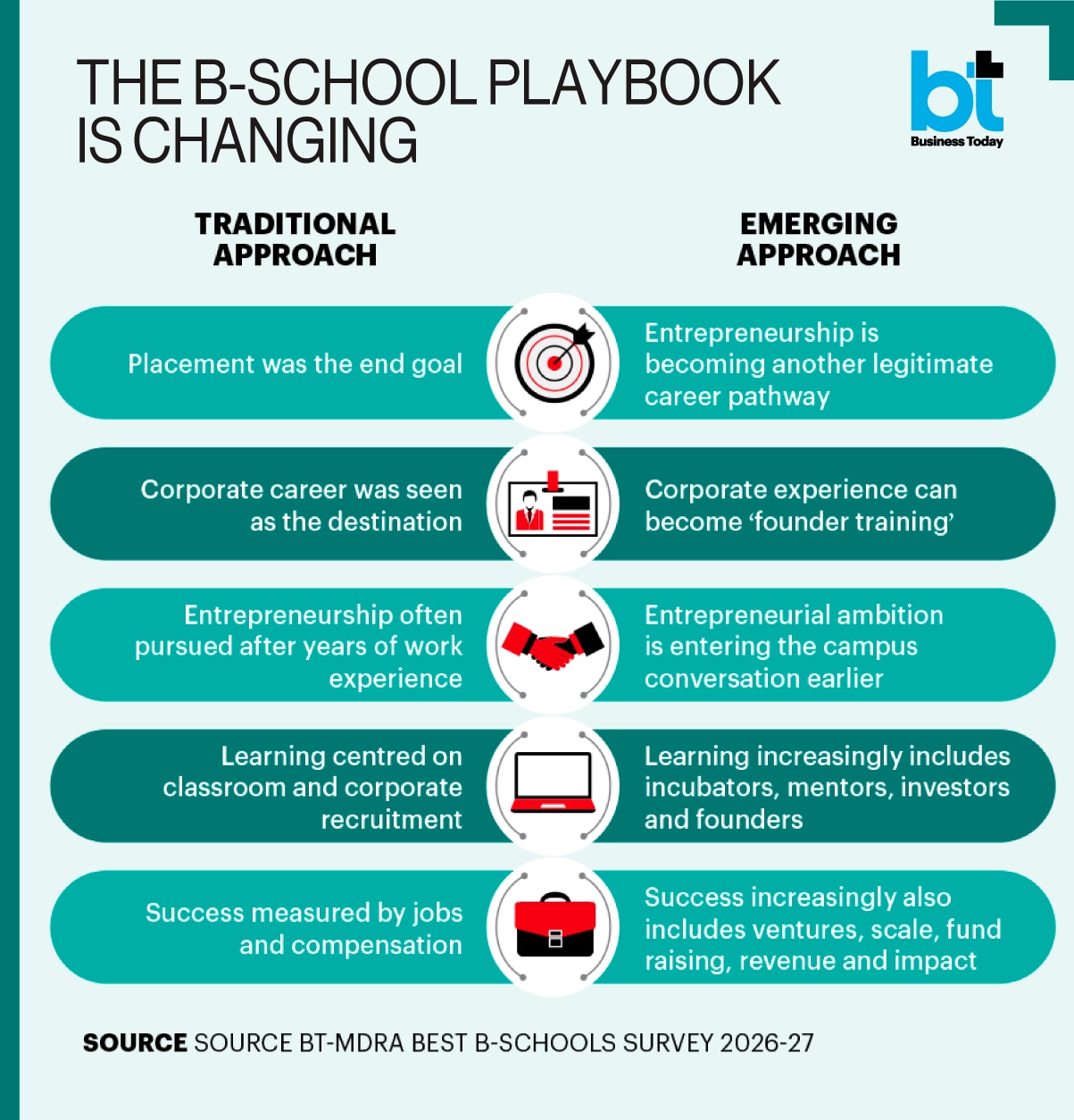
For a growing number of students, entrepreneurship is no longer a leap taken only after years in corporate India. The idea of building a company or, in today’s parlance, a “start-up” is entering the career conversation much earlier, sometimes even before the first job.
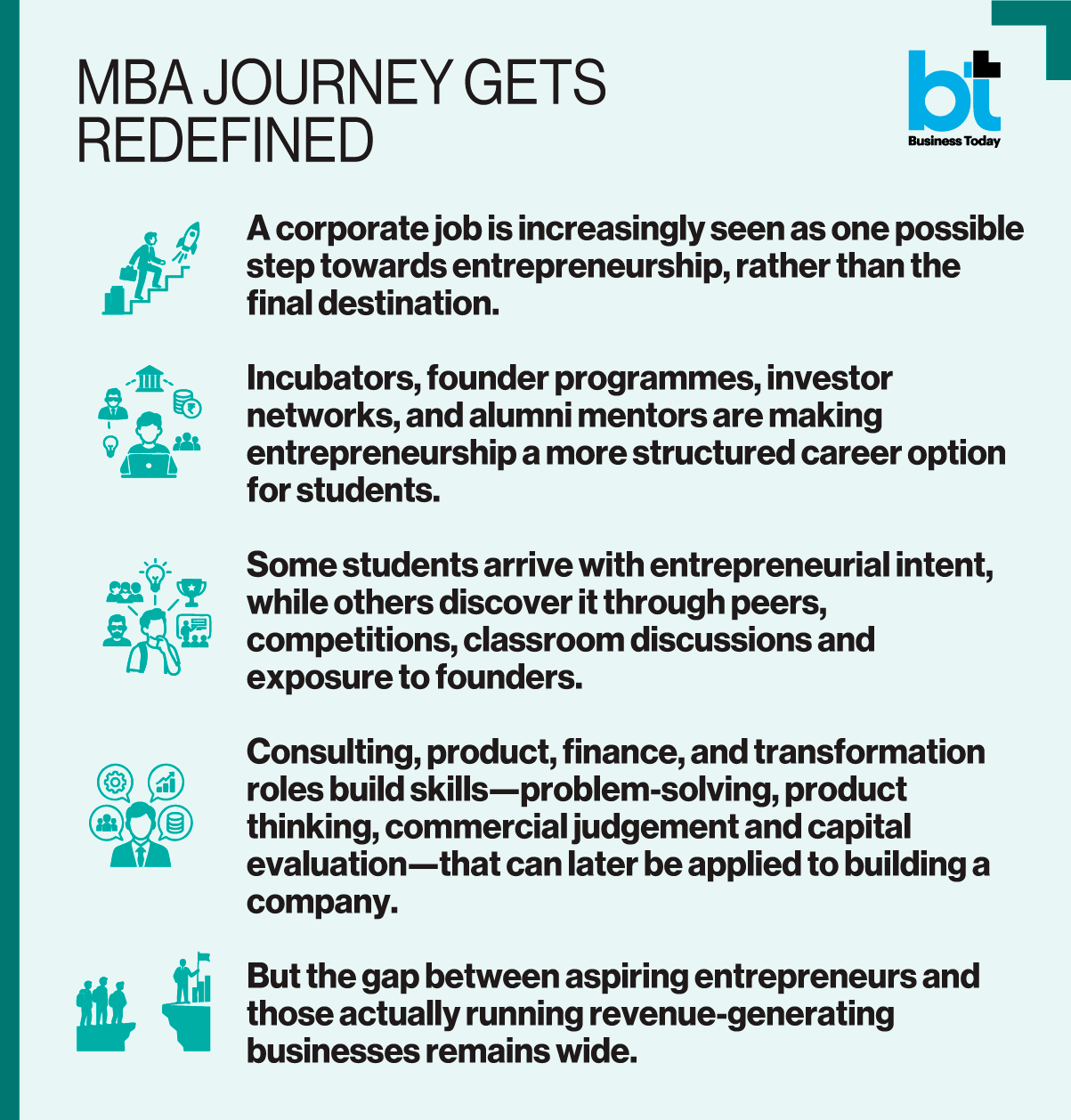
Increasingly, students do not necessarily see a corporate role and entrepreneurship as opposing choices. For them, a stint in consulting can sharpen problem-solving, product management can teach customer and product thinking, finance can help evaluate businesses and capital, a transformation role can teach how organisations change.
Read More: BT BIG STORY: Why young global scholars are returning to teach at India's B-schools
The choice is not entirely new. IIM Ahmedabad alumni Vineeta Singh and Kaushik Mukherjee turned down lucrative investment-banking offers to pursue entrepreneurship, while IIM Calcutta graduates Dharamveer Singh Chauhan and Paavan Nanda chose to build Zostel rather than follow the conventional corporate route. IIM Bangalore alumnus P.C. Mustafa, meanwhile, went on to build iD Fresh Food, another example of a B-school graduate choosing entrepreneurship as a career path.
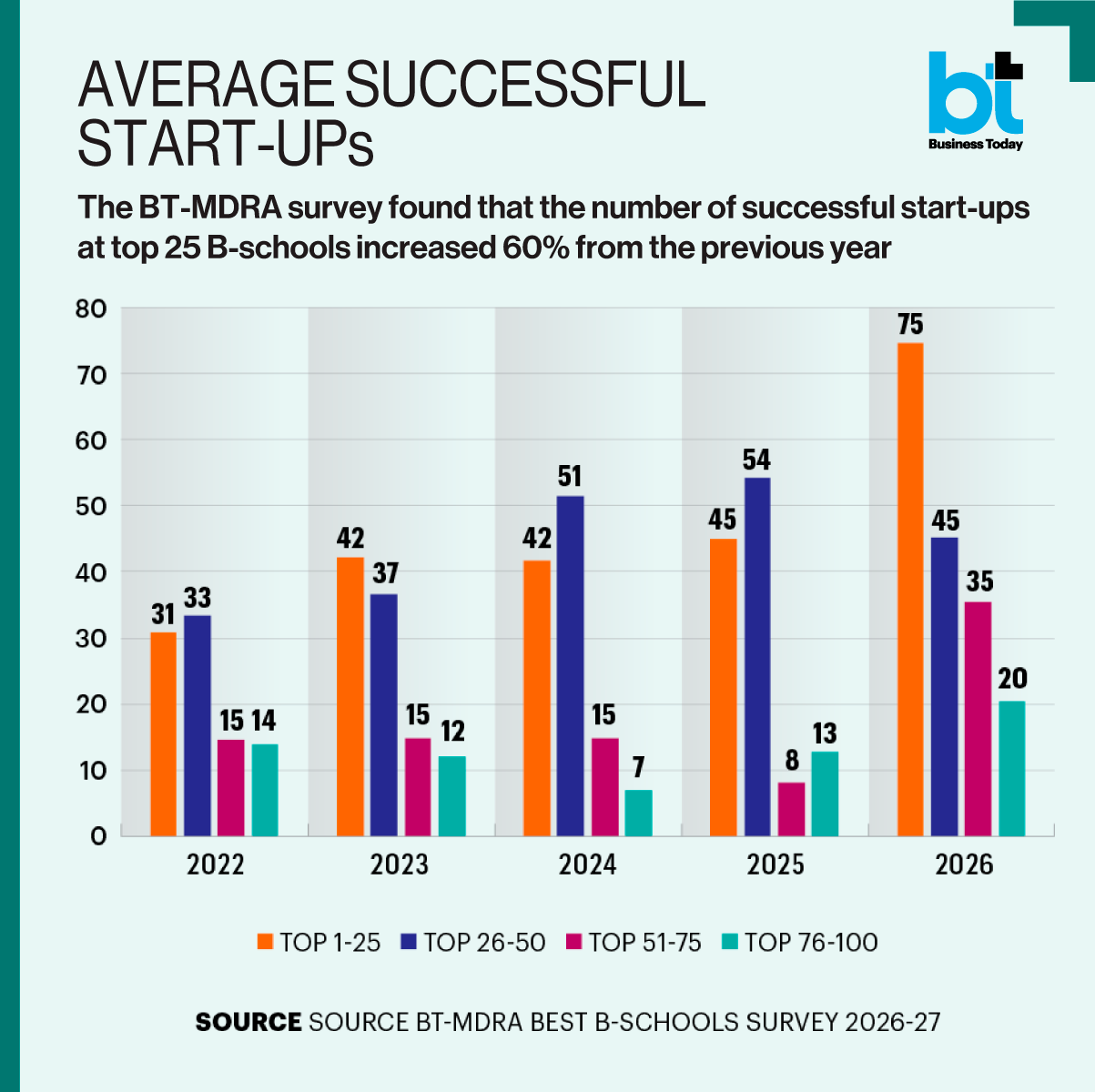
The numbers offer some evidence of the broader shift. The BT-MDRA survey found that the number of successful start-ups at the top 25 B-schools increased 60% from the previous year. A separate GUESSS India survey of 13,896 higher-education students found that 14% intended to become entrepreneurs immediately after graduation; five years later, the figure rose to 31.4%.
A launch pad
India’s B-schools are responding to this changing calculus. Incubators, founder programmes, alumni networks, investor access and start-up-focused courses are becoming part of the campus infrastructure.
The objective is not simply to persuade students to become entrepreneurs, but to make entrepreneurship a credible career pathway alongside the traditional corporate route.
From IIM Bangalore’s NSRCEL and ISB Hyderabad’s DLabs to IIM Ahmedabad’s CIIE.CO, India’s top B-schools are getting increasingly serious about building the infrastructure, networks and support systems needed to turn entrepreneurial ambition into businesses.
Speaking with Business Today, Professor Debashis Chatterjee, Director, IIM Kozhikode, describes what he is seeing as a “very significant momentum shift towards entrepreneurship”. Among its undergraduate students, roughly 10-15% are interested in doing something on their own rather than taking a conventional job.
Don't Miss: BT BIG STORY | No jobs, no security: The crisis facing India's educated youth
At XLRI, however, the interpretation is more measured. According to Sebastian George, Director, XLRI—Xavier School of Management, Jamshedpur, the institute cautions against reading the trend as students abandoning corporate careers. Instead, entrepreneurship is increasingly being treated as another form of leadership.
“Entrepreneurship in our view is most meaningful when innovation is accompanied by a clear understanding of its impact on employees, communities, markets and the wider society,” he says.
That distinction is important. The story unfolding across India’s B-schools is not necessarily about the death of the MBA-to-corporate-job pipeline. It is about that pipeline becoming less linear.
The latter is not an MBA-specific number—its respondents span India’s wider higher-education system—but it captures a changing attitude towards careers. The corporate job can increasingly be viewed as a starting point rather than an endpoint.
Founder training ground
Deloitte’s Campus Workforce Trends 2026 study offers another piece of the puzzle. It does not establish that MBA students are taking corporate jobs specifically to prepare for entrepreneurship. What it does show is that the roles attracting MBA talent are increasingly building capabilities that are also useful for creating and scaling businesses.
Management consulting and product management for AI-enabled products are among the preferred roles for MBA students, while capabilities such as agile project management, change management, data analytics and experimentation attract 15-20% hiring premiums, per the study.
“The corporate pathway is increasingly equipping MBAs with capabilities that are equally relevant to building and scaling businesses, from commercial decision-making and product thinking to transformation and investment evaluation,” says Neelesh Gupta, Partner, Deloitte India.
Must Read | BT BIG STORY: Your next colleague could be an AI agent. What does that mean for Indian IT, and for your job?
In effect, the corporate ladder itself is becoming a kind of entrepreneurial training ground.
Yet there is a catch.
The gap between wanting to build a company and building one that actually earns money remains substantial. GUESSS found that 32.5% of Indian students were nascent entrepreneurs, while only 4.8% were running revenue-generating businesses.
That is where the expanding B-school ecosystem will face its real test.
But are students increasingly arriving at B-Schools with an entrepreneurial ambition, or is the interest in entrepreneurship being created during their time on campus?
George believes it is a combination of both. “Some students arrive with a clearly articulated entrepreneurial ambition, often based on a problem they have encountered through their professional or personal experiences. Others discover entrepreneurship during their time at school through classroom discussions, peers, industry interactions, competitions, mentoring or exposure to the broader startup ecosystem,” he adds.
IIM Kozhikode’s incubator programme IIMK LIVE, launched in 2013, has evolved into a platform offering support from ideation and incubation to fundraising. Similarly, XLRI’s XCEED brings together mentors, investors, industry leaders and alumni, while its NABARD-supported rural incubation programme works with ventures across 12 eastern and north-eastern states.
For B-schools, that may ultimately prove a more meaningful measure of their entrepreneurial push than the number of start-up competitions, incubators or founder clubs. The test will be whether ideas survive beyond campus, find customers, generate revenue, and build businesses capable of lasting without the institutional scaffolding that helped launch them.
Chatterjee believes it will take two to five years to see the full impact of many ventures emerging from the ecosystem.
That is perhaps why the most interesting change is not that every MBA student now wants to become a founder. Most do not. It is that the definition of a successful MBA career is becoming broader. Students can still take the consulting offer. They can move into product, finance, or strategy and later start a company or can decide that entrepreneurship is not for them.
The choice itself is changing.
As Chatterjee puts it, there is a “start-up infection”. Whether it eventually becomes a fever, he says, is a matter of time.
For India’s B-schools, the bigger question is whether they are merely producing more students who want to become founders or creating an ecosystem capable of turning that ambition into enduring businesses.
















 Indian MBA students shift focus to entrepreneurship amid placement season buzz

 Noel Tata challenges Chandrasekaran's reappointment as Tata Sons chairman, seeks board meeting video
 Sugar season 2026-27 begins on schedule, 107 mills start crushing; ISMA expects stable prices
 Why banks are seeing strong growth in corporate credit despite geopolitical uncertainties
 'It's not AI, it's Arrogant India': Veteran investor warns India is losing FPIs' trust
 Jio's record IPO paid bankers less than half of what Hyundai paid
 Silver Prices Crash Over 50% From Peak | Is This The Right Time To Buy Before Wedding Season?
 ‘Yeh Dil Maange More’: Piyush Goyal On India’s Maritime Vision, Sagarmala And Seafarer Training
 Market Masters: Manish Sonthalia’s Wealth Creation Masterclass For Diwali 2026
 DCB Bank Q2 Results | CEO Praveen Kutty On Record Profit, Growth And Asset Quality
 Piyush Goyal’s $85 Trillion Trade Vision: 9 FTAs, 38 Nations and More Deals In The Pipeline

 Kotak Mahindra Bank, JSW Steel, Jindal Steel, Shree Cement, Nuvoco, AU SFB: Brokerage outlook, share price targets
 Who is Avadhut Sathe? The trader behind the academy at the centre of Sebi’s ₹546 crore order
 Sensex, Nifty snap four-session losing run; tentative relief or more recovery ahead?
 Tata Motors shares: Why this Tata stock fell today; worth buying now?
 Indian expat wins ₹12.96 crore from a ₹1,300 UAE Lottery ticket just days before his 60th birthday
 Dubai South property boom: Sales are surging, but are buyers getting smaller homes for their money?
 Refund claim takes an AI twist. Customer said boba drinks spilled, café finds packaging did not match. Here’s what happened next
 Financial Horoscope Today, October 27, 2026: Earnings Will Increase for Libra, Know the Financial Horoscope of 12 Zodiac Signs
 India makes more electronics, but how much value does it actually add?