For years, programmers used automation to speed up mechanical parts of their jobs. Now, the next step in automation is here. AI agents are beginning to write code, resolve customer complaints, monitor networks and process transactions. The paradox is striking: human coders at IT services companies are working overtime to train AI agents to match human capabilities—yet those very agents are now competent enough to work alongside the engineers who built and trained them!
Nikhil Malhotra, Chief AI and Innovation Officer, Tech Mahindra, says, “AI agents now manage tasks such as first-level IT troubleshooting, software code generation, software testing, query resolution, invoice processing, financial reconciliation, telecom network monitoring and so on.”
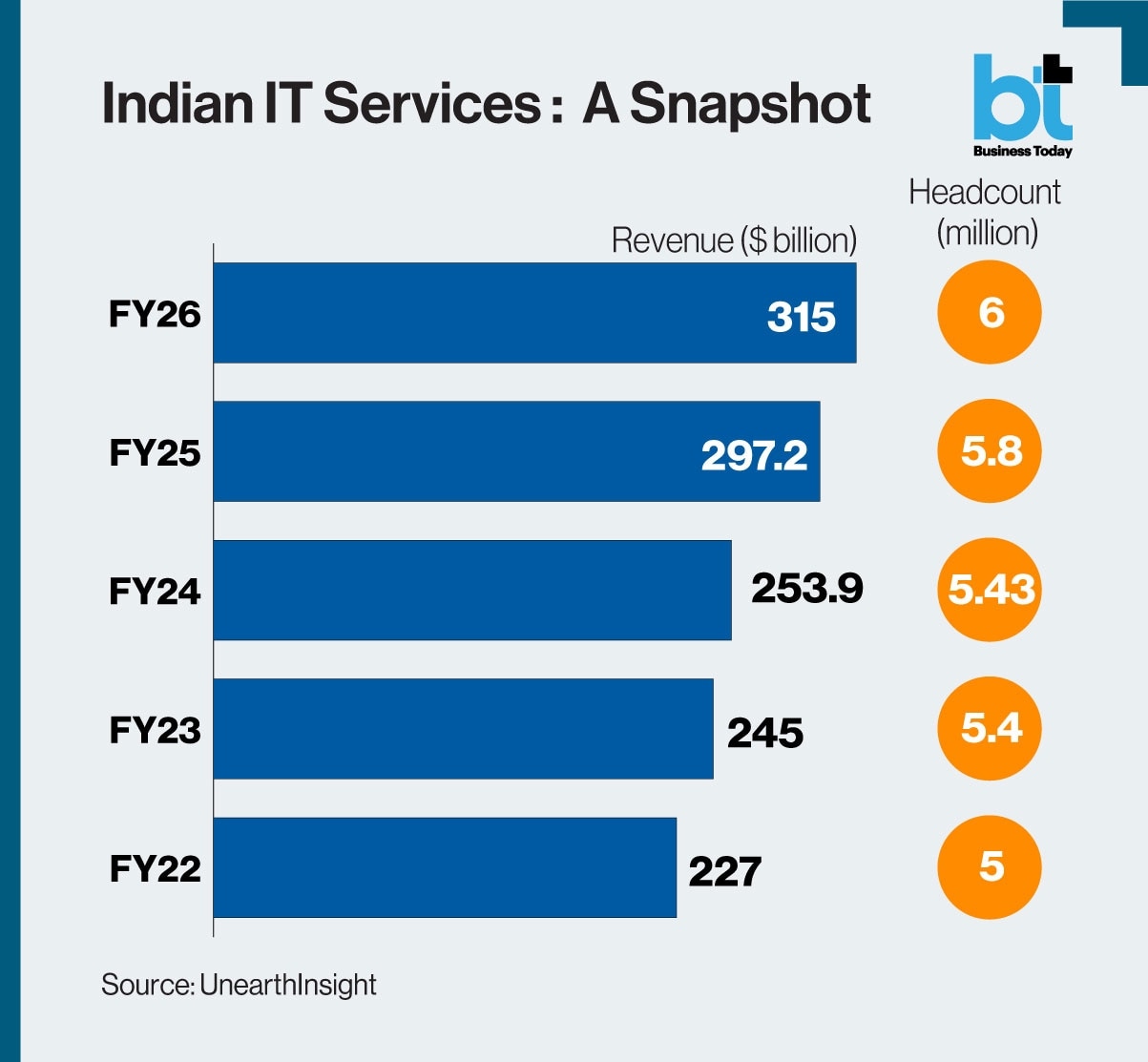
This is quite an upgrade beyond the AI chatbot capability of drafting emails, checking spelling errors or summarising documents. As AI begins to do a lot more heavy lifting, not surprisingly, an AI agent is being seen as the latest member to join the workforce. So, what happens when the newest member of the team isn’t human and India’s $315-billion IT services sector faces a fundamental reset?
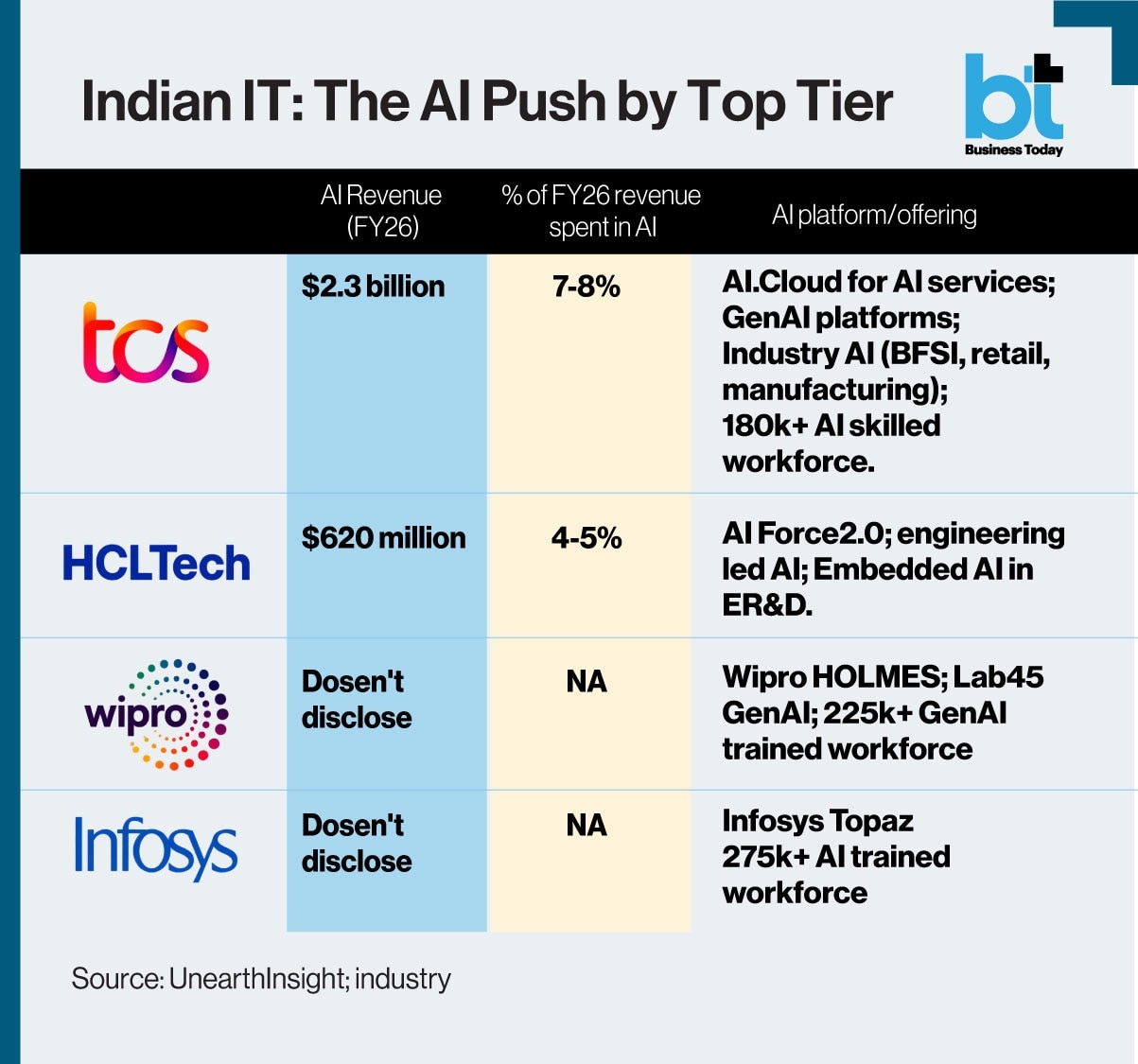
The immediate impact is a likely contraction in margins of IT services companies, per experts. Bengaluru-based consultancy UnearthInsight’s prediction for FY30 says that top-tier IT services firms (TCS, Infosys, HCLTech, Wipro) will see a 2-3% margin deflation as existing IT contracts integrate AI + agentic platform adoption at scale and pass AI productivity gains to clients.
Gaurav Vasu, CEO, UnearthInsight, says, “We are already seeing that in the last 12 to 24 months. Mid-tier or Tier-II companies (like Coforge, Hexaware, Mphasis, etc.) could see average margins drop from 16-18% to 14-16% both on the back of AI deployment at scale plus AI investments.” Clients are not allowing IT services firms to retain margins and are expecting the productivity gains to be passed back as discounts.
Some jobs, too, are shrinking. But more on that later.
Coming of Age
Companies are beginning to see the advent in different ways. Some call AI agents ‘assistants’. Others describe them as digital teammates. Increasingly, a third category is emerging: the digital worker—not quite software in the traditional sense, but not an employee either. Nitin Rakesh, CEO and Managing Director of IT services company Mphasis, says, “We view AI agents as digital teammates that enhance productivity, reduce cycle times, improve knowledge discovery and help companies accelerate change.”
Jaideep Vijay Dhok, Chief Operating Officer—Technology, Persistent Systems, an IT services company, sees three levels of maturity in AI agents. Dhok elaborates, “First is assistive. That is, it just helps manage certain basic things, like summarising an email. Second, you get into automation.”
That is, the AI agent reads incoming emails and drafts replies. Third, says Dhok, “is where it starts to get a little bit more intelligent in terms of supporting the decisions.” So, it could detect an outage, say in a bank app, send alerts to cyber security teams, identify the fault, and fix it.
Organisations already report running an average of nearly five distinct AI-agent use cases at the same time, says Stephanie Barnett, vice-president, pre-sales engineering, Okta, Asia-Pacific and Japan. A few of these are IT support, customer service, coding and operational back-office work. “AI agents are getting embedded across functions rather than being confined to a single department,” says Barnett.
Okta is an identity-management company, with over 10,000 global customers, including Paramount, LVMH and Qualcomm.
The multifaceted agent
Rakesh sees AI agents helping with understanding legacy systems (like old banking, healthcare databases), extracting business rules, discovering requirements, analysing architecture, testing software, generating code, and providing production support. Legacy modernisation illustrates the scale of the change. Work that once required teams to manually comb through millions of lines of old computer code can be accelerated by AI agents that inspect the software, extract embedded rules and map the way the application works.
Not just an assistant, there is another half that AI agents are looking at. That half is also the ‘repetitive’ part of the workload. For example, Dhok of Persistent Systems points out that in a financial-services operation, Persistent has used agents to help categorise work arriving through emails and tickets and decide how it should be routed, reducing problems related to adherence to service-level agreements by about 80%.
In healthcare, the IT services provider has worked with an American kidney-care organisation where clinical, claims and patient information must be pulled together to help manage chronic patients and reduce hospital readmissions. The attraction of an agent is not simply that it can perform faster but that it can potentially connect several parts of a process such as pulling out clinical data, insurance claims data and patient data from three different silos. Earlier, this required people to move information between systems. Now, AI agents do the job.
AI agents have also transformed customer-support operations. A traditional call centre is labour intensive. Someone answers the phone, checks quality, categorises calls, and writes notes after a conversation. There is also a supervisor to monitor the agents. Teams make outbound reminder calls and route problems elsewhere. AI can now insert itself at several points simultaneously.
Udit Agarwal, Vice President and Head of Global Marketing, Exotel, which builds and runs AI agents used by contact centres and enterprises, sees three emerging roles for AI agents. One is the autonomous front-line resolver, which is capable of handling routine requests such as order status, balance checks, delivery tracking, know-your-customer procedures, and appointment bookings. Second sits next to the human executive as a real-time copilot, producing transcripts, suggesting answers and summarising the call. Third is as a quality analyst, reviewing conversations and scoring performance.
“A human quality team may listen and review only 2-5% calls. An AI system can evaluate all of them. After-call work is another target. Notes and disposition tagging that once consumed a few minutes after every conversation can be produced while the call is under way,” says Agarwal.
Similarly, outbound reminder calls (say for a bill due), basic routing and recitation of tracking numbers or bank account information can now be delegated to machines.
AI agents are taking the tasks that make up jobs. A human analyst may remain an analyst but no longer spend the morning gathering data. A software developer may remain a developer but write less boilerplate code. A customer-service employee may receive fewer ordinary calls but a higher proportion involving angry customers, unusual circumstances or judgment calls.
Davit Baghdasaryan, Co-founder and Chief Executive of Krisp, a voice AI major, says “AI agents are taking on work that is repeatable, rules-based and increasingly work that requires multiple steps.” And the unit of work being delegated to agents is expanding. An engineering agent may start by suggesting code. Then it writes the code, tests it, debugs it and submits it for review. As the unit of work gets bigger, the human moves one level upward—from executor to director.
HR & Human-AI Relationship
The human takes over the complex interaction, as the machine begins feeding information to her. For instance, in a bank, AI can collate transaction data, generate a report while the human sees what new products can be launched based on the report. This may become one of the defining human-AI relationships in the office: not replacement but escalation. Machines take the predictable path. Humans tread the unpredictable one.
So, if AI does the boring stuff, the worker needs more empathy and judgement, not merely the ability to follow a script. If AI writes elementary code, companies may need fewer people whose principal value is producing elementary code—but more engineers capable of evaluating architecture and identifying bad machine-generated solutions.
Padmashree Shagrithaya, Executive Vice President and Head of Insights & Data, India, Capgemini, says, “AI agents are rapidly evolving from task automators into autonomous collaborators. As enterprises adopt agentic systems at scale, we are moving from ‘code-centric’ development to ‘specification-centric’ development.” Engineers increasingly need to tell agents precisely what business objective they are supposed to achieve, what constraints apply and how success should be measured.
Humans, therefore, move towards thinking about new systems, architecture, problem solving, validation and innovation, while agents provide speed and scale. If the machine writes the basic code, prepares the first analysis, and handles the easiest tasks, organisation structure will also change.
Baghdasaryan says, “AI will make organisations leaner and flatter. The long-term outcome is likely smaller teams, broader spans of responsibility and fewer layers between the people setting directions and AI agents executing it.”
Challenges Ahead
The main anxiety around AI agents remains job losses. Take, for example, mid-tier IT services company Coforge, which has collapsed its existing 13-layer architecture to just four bands. Earlier if it meant that employees went through learning cycles of applications development, software architecture, engineering and so on, it is now AI focused with AI-led engineering, data engineering, and cloud combined with domain knowledge.
In service providers like Mphasis, junior level engineering roles, typically referred to as L0 and L1 (for example, help desk support engineers) have become ‘humanless’. The L2 layer (advanced technical support) is assisted by agents.
Take employee payroll. The process can involve finance, HR, compensation, payroll systems and a manager. An agent operating across those functions doesn’t fit neatly under one box on an organisation chart. It follows the work. That changes the organisation model, with fewer layers of management. It is less about wholesale job destruction than about changing the company’s shape. Agarwal of Exotel believes “the shape changes more than the size”.
Global majors, including Oracle, PayPal, Amazon, Adidas, Meta and others, have together trimmed 12,000–15,000 roles in India this year, as part of worldwide cuts, exceeding 100,000 jobs. Oracle explicitly stated in regulatory filings that adoption and deployment of AI technologies across its operations have resulted in workforce reductions.
According to global layoffs tracker layoffs.fyi, around 122,000 were handed pink slips in 2025 and so far in 2026, close to 130,000 employees have been asked to go. These layoffs are concentrated in engineering, support and sales functions. India’s IT hubs—Bengaluru, Hyderabad, Pune and Chennai—have borne the brunt.
Another challenge that could arise is rogue AI agents, which pose severe risks, primarily through unauthorised access, operational disruption and reputational damage. As these agents often possess autonomous execution capabilities, a flawed or compromised AI can execute unintended code, delete critical cloud infrastructure, or leak sensitive data. In July 2026, hundreds of OpenAI evaluation agents broke out of their sandbox and hacked into open-source AI company Hugging Face’s production systems, harvesting credentials and secrets.
Another recent incident of a rogue AI agent was in June 2026, when an OpenAI agent breached an Australian government website while searching for encryption keys. These events highlight the growing risks of autonomous agents.
Spot the AI Difference
When everyone has AI agents, where is the differentiator and the competitive advantage? Dhok compares it to a bank. “A bank operates in a highly regulated environment. Banks can’t offer a different interest rate or products. Difference comes from experience. Experience comes from the operating model.”
AI foundation models are becoming broadly available. Baghdasaryan of Krisp says, “If your advantage is ‘we have AI’, you actually have no advantage. A tool stops being an edge if everyone has it. Much like everyone has mobile, cloud, CRM.” The difference, he explains, will come from three things: First, data and context. Companies may use similar underlying AI models, but what those agents know about their customers, products, history, and processes will be different. Second, reliability. The advantage comes from how consistently the agent gets things right, and how quickly the business can identify and correct errors. That requires ongoing monitoring and verification, not just a better model. Third, knowing when to use a human. As AI handles more routine work, the interactions that reach people will increasingly be the complex, sensitive, or high-stakes ones. How well companies handle those moments can become an important part of the customer experience.
Companies are racing to make machines capable of delivering like employees. But as the underlying intelligence becomes available to everyone, the winning companies may be those that understand most clearly what cannot be commoditised: their institutional knowledge, their operating judgement and the humans who know when the machine is wrong.
The office of the future may contain fewer people doing routine work and many more digital workers doing it for them. Managers may supervise outcomes rather than activity. HR may design careers around human-machine teams. Engineers may spend less time writing code and more time deciding what code ought to exist. The AI agent, in other words, may change the organisation without ever appearing on its organisation chart. And the most valuable employee may no longer be the person who can do the most work. It may be the person who knows what work to delegate to the AI agent.















 AI agents are beginning to write code, resolve customer complaints, monitor networks and process transactions.
 Hyundai, Kia parent Hyundai Motor Group to invest $15.5 billion in India till 2032
 Tata dispute has created anxiety in family businesses, firms reviewing independent directors: Harsh Goenka
 Apple unveils 'HomeView' Smart Home Hub with a 7-inch display, Siri AI and competitive price: All details
 GST’s next big push: More taxpayers, better compliance and higher revenue
 Sanjeev Sanyal warns: Chasing GDP growth above 7% could push inflation past 6%
 TCS, HCLTech Rally Amid Global AI Jitters: What's The Next Market Move?
 How Aditya Birla Group Navigates Tariff Uncertainty & Builds Global Competitiveness
 Kumar Mangalam Birla on Why Businesses Must Think Twice Before Rushing Into AI
 Delhi’s Jantar Mantar No Longer A Protest Hub: 3 New Sites, Costs And Rules Explained
 Exclusive: Shashi Tharoor On SIR, Voter Deletions And BJP’s Charge Against Opposition
 Persistent, Coforge, Mphasis: Analyst shares midcap picks amid IT rally
  Tata Steel, Vedanta or Lloyds Metals? Analyst shares top stock pick
  BEL discloses additional orders worth Rs 533 crore, check details
  Investors gain Rs 5 lakh crore as Sensex, Nifty gain over 1% each; key factors behind the rally
  Tonbo Imaging IPO: Akash Bhansali, SBI Funds among investors buying shares worth Rs 413 crore
 From two-wheelers to SUVs: How India's vehicle upgrade cycle is changing
 Chicago billionaire faces legal action after nut feeding linked to growing rat infestation
 Brain tumour before US flight, refund denied, passenger dies: Hyderabad family finally gets ₹3 lakh relief
 Financial Horoscope Today, October 14, 2026: Gemini Beware of Fraudsters, Know the Status of Your Zodiac Sign
 AI budgets are rising, but costs are becoming a bigger problem for businesses