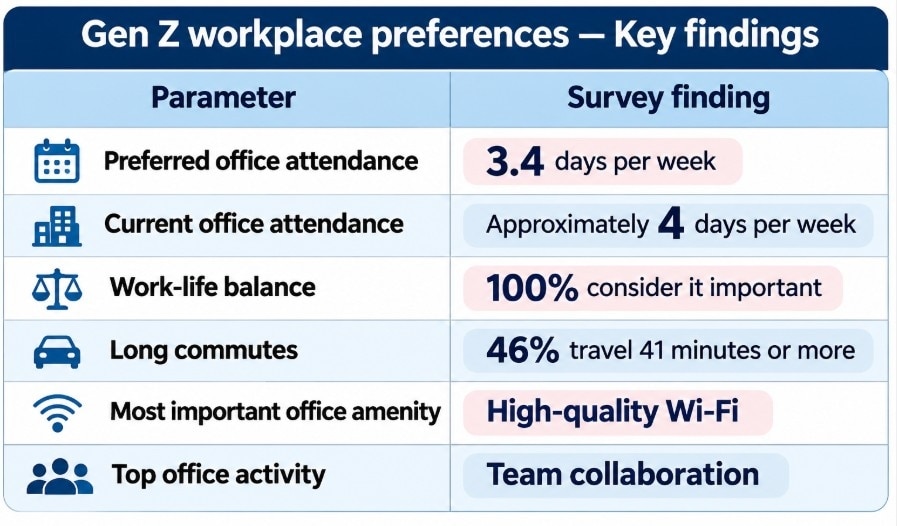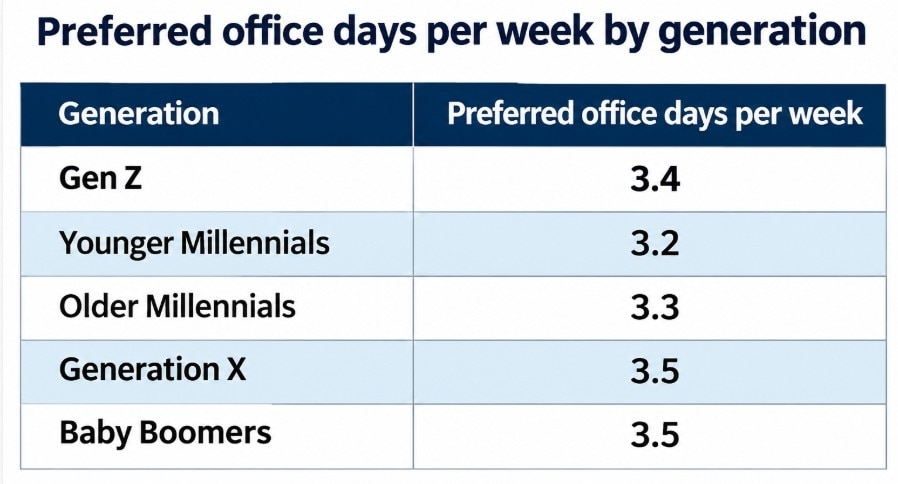



 Gen Z employees prefer 3.4 office days a week, compared with 3.2 days for younger millennials and 3.3 days for older millennials.
Gen Z may be challenging the conventional belief that younger employees prefer working remotely. A new global survey by real estate consultancy Savills has found that Gen Z workers want to spend more days in the office than millennials, highlighting the growing importance of collaboration, learning opportunities and workplace interactions.
According to the Savills Impacts Generational Preferences Survey, released on November 3, Gen Z employees, born between 1997 and 2012, prefer working from the office for an average of 3.4 days per week. This compares with 3.2 days for younger millennials and 3.3 days for older millennials.

 India may soon install 1 lakh rooftop solar systems every 4-5 days, says Pralhad Joshi
 TVS succession: A question of who gets what
 NSE Q2 results: Net profit jumps 23% to ₹2,578 crore, trading volumes lift revenue
 Odisha targets 74% non-fossil energy mix by 2047, bets on floating solar and storage expansion
 India deserves three national carriers, says Adani Airports CEO: Is Adani the answer?
 Is SIF Right For You? Strategy, Risk And Returns Explained
 India's Gold Demand Crashes 29%: Modi's Appeal, High Prices Hit Buying Appetite
 Trump’s Plan B: How White House Could Govern Without Congress | US Midterm Elections
 32,490 Trees At Risk? Maharashtra’s Saidongar Project Sparks Row
 From Wheat And Bajra To Chillies And Tomatoes: A Farmer’s Solar Experiment In Rajasthan
 NSE Q2 results: Net profit jumps 23% to ₹2,578 crore, trading volumes lift revenue
 BLS Polymers, SFC Environmental shares zoom up to 81% in maiden trade
 India is a market for multibagger stocks, says Shankar Sharma; cautions against calling market bottom
 Upcoming IPOs: Over 20 issues may hit market soon after Rs 1.35 lakh crore fundraise in 4 months
 Zerodha raises instant withdrawal limit to ₹5 lakh: Nithin Kamath says ₹1 lakh crore paid out free
 Ramayana 3 on the cards? Here's what Ranbir Kapoor and Namit Malhotra have to say
 Greece picks Embraer's KC-390 Millennium, Anand Mahindra calls it 'most modern' military aircraft
 Royal Enfield unveils Himalayan 750, Continental GT 750; expands premium motorcycle portfolio
 Election Commission issues clarification on Form 6, addresses voters' fear of prosecution
 Will Trump's Presidency be affected if Republicans lose US midterms?