The differences became public on October 9, when media reports emerged of competing claims over the businesses and a family memorandum of understanding (MoU). A week ago, all members of the family filed caveats in two Chennai courts. The filings indicate that the dispute could acquire a legal dimension, although they do not amount to a lawsuit.
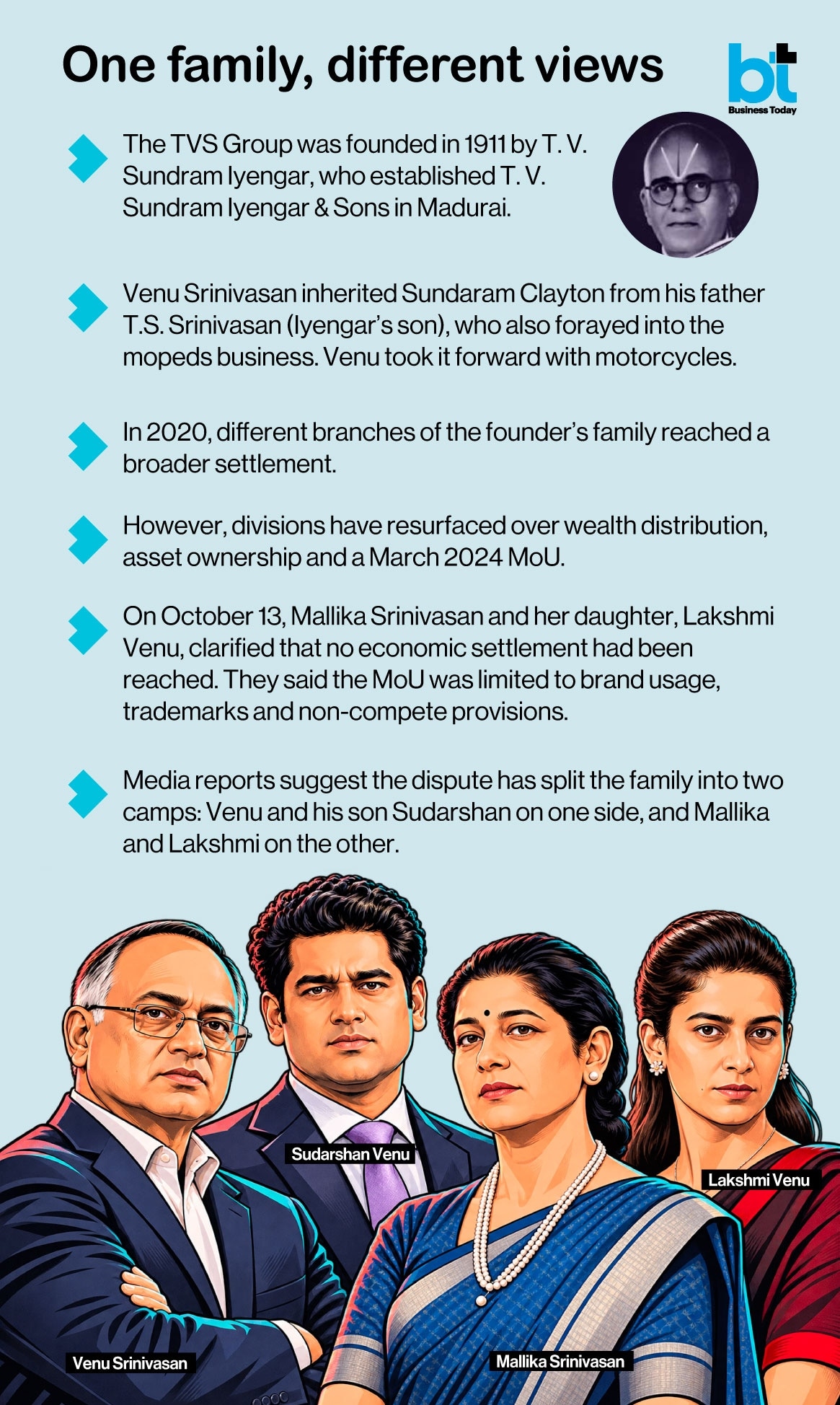
The disagreement centres on an MoU signed by the four family members in March 2024, which was essentially a non-compete agreement that restricted entry into competing businesses.
Don't Miss: All about Venu Srinivasan, the 73-yr-old TVS scion at the centre of Tata boardroom showdown
Venu Srinivasan said the separation of the group’s assets was conducted fairly and transparently. But Mallika Srinivasan and Lakshmi Venu, in a statement, said no economic settlement was reached within the Venu Srinivasan family, plus the suggestion that all family assets belong exclusively to one individual, who is therefore free to distribute them unilaterally, is neither an agreed nor an established position.
For context, TAFE, a key player in the tractor business, is a part of the Amalgamations Group, founded by S. Anantharamakrishnan. Other companies that form the conglomerate include India Pistons, Simpson & Co and Bimetal Bearings. Anantharamakrishnan’s son, A. Sivasailam, took charge of Amalgamations in the mid-1960s, with TAFE as the flagship. His daughter Mallika Srinivasan took over as Chairman of TAFE in 2011 after her father passed away.
The TVS Group, founded by T.V. Sundaram Iyengar in 1911, has been around for 115 years. Venu Srinivasan, his grandson, took charge of Sundaram-Clayton, a company established in 1962, as Managing Director in 1979. The same year, TVS Motor Company was set up. Under Venu’s leadership, it grew into one of India's largest two- and three-wheeler manufacturers.
To be sure, a larger family settlement took place in 2020 between different branches of the family of TVS founder Iyengar, but Mallika and Lakshmi made it clear in a statement on October 13 that no similar settlement has taken place with Venu Srinivasan’s family.
“The larger TVS family partition, agreed in 2020, and implemented subsequently, was undertaken through a process involving the relevant stakeholders. No comparable process involving transparent valuation, discussion and mutual consent has taken place concerning the economic interests within the Venu Srinivasan family. No agreement dividing these economic interests has been concluded,” the statement said.
The joint statement by mother and daughter has reinforced the belief that Venu Srinivasan and Sudarshan are on one side, and Mallika Srinivasan and Lakshmi are on the other.
The economic stakes involved have become considerably larger over the years. TVS Motor Company, currently headed by Sudarshan Venu, has seen its market capitalisation rise more than fivefold over five years to over Rs 2 lakh crore, and 22% over the past year. This makes the question of how the family's economic interests are distributed particularly consequential, although the market capitalisation of the company should not be confused with the value of the family’s own holdings.
The shareholding structure of two listed entities – TVS Motor Company and its promoter entity, TVS Holdings – provides some context to the dispute. Shareholding data from the exchanges show that as of September 2026, TVS Holdings owns 50.26% of TVS Motor Company, while Mallika Srinivasan holds a direct stake of 0.01% in the two-wheeler maker.
In TVS Holdings, the VS Trust, of which Venu Srinivasan is a trustee, holds 66.55%. Mallika and Lakshmi Venu hold 0.29% and 0.82%, respectively, in TVS Holdings. These are the disclosed shareholdings; the economic interests underlying the family’s trust structures are a separate matter.
The question on hand really relates to whether the 2024 MoU can be construed as a complete economic settlement of the family’s business empire.
Proxy advisory firm, InGovern, in its report put out earlier this month, says, “Disclosure of an MoU establishes its existence but not necessarily the completion, fairness or enforceability of the underlying family settlement.”
Specifically, on the issue of family succession disputes, InGovern’s view is that they can become material governance risks for listed companies (includes TVS Motor Company and its holding company, TVS Holdings). According to the report, family-controlled groups often combine long-term stewardship with concentrated control.
Of course, there is the issue of minority investors. “Where succession arrangements are privately documented, incompletely disclosed or disputed within the controlling family, minority shareholders may face uncertainty over promoter control, management continuity, brand use and strategic direction,” it says.
InGovern's report points to minority investors having a direct interest as far as these two companies go – continuity of management, clarity of ownership and control, protection of listed company value, disclosure discipline, and resolution through lawful mechanisms.
According to its assessment, the TVS succession is based not in deciding private family entitlements, but on whether the succession framework supports these five minority shareholder outcomes. “Where succession arrangements are confidential or contested, the absence of public clarity can itself be a governance risk, even if day-to-day operations remain unaffected,” says the report.















 The TVS family business dispute has escalated with competing claims over economic interests despite a March 2024 MoU

 India deserves three national carriers, says Adani Airports CEO: Is Adani the answer?
 'We'll never allow GM products into India': Piyush Goyal draws red line amid US trade talks
 Gold bars, coins attract ₹81,890 crore in India despite 40% demand crash; how does China compare?
 Adani Ports, Eternal, Titan, Unimech Aerospace shares among brokerage's top Diwali 2026 picks
 Deepinder Goyal says Temple beats Apple Watch Series 12, but urges some buyers to wait
 Trump’s Plan B: How White House Could Govern Without Congress | US Midterm Elections
 32,490 Trees At Risk? Maharashtra’s Saidongar Project Sparks Row
 From Wheat And Bajra To Chillies And Tomatoes: A Farmer’s Solar Experiment In Rajasthan
 US Midterms Election: Inside Elon Musk’s $445 Million Political Spending Spree
 Crude Oil At $150? Joe McMonigle Warns Markets Are Underpricing West Asia Risks

 India is a market for multibagger stocks, says Shankar Sharma; cautions against calling market bottom
 Upcoming IPOs: Over 20 issues may hit market soon after Rs 1.35 lakh crore fundraise in 4 months
 Zerodha raises instant withdrawal limit to ₹5 lakh: Nithin Kamath says ₹1 lakh crore paid out free
 Buy Suzlon Energy for 65% upside, says Religare Broking; here's why
 Flight was cheaper, but traveller chose ₹5,300 Rajdhani First AC for Mumbai-Delhi trip; was it worth it?
 Gold jewellery gets costlier this Diwali: Hallmarking charges jump 67% — what buyers must know
 OnePlus 16 could cost around 1.4 lakh in India, OnePlus 16R could also debut: All details


