


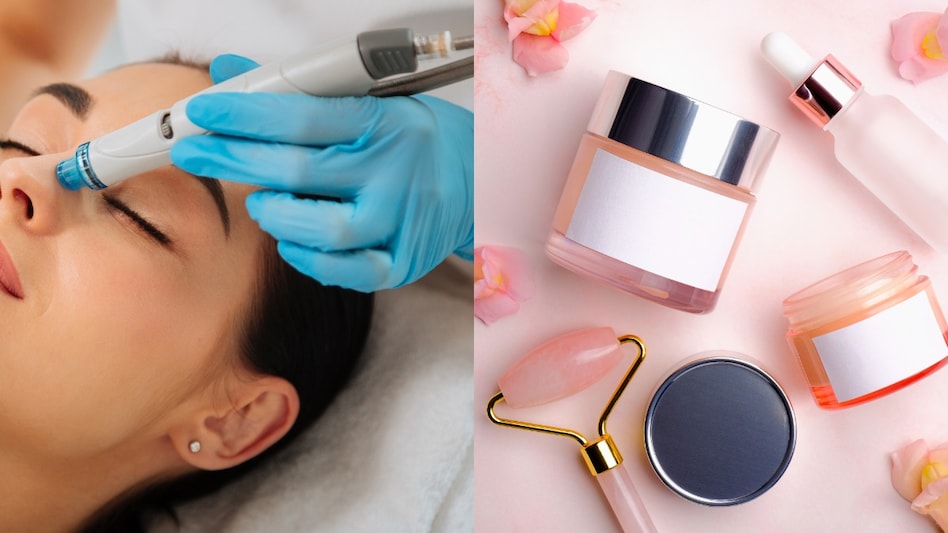
 Dermatological procedures and professional skincare routines are increasingly becoming a line item in monthly budgets of women, and increasingly for men and non-binary people as well.
The Indian beauty industry is in the midst of a striking transformation. Once perceived as a luxury reserved for the elite, dermatological procedures and professional skincare routines are increasingly becoming a line item in monthly budgets of women, and increasingly for men and non-binary people as well. Fuelled by rising awareness, evolving beauty ideals, and the proliferation of homegrown and global brands, the sector is shifting from indulgence to necessity, mirroring global trends in wellness and self-care.
When Dr. Chiranjiv Chhabra, a leading dermatologist and founder of Alive Wellness Clinics, began her practice in 1997, the clientele for medical aesthetics was limited. “Earlier, only the very wealthy, well-travelled people with old money would come and take care of their skin. But now, I find that more and more women from different financial backgrounds are allocating part of their money for the best skincare,” she explains.
This sentiment is echoed by Radhika Ghai, Founder and CEO of kindlife, a retailer of organic multi-category beauty products. She says, “A few years ago, skincare in India was still a “special-occasion” category—something you’d splurge on before a wedding or big event. That’s no longer the case. Today, skincare is part of daily life. Consumers read labels, study ingredients, and expect visible, long-term results. The shift is profound: skincare has moved from luxury to lifestyle, from indulgence to self-care.”'
This democratization of beauty is aided by flexible payment models, bundled therapies, and EMIs that allow consumers to access advanced procedures without prohibitive costs. Treatments can start at as little as ₹2,500, making professional skincare more accessible to a wider demographic. As Dr Chhabra puts it, “Beauty should be inclusive. Nobody should be deprived just because treatments are expensive.” Complementing this shift is the rise of a diverse ecosystem of Indian and global skincare brands, each tailoring solutions to varied skin types and concerns. Ghai says, “At kindlife, we curate brands across multiple price points—from starter ranges for beginners to advanced formulations for the skincare-obsessed. Bundled discovery kits, loyalty rewards, and accessible entry ranges help first-time users start small, while premium products cater to evolved customers.”
BEAUTY MARKET BOOM
India’s beauty and personal care industry is set to cross US$48 billion while the medical aesthetics industry is expected to nearly double to $1.27 billion by 2033, according to a report by IMARC Group. Driving this growth are both cutting-edge innovations and shifting consumer attitudes. While anti-aging treatments once dominated demand, the focus has now broadened to preventative care and healthy skin maintenance.
Ghai breaks down how serums, sunscreens, and beauty essentials that address pigmentation, hydration, and sun protection are leading demand on kindlife while haircare, with skincare-style formulations such as hyaluronic acid shampoos, peptide or ceramide hair masks are emerging as the next big category. She adds, “Our average order value has increased ~35% in the last 12 months, proving that customers are trading up to advanced, result-driven formulations.” Dr Chhabra says, “Facials are getting really hot with a strong appetite for results-driven treatments." There is an increased demand for Korean glass facials, hydrafacials, microneedling and newer therapies like Ultherapy Prime, which is a non-invasive skin lifting treatment that uses micro-focused ultrasound technology to stimulate natural collagen production with claims that it will last two years. On the rise are also exosome and salmon sperm therapies, showcasing India’s rapid adoption of global skincare science.
For Riddhima Kapoor Sahni, entrepreneur and face of Alive Wellness, the cultural shift is equally visible on the consumer side. “There’s so much awareness now, especially among teenagers and young adults who are constantly on social media. I don’t think it’s about status symbols anymore, it’s about looking after yourself,” she notes.
At the same time, at-home skincare devices and personalized product lines are bridging the gap between clinic visits and daily routines. From LED therapy masks and ultrasonic facial cleansers to microcurrent toning devices, consumers now have access to technologies once restricted to professional settings. Alongside, personalized product ranges, such as serums customized to individual skin types, AI-driven diagnostic apps that recommend routines, and subscription-based regimens that adjust with seasonal changes, are allowing people to extend the benefits of their in-clinic treatments into their everyday care. Dr. Chhabra’s own family launched the Indian skincare brand Alive & Well in 2021 to address the lack of locally tailored solutions for diverse Indian skin types.
It's an exciting mix of East-meets-South Asia as customers are layering Korean-style serums with traditional Indian oils, says Ghai. She adds, “They’re actively shopping by ingredients—Niacinamide, Vitamin C, and Peptides are practically household names. Transparency and sustainability are non-negotiable. And the biggest shift is the rise of inside-out beauty. Supplements, boosters, ingestibles, and clinic-inspired categories like Reedle Shots are moving into mainstream routines.” This normalization of skincare has led to women of all ages incorporating procedures into their monthly or quarterly spending habits. Yet Riddhima emphasises on balance: “Your body, your face, your money—it’s your choice. All we can say is look after yourself and just don’t go overboard with whatever you’re doing.”
As India’s beauty and wellness market matures, trends like clean beauty, minimalism, and hybrid Indian-Korean routines will continue to define consumer preferences. But beyond fads, what anchors this industry is a fundamental redefinition of beauty: from being a marker of wealth to becoming an expression of self-care and well-being.
With more people budgeting consciously for beauty, the business opportunity is vast. Yet, the industry’s long-term credibility will rest on inclusivity, transparency, and respect for individual choice.

 LIC emerges as biggest bidder in NSE IPO, applies for shares worth Rs 4,500 crore: Report
 NSE IPO listing on September 24: How 5 largest IPOs fared on market debuts
 UPI MDR GST: NPCI says small merchants and 96% of transactions remain unaffected from October 15
 BT Big Story: How the FCNR(B) deluge has created two new problems for the RBI
  OpenAI warns of autonomous AI risks, calls for global rules before AI starts improving itself
 TRAI New Rules: Voice-SMS Only Plans Mandatory | What It Means For 20 Crore Non-Data Users
 Oil & Gas Capex Boom: Anshul Saigal Names Energy Stock He Owns | Saigal Capital Advisors
 Small Caps Too Expensive? Anshul Saigal On Valuations, Earnings & Upside
 Markets Going Nowhere? Anshul Saigal On The Opportunity For Stock Pickers
 IIT Bombay Protest: Rajkumar Pant On Student Demands, Professor Suspension And Campus Row
 Sansera Engineering shares rise 7%; Goldman Sachs raises target; sees further upside
 US-Iran talks today? Oil slips to $98 a barrel; will Sensex, Nifty rebound?
  Borosil Renewables shares rise 3% as board approves revised Rs 1,100 crore expansion cost
 L&T, DRL, Vijaya Diagnostic, M&M Financial: Buy, Hold or Sell? Here are target prices
 HAL, BEL, BDL, BEML: Defence stocks to buy for 13-24% upside
 Xbox layoffs: Microsoft reportedly planning another round of job cuts
 Who controls Tata Sons? Why Tata Trusts’ 66% stake does not tell the whole story
 From Rapido To 10 Crore Jobs: Nitin Gadkari’s Big Vision
 Adani Group Airline Plan: Ram Mohan Naidu Says Govt Weighing Pros And Cons
 “Don’t Know Impact As Yet”: T.V. Narendran On U.S. 100% Tariff Bill On India












