


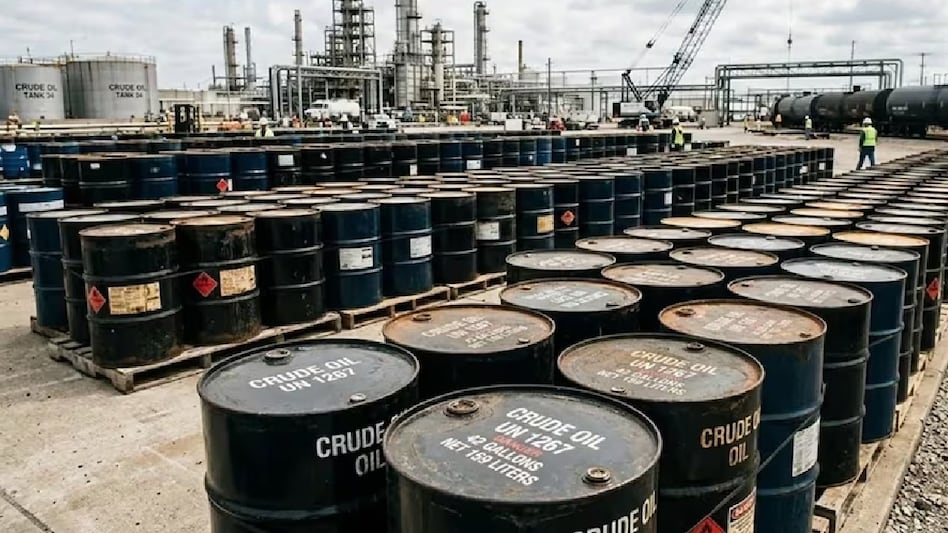
 Concerns in the oil market have intensified as several Gulf producers have begun halting or scaling back oil and gas production amid escalating hostilities and the threat to critical infrastructure.
 Escalating tensions in West Asia, disruptions to Gulf energy production and the sharp surge in global crude oil prices are expected to dominate investor sentiment when stock markets reopen on Monday (March 9), with analysts warning that the conflict could trigger fresh volatility across equities, currencies and commodities.
Catch live coverage of West Asia conflict here
Oil prices recorded historic weekly gains on Friday (March 6) as the war in the region threatened to severely disrupt global energy supplies. US benchmark West Texas Intermediate crude surged 12.21%, or $9.89, to close at $90.90 per barrel, while global benchmark Brent crude rallied 8.52%, or $7.28, to settle at $92.69 per barrel.
For the week, WTI soared 35.63% — the largest weekly gain since the futures contract began trading in 1983 — while Brent jumped about 28%, marking its biggest weekly rise since April 2020.
Global oil prices could breach the $100 per barrel mark within days, and reach $150 a barrel by the end of the month, without a solution to the severe disruption in crude flows through the strait of Hormuz, Goldman Sachs has warned.
Gulf production disruptions add to supply fears
Concerns in the oil market have intensified as several Gulf producers have begun halting or scaling back oil and gas production amid escalating hostilities and the threat to critical infrastructure.
Export facilities and processing plants across parts of Saudi Arabia, United Arab Emirates, Qatar and Kuwait have reportedly slowed operations or temporarily suspended some output as companies reassess security risks to workers, pipelines and export terminals.
The disruption has raised fears that supply losses could compound the impact of shipping bottlenecks in the Strait of Hormuz — the world’s most important oil transit chokepoint — through which roughly a fifth of global oil consumption normally flows.
With tanker movements slowing dramatically and insurers raising war-risk premiums, traders are increasingly pricing in the possibility of prolonged supply disruptions.
War rhetoric intensifies market anxiety
The spike in crude prices comes amid escalating military confrontation involving Iran and Israel. The situation intensified after US President Donald Trump demanded Iran’s unconditional surrender on March 6, fuelling fears that the crisis could expand into a broader regional conflict capable of severely disrupting global energy markets.
The war has already brought tanker traffic through the Strait of Hormuz close to a standstill, raising concerns that exports from the Gulf — home to some of the world’s largest oil and liquefied natural gas producers — could be significantly curtailed.
$150 oil warning
Saad Sherida Al-Kaabi, Qatar’s energy minister, warned in an interview with the Financial Times that crude prices could surge to as high as $150 per barrel in the coming weeks if oil tankers remain unable to pass through the Strait of Hormuz.
Such a spike, he cautioned, could have severe consequences for the global economy.
“This could bring down the economies of the world,” Al-Kaabi said, adding that exporters across the Gulf region may soon be forced to declare force majeure on shipments if the disruption persists.
US downplays long-term supply shock
Despite the surge in prices, Chris Wright suggested the spike reflects market anxiety rather than a structural disruption to global supply.
Speaking on CNN, Wright said the rise in crude prices includes a significant “fear premium in the marketplace.”
“We never know exactly the timeframe of this,” Wright said. “But in the worst case, this is weeks, this is not a months thing.”
Earlier in the day, Wright also downplayed concerns about a prolonged closure of the Strait of Hormuz during an appearance on Fox News.
“One large tanker has already gone through the straits with no issues at all. So as the general just described, we’re massively attriting their ability to strike with missiles and drones, and that rate of attrition will increase in the coming days,” he said.
“So we’ll be cautious. We’ll be careful, but energy will flow soon,” Wright added.
Emergency measures fail to calm markets
In an attempt to stabilise shipping operations, the US government also announced a $20-billion insurance programme for oil tankers operating in the Persian Gulf to offset soaring war-risk premiums. However, the move did little to calm traders, who continue to price in the possibility of prolonged disruption to Gulf exports.

 Exam reforms: Tech titan Nandan Nilekani picked by PM Modi to fix national public examination system
  'Tax officers struggled for own land': Nirmala Sitharaman slams laidback attitude of govt depts
 CBDT issues new crypto reporting guidance: No new tax, but exchanges must track and report all transactions
 Did Cockroach Janta Party's 'Chalo Sansad' 2.0 threat trigger Dharmendra Pradhan's resignation? What we know so far
 'Will discharge my responsibilities with complete humility': Pralhad Joshi after being appointed Education Minister
 AI Data Centers, Aerospace & Gas Turbines: What's Powering Indo-MIM's Future Growth?
 Best Healthcare Stocks: Gaurang Shah's Outlook On Apollo Hospitals, Fortis & The Manipal Health IPO
 Is Indo-MIM's IPO Valuation Justified? Here's Why The Company Sees Strong Growth Ahead
 Treasury Bills Explained: Why T-Bills Are One Of The Safest Short-Term Investment Options
 FDs vs Markets: Where Should You Keep Your Short-Term Money?
 Gland Pharma stock: Price target of Rs 3,250 likely in medium term, says analyst
  Metal recycling stocks to buy: Gravita, Pondy Oxides, Jain Resource among top picks
 TRIL shares: Should you average the falling stock? Here's 'fixed and final' stop loss
 Adani Power: 45 GW target, Rs 2 lakh crore capex plan among conference call highlights
  ITC Hotels, Chalet, Ventive, IHCL, SAMHI: Hotel stocks to buy despite travel disruptions
 Beyond mutual funds: Why analysts see SBI Funds' alternative asset business as a long-term growth engine
 'Ashamed of it...': Manoj Muntashir calls Adipurush his biggest mistake, seeks country's forgiveness Exam reforms: Tech titan Nandan Nilekani picked by PM Modi to fix national public examination system 'Tax officers struggled for own land': Nirmala Sitharaman slams laidback attitude of govt depts
 Delhi targets traffic bottlenecks on Aruna Asaf Ali Marg with ₹1.97 crore elevated road study









