In a region where millions depend on desalinated seawater for drinking supplies, the targeting of desalination plants signals a dangerous evolution in the conflict — one where the battle is being fought over essential lifelines rather than purely military assets.
From oil depots to water systems
Recent Israeli strikes on Iranian fuel storage facilities triggered massive fires and thick plumes of smoke, highlighting the vulnerability of Iran’s energy infrastructure. Oil depots and storage tanks have long been strategic targets in conflicts across the Middle East because they underpin both economic stability and military logistics.
But Iran’s response has revealed a different pressure point.
Authorities in Bahrain reported that a drone strike linked to Iran damaged a desalination facility, marking one of the first instances in the current conflict where drinking-water infrastructure has been directly targeted. The incident underscored how vulnerable Gulf states are to attacks on facilities that sustain their urban populations.
A war over lifelines
Despite its reputation for oil wealth, the Persian Gulf region depends heavily on desalinated seawater for survival.
Countries such as Kuwait, Saudi Arabia and the United Arab Emirates obtain most of their drinking water from desalination plants located along their coastlines. These plants convert seawater into freshwater through complex treatment processes powered by large amounts of energy.
Analysts say even limited damage to a few of these facilities could create severe shortages within days.
In several Gulf countries, desalination provides up to 90 percent of daily water consumption, leaving cities with little buffer if plants are disabled or power supplies are disrupted.
World's largest desalination plants
Gulf countries operate some of the world’s largest desalination plants, producing millions of cubic metres of freshwater every day to supply cities built in arid environments.
In Saudi Arabia, the Ras Al Khair power and desalination plant is the world’s largest, with a capacity of about 2.99 million cubic metres per day, while other major facilities include the Jubail plant (around 800,000 m³/day), Shuaiba-3 near Jeddah (about 600,000 m³/day) and Al Khobar 2 (around 630,000 m³/day).
The United Arab Emirates also hosts several large plants, including the Jebel Ali desalination complex in Dubai, which produces roughly 2.2 million m³/day, the Taweelah reverse-osmosis plant in Abu Dhabi with about 909,000 m³/day capacity, the Fujairah plant producing around 1.04 million m³/day and the Umm Al Quwain facility with about 681,900 m³/day capacity.
In Qatar, major plants include Umm Al Houl (around 620,500 m³/day), Ras Abu Fontas (over 500,000 m³/day) and Ras Laffan (about 300,000 m³/day). Kuwait’s key facilities include Az-Zour North with around 486,000 m³/day capacity, the Doha East and West plants producing roughly 970,000 m³/day combined, and the Shuaiba plant with more than 200,000 m³/day capacity.
Bahrain’s main desalination facilities include the Al Hidd plant producing about 270,000 m³/day and the Al Dur plant with around 218,000 m³/day capacity.
Oman’s largest facilities include the Barka and Al Ghubrah plants near Muscat, each capable of producing around 300,000 cubic metres of freshwater per day.
Together, these plants form the backbone of the Gulf’s water supply, with some countries relying on desalination for up to 90-95% of their drinking water.
The logic of asymmetric warfare
Experts say the growing focus on infrastructure reflects a classic asymmetric strategy.
Iran cannot match Israel’s technological advantages and airpower in a direct confrontation. Instead, it can impose pressure by targeting vulnerable systems across the region, including ports, energy installations and water infrastructure.
Desalination plants are particularly exposed targets. Located on coastlines and spread across large industrial complexes, they rely on interconnected systems — electricity grids, seawater intake pipelines and filtration units — that can be disrupted by relatively small strikes.
Even damage to a single component in this chain can halt water production for entire metropolitan areas.
Unlike oil supplies, which can be sourced globally and rerouted through international markets, freshwater in the Gulf has few alternatives. Cities built in desert environments rely almost entirely on desalinated water for drinking, sanitation and industry.
If major facilities were knocked offline for extended periods, governments could be forced to impose strict rationing or rely on emergency water imports. In worst-case scenarios, prolonged outages could disrupt daily life for millions.


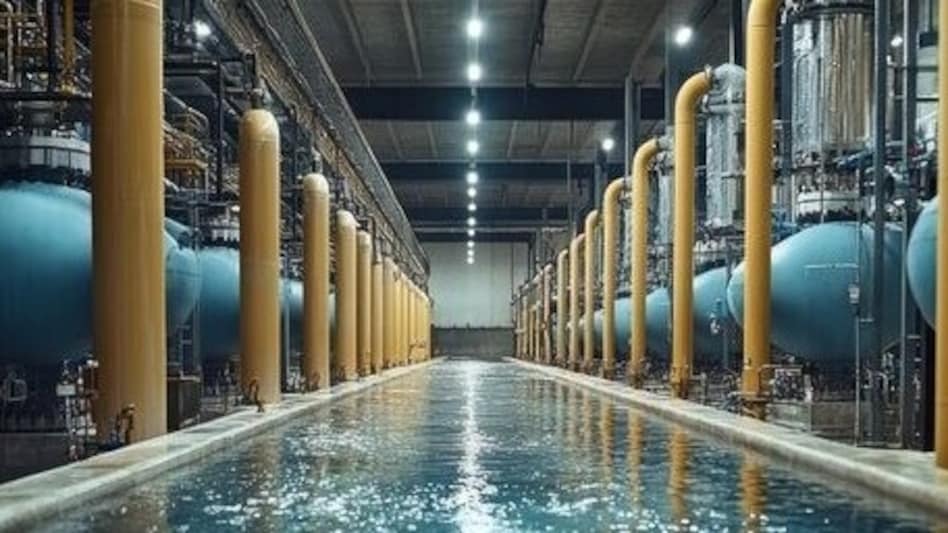 In several Gulf countries, desalination provides up to 90 percent of daily water consumption, leaving cities with little buffer if plants are disabled or power supplies are disrupted.
  China announces export controls on tunnel boring machines. Challenge for India's infra push?
 'AI models cannot be trusted': Microsoft warns of insider threats, expands Project Perception
 Ferrari expects FTA to boost demand in India; plans new dealerships in Ahmedabad and Chennai by year-end
 Houthi attacks disrupt Saudi aviation: Riyadh airport restricts flights indefinitely
 Fewer seats, higher fares: Why flying home this festive season costs more
 PNB Reports Strong Q2FY27 Results; MD & CEO Ashok Chandra On Earnings And Growth Outlook
 Market Commentary | Axis, HDFC Bank & IT Stocks Bleed! Vaishali Parekh On Key Support Levels
 Cricket Diplomacy To Zero Tariffs: Why The India-New Zealand FTA Is A Total Win-Win
 How Many Mutual Funds Should You Hold? Expert Explains Portfolio Diversification And Fund Overlap
 Why Smartphone Prices Are Skyrocketing Despite Festive Discounts?
 Indian stock market outlook: Nikunj Saraf prefers large-caps, cautions against small-caps
 Hindustan Zinc Q2 earnings: Net profit zooms 149%, revenue at Rs 15,093 crore
  Muhurat Trading 2026: NSE, BSE announce Diwali timings; check full schedule
 ICICI Bank shares close lower after Q2 earnings; 3 brokerages remain bullish
 Union Bank of India shares rise 5% on Q2 earnings, check details
 Saudi Arabia drops in-person 'Davos in the desert' event amid Houthi attacks
 ‘Made in India’ JCB heads to New Zealand: Piyush Goyal flags off first-ever machine export from Pune
 Volkswagen explores CNG cars as India powertrain strategy evolves












