









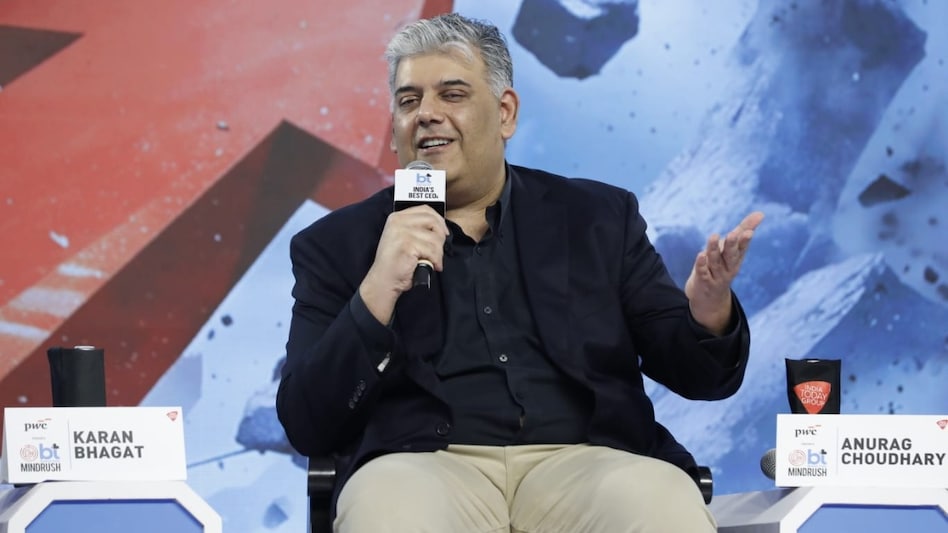
 Bhagat remains optimistic about the near-term outlook, expecting growth to return within the next 12–18 months. Bhagat remains optimistic about the near-term outlook, expecting growth to return within the next 12–18 months.
 Speaking at the Business Today MindRush & India’s Best CEOs Awards, Karan Bhagat, Managing Director & CEO of 360 ONE WAM, reflected on how crises often create the foundation for stronger, more resilient businesses.
Looking back at the past 25 years, Bhagat said, “Adversity is always the best opportunity. It makes us more modest and humble, keeps us tight on resources, and helps us plan our resources better and operate efficiently.”
He described the current crisis is a good opportunity for businesses to reset. “There will be challenges, but over the next 18-24 months, we will emerge with stronger business models,” he added.
From an investor’s perspective, he pointed to major disruptions since 1997 — the Asian currency crisis, the dot-com bubble burst, the Indian Parliament attack, the 2008 global financial crisis, the currency depreciation in 2013, and the COVID-19 pandemic and now the ongoing geopolitical tensions and the oil shock.
Despite these repeated shocks, Indian markets have delivered steady returns. “Over the last 25-26 years, despite so much volatility, the Indian market has grown around 12-13% in nominal terms and 6-7% in real terms. This too will pass,” he said.
He added that by 2030, the current crisis will likely be seen as just another episode in a long cycle of market disruptions.
However, Bhagat cautioned against complacency. “It doesn’t mean we sit back and wait. We must stay nimble and diversified.” He further added that diversified portfolios have helped his clients navigate volatility more effectively.
Bhagat remains optimistic about the near-term outlook, expecting growth to return within the next 12-18 months. He advised investors to focus on deploying capital now rather than expecting immediate returns. “Post-18 months, you will start seeing rewards,” he said.
He also pointed out that while cities like Dubai and Singapore have long attracted Indian wealth, a reversal trend may emerge at the backdrop of current crisis.
“A few years ago, every family wanted a foothold in Dubai or Singapore. Now, many of those who moved would want one or two feet back in India,” he said, adding that this could benefit sectors such as real estate and domestic investments.
 ED searches Vedanta Group premises in FEMA case: Report
 Oracle’s Larry Ellison races past Bezos and Brin to become world’s third-richest person
 IREDA shares fall 8% in two days post Q4 – Brokerage target price hints at 45% upside
 What is an AI PC and why is Nvidia betting on it?
 Maya Tata, daughter of Noel Tata, may exit Tata Digital: Report
 Piyush Goyal: Most India-U.S. Trade Issues Already Resolved
 India’s $11 Billion Semiconductor Plan | Extreme Summer Gadget Tips + MacBook Neo Review
 "Complete Nonsense…": NVIDIA's Jensen Huang Explains Why AI Won't Steal Software Engineering Jobs
 Gold Demand Falls 70% After Duty Hike; What Lies Ahead For Gold And Silver Prices?
 India Inc. Posts 15% Profit Growth In Q4FY26 As Revenue Expands At Fastest Pace
 IREDA shares fall 8% in two days post Q4 – Brokerage target price hints at 45% upside
 NMDC shares: Brokerages raise target prices after Q4 earnings; NMDC Steel turns profitable
 Vedanta share price recovers 3% amid reports of ED raids; key details
 TCS, Infosys, HCL Tech, Wipro, Coforge, Mphasis, TechM: IT stocks to buy— Fresh targets
 Jeena Sikho shares gain 14% today after Q4 results - Key details