












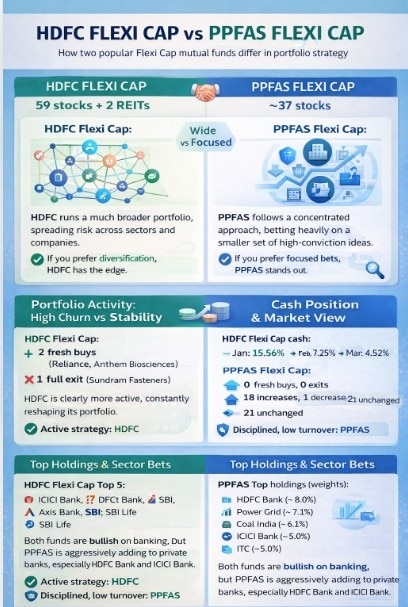



 HDFC Flexi Cap Fund continues to follow a broad-based, actively managed strategy, while PPFAS Flexi Cap Fund presents a high-conviction, low-churn strategy.
India’s flexi-cap mutual fund space saw contrasting portfolio strategies in March 2026, as HDFC Flexi Cap Fund and PPFAS Flexi Cap Fund took notably different approaches. For you as an investor, the comparison comes down to a fundamental choice: active diversification or conviction-driven investing.
HDFC Flexi Cap

 Bessent's big reveal: 'I asked Europe to impose secondary tariffs on India, but they refused'
 'Close your borders before it's too late': Trump sounds alarm as France erupts in violence
 New Noida to become UP's next manufacturing hub: Land acquisition begins in 37 villages
 'Deport those who refuse to integrate': Milind Deora's warning as France burns
 Firing at Tiger Shroff's car in Mumbai's Juhu; Lawrence Bishnoi gang claims responsibility
 Gold Vs Silver: Which Could Deliver Better Returns Over The Next 3–5 Years? Expert Shares Targets
 Gold, Silver ETF Purchases Halted: Why Mutual Funds Have Restricted Fresh Investments Before Diwali
 SIR Explained: Forms 6, 7 And 8—What Voters Must Know | Akshita Nandagopal Explains
 Gold Investment Options: ETFs, EGR And MCX Explained | How To Invest In Gold Beyond Physical Buying
 Redmi Note 17 Pro Max Review , Vivo V80, Vivo Vision | Tech Gear EP 20 | Business Today
 Markets Next Week: Jio Platforms IPO, high crude oil prices and Q2 earnings in focus
 10 investing mistakes retail investors should avoid, from overpaying to panic selling
 YES Bank Q2 profit rises 65% to Rs 1,080 cr; proforma impact of restatement of AT-I bonds revealed
 ICICI Bank Q2 results: Net profit jumps 20% to Rs 14,843 crore; NIM contracts
 IDBI Bank Q2 net profit falls 39% to Rs 2,205 crore on year-ago's one-off gain Bessent's big reveal: 'I asked Europe to impose secondary tariffs on India, but they refused'Firing at Tiger Shroff's car in Mumbai's Juhu; Lawrence Bishnoi gang claims responsibility
 'Take shelter, don't film attacks': India's fresh advisory for citizens in Saudi Arabia amid rising tensions'Close your borders before it's too late': Trump sounds alarm as France erupts in violence'Deport those who refuse to integrate': Milind Deora's warning as France burns


