












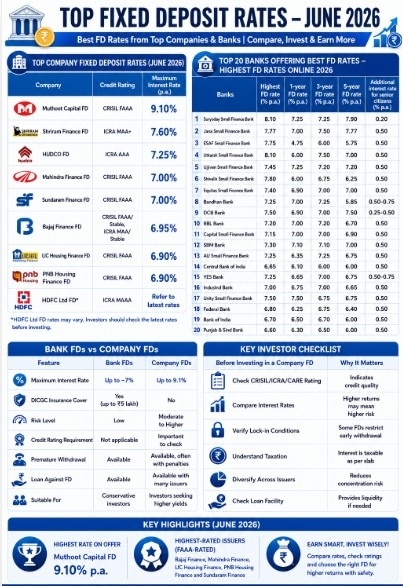



 Among top-paying company FDs, Muthoot Capital offers 7.9%-9.1% interest, Shriram Finance 7%-7.6%, and HUDCO 7%-7.25% annually.
With bank fixed deposit (FD) rates largely capped at around 7% for general investors, company fixed deposits issued by non-banking financial companies (NBFCs) and housing finance companies (HFCs) are attracting attention by offering significantly higher returns, in some cases exceeding 9% per annum.
Fixed deposits continue to remain one of the most popular investment options for risk-averse investors seeking predictable returns and capital protection. Most leading banks currently offer FD rates of up to 7% for regular depositors, while senior citizens typically receive an additional 50 basis points. However, investors willing to take on slightly higher risk can potentially earn better returns through corporate fixed deposits.

 Navratri gift: Govt caps margins to 30% for 137 anti-cancer drugs; revised prices from Nov 9
 Regulatory outreach a priority: Incoming CEO Anup Bagchi maps operational plan for HDFC Bank
  YES Bank Q2 profit rises 65% to Rs 1,080 cr; proforma impact of restatement of AT-I bonds revealed
 Yes Bank examining in detail Supreme Court verdict on AT1 bonds: CEO
  FSSAI cracks down on FMCG giants Nestlé India and HUL over misleading labels, safety violations
 Gold Investment Options: ETFs, EGR And MCX Explained | How To Invest In Gold Beyond Physical Buying
 Redmi Note 17 Pro Max Review , Vivo V80, Vivo Vision | Tech Gear EP 20 | Business Today
 Mahindra XUV 3XO ZNG Review: Turbo Power Meets CNG Mileage
 Gold, Silver Prices: Limited Upside Ahead Of Diwali? Expert Sees Gold At ₹1.5 Lakh, Silver At ₹2.3
 Expert Names REITs And INVITs To Watch For Quarterly Payouts And Potential Investment Returns
 10 investing mistakes retail investors should avoid, from overpaying to panic sellingYES Bank Q2 profit rises 65% to Rs 1,080 cr; proforma impact of restatement of AT-I bonds revealed
 ICICI Bank Q2 results: Net profit jumps 20% to Rs 14,843 crore; NIM contracts
 IDBI Bank Q2 net profit falls 39% to Rs 2,205 crore on year-ago's one-off gain
  Axis Bank Q2 net profit surges 38% to Rs 7,003 crore; NIM at 3.36%; key details10 investing mistakes retail investors should avoid, from overpaying to panic selling
 China, US and India account for half of global emissions. Check top 10 countries
 Saptami chaos: Stampede at Kolkata Durga Puja pandal leaves several dead, many injured
 IPL 2027: Goa likely to host auction on December 16 as BCCI informs franchisesYes Bank examining in detail Supreme Court verdict on AT1 bonds: CEO


