Economist and member of the Prime Minister’s Economic Advisory Council Sanjeev Sanyal highlighted the changes on social media, saying PF withdrawal claims will now be settled within three days, with officials facing a 12% penal interest on delays beyond the prescribed timeline.
"EPFO radically simplifies withdrawal rules: Full withdrawal in case of VRS, disability or emigration; full withdrawal at 55 years; 75% for unemployment. Settlement to be done in 3 days (with 12% penal interest on delays by officials & recovered from EPFO commissioner's salary)," Sanyal posted.
PF claims to be settled in 3 days
One of the biggest changes is the mandatory timeline for processing PF withdrawal claims.
Under the new rules, the EPFO must settle eligible provident fund withdrawal claims within three days, while pension and EDLI claims must be processed within 20 days. The three-day timeline will apply to claims that are complete in all respects and do not require additional verification. Claims involving discrepancies or incomplete documentation may continue to take longer.
To improve accountability, if the EPFO Commissioner fails to settle a claim without sufficient cause within the prescribed timeline, 12% penal interest per annum may be added to the claimant's benefit for the delayed period. The amount may be recovered from the commissioner's salary.
EPFO's new PF framework: Key changes at a glance
| Feature |
New Rule |
|---|
| PF claim settlement |
Eligible PF withdrawal claims to be settled within 3 days |
| Penalty for delays |
12% annual penal interest on unjustified delays beyond 20 days; recoverable from the EPFO Commissioner's salary |
| Claims eligible for 3-day settlement |
Claims with complete documents and no additional verification |
| Claims that may take longer |
Cases involving discrepancies, incomplete documents or additional verification |
| Auto-settlement limit |
Increased from ₹1 lakh to ₹5 lakh for eligible advance PF withdrawals |
| Mandatory EPF contribution |
Remains 12% of wages for both employee and employer |
| Wage ceiling |
Mandatory contribution applicable up to ₹15,000/month |
| Maximum mandatory EPF contribution |
₹1,800 per month each by employee and employer |
| Contribution above ₹1,800 |
Treated as Voluntary Provident Fund (VPF); employer not required to match it |
| Digital initiatives |
Greater automation, online processing, UPI-based withdrawals and ATM-like access under EPFO 3.0 |
Source: Ministry of Labour & Employment, EPFO
Earlier, the schemes also provided for penal interest, but the rate was linked to the EPF interest rate declared each year. The new framework fixes it at 12% and strengthens enforcement by prescribing a uniform penalty.
The EPFO has also expanded its automated claim settlement mechanism. Earlier, it increased the auto-settlement limit for advance PF withdrawals from ₹1 lakh to ₹5 lakh, allowing a larger number of eligible claims to be processed without manual scrutiny.
MUST READ: Mandatory PF capped at ₹1800! Will Your in hand salary increase?
Withdrawal rules simplified
The revised rules make PF withdrawals easier in several situations.
Employees who become unemployed can now withdraw up to 75% of their PF balance immediately after losing their job.
The number of advance withdrawal categories has been reduced from 13 to three—illness, education and marriage. The minimum service requirement for several withdrawals has also been reduced to 12 months, compared with up to seven years under some earlier provisions.
Subscribers can continue to use their PF savings for housing-related needs, including buying a house or plot, constructing a home, repaying a home loan, and carrying out repairs or improvements.
READ THIS: Should you put only ₹1,800 into EPF? Experts say don't decide before checking these 5 things
Full withdrawal at 55 and contribution rules
The government has also lowered the age for full withdrawal of the PF corpus to 55 years.
Full withdrawal will also be permitted in cases of voluntary retirement (VRS), permanent disability, retrenchment and permanent migration outside India.
The mandatory contribution structure remains unchanged. Employees and employers will continue to contribute 12% of wages, subject to the statutory wage ceiling of ₹15,000 per month, keeping the mandatory monthly EPF contribution capped at ₹1,800 each. Any employee contribution above this limit will be treated as a Voluntary Provident Fund (VPF) contribution, which employers are not required to match.
DON'T MISS: EPF Scheme 2026: What changes for your PF contribution, withdrawals or EPF interest?
Greater focus on digital services
The new framework places greater emphasis on digital and paperless services.
Employers and exempted establishments will be required to facilitate online filing of claims and applications, enabling faster processing. The government is also working towards enabling PF withdrawals through the Unified Payments Interface (UPI), while EPFO is exploring additional digital services such as ATM-based access to PF savings.
Subscribers with an Aadhaar-linked Universal Account Number (UAN), updated KYC, PAN and bank account details are expected to benefit from the fastest claim processing under the new system.
The reforms form part of EPFO's broader digital transformation initiative, often referred to as EPFO 3.0, aimed at making provident fund services faster, simpler and more transparent for millions of subscribers while ensuring greater accountability in claim processing.



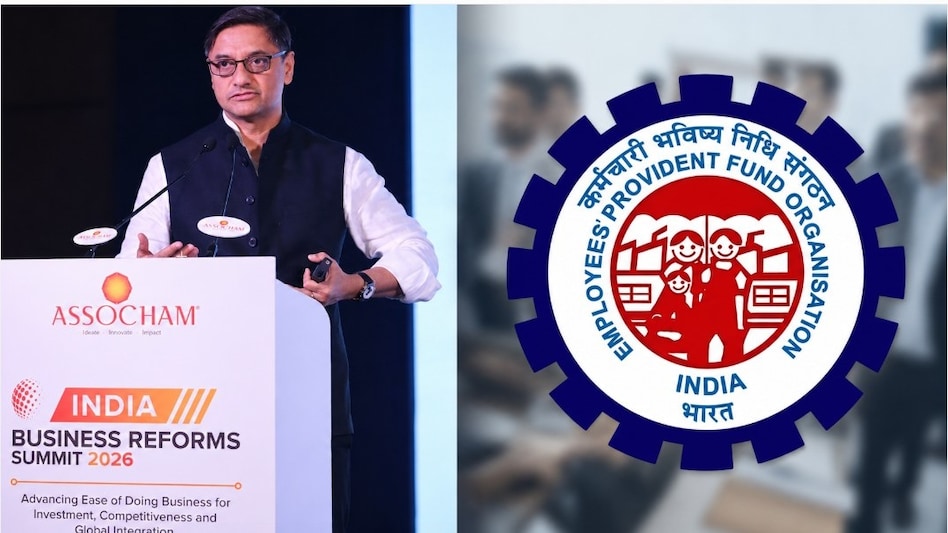 Economist Sanjeev Sanyal noted one of the biggest changes is the mandatory timeline for processing PF withdrawal claims.
 No prescription, no pills: Govt cracks whip on misuse of painkillers, antibiotics
 SEBI settles proceedings linked to Hindenburg report against 5 Adani firms for ₹1.51 crore
 'No positive response on 5-day banking': Bank unions to go ahead with 3-day strike
 LIC emerges as biggest bidder in NSE IPO, applies for shares worth Rs 4,500 crore: Report
 NSE IPO listing on September 24: How 5 largest IPOs fared on market debuts
 IT Stocks Under Pressure: What Next For Indian Markets? | Chakri Lokapriya
 Karnataka’s Welfare Schemes Under Pressure As Finance Department Flags New Challenges
 Family Disputes Can Hold Businesses Back: Nirmala Sitharaman’s Message To Family Firms
 TRAI New Rules: Voice-SMS Only Plans Mandatory | What It Means For 20 Crore Non-Data Users
 Oil & Gas Capex Boom: Anshul Saigal Names Energy Stock He Owns | Saigal Capital Advisors
 Balmer Lawrie to demerge Travel & Vacations unit into wholly-owned subsidiary: Report
 Sansera Engineering shares rise 7%; Goldman Sachs raises target; sees further upside
 US-Iran talks today? Oil slips to $98 a barrel; will Sensex, Nifty rebound?
  Borosil Renewables shares rise 3% as board approves revised Rs 1,100 crore expansion cost
 L&T, DRL, Vijaya Diagnostic, M&M Financial: Buy, Hold or Sell? Here are target prices
 ONGC strikes gas in Mahanadi Basin: What it means for India's LNG imports
 BHIM app gets MyUPI AI assistant with 24/7 multilingual UPI support: Key features explained
 JSW plugs into India’s electric truck and bus race with Amp Star












