














 Parents should maintain gift declarations, bank transfer records and investment statements to establish the source and ownership of funds.
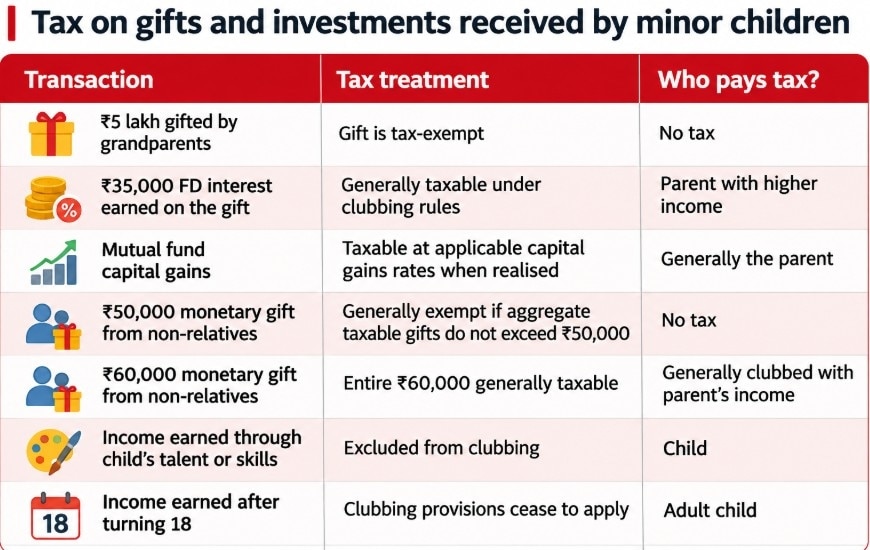
On Children's Day, grandparents often gift money to their grandchildren to support their education, future expenses or long-term financial security. While such gifts may be exempt from income tax, investing the money in fixed deposits (FDs), mutual funds or other financial instruments can create tax obligations for the child's parents.
Under India's income-tax rules, gifts received from specified relatives, including grandparents, are generally exempt from tax, irrespective of the amount. However, the income generated from investing these gifts is subject to separate taxation provisions.

 Tata Motors PV mulls bigger price hikes in Q4 as commodity costs bite: MD & CEO Shailesh Chandra
 Nvidia chip row escalates: Bessent throws Howard Lutnick under the bus over Megaspeed; here's why
 'Bulk of issues sorted out': S Jaishankar on India-US trade deal, says remaining concerns more on Washington's side
 'I'm signing it too': Elon Musk backs employees' petition to reinstate Jensen Huang
 Tata Group friction spills into operating firms as Voltas chairman pick bypasses Chandrasekaran’s nod
 How Should Women Invest In Their 20s, 30s, 40s & 50s To Build Long-Term Wealth?
 Samvat 2083: How Should Investors Rebuild Portfolios After Market Correction? Expert Advice
 PM Modi: Govt Limits Diesel Price Hike To ₹7, Absorbs ₹43 Burden To Protect Farmers
 PM Modi Links 4% Farm Growth To 50 Crore Indians Escaping Poverty In Just 12 Years
 J&K Security Alert: 2 Attacks Across 3 Districts Trigger Alert; LeT Hunt Intensifies

 Coinbase halts INR withdrawals in India amid banking outage; Unocoin, ZebPay users also face disruptions
 FII buying at 5-year high, Nifty profits up 22% and valuations ease: Is India's bull market back?
 Recent market rally proved time in the market and not timing delivers better outcomes: Navneet Munot of HDFC AMC
 Retail investors pour $1.6 billion into Nvidia in 3 days: Are they buying the dip or catching a falling knife?
 Mazagon Dock, Cochin Shipyard report weak Q2 earnings; fresh price targets and more
 'Return the money by Nov 30 and...': Suvendu Adhikari orders CID probe into alleged housing scheme irregularities
 YES Bank moves Supreme Court for review of ₹8,415 crore AT1 bond rulingCoinbase halts INR withdrawals in India amid banking outage; Unocoin, ZebPay users also face disruptions
 India's gem and jewellery exports jump 34% to $2.92 billion in October; gold jewellery leads growth
 Credit card mistakes Gen Z must avoid: Axis Bank expert shares five habits for financial success


