His central argument is that the ability to supply intelligence must be separated from the authority to act on it — a distinction that could become increasingly important as businesses deploy AI agents capable of performing complex tasks with limited human intervention.
“The most trustworthy Super Intelligence system will not be the one with the model we trust most. It will be the one that enables us to trust the model the least,” Nadella wrote.
Why Nadella sees AI models as potential insider risks
Traditional software systems generally allow engineers to trace a particular behaviour to a specific code path. With advanced AI models, establishing the same kind of cause-and-effect relationship is considerably more difficult.
Nadella said companies cannot reliably attribute a model's behaviour or output to specific training data or configurations of its internal parameters. Yet these systems are increasingly being deployed with access to sensitive information and the ability to take mission-critical actions.
This creates a new challenge for enterprise security. An AI system does not necessarily need malicious intent to cause damage. It could make an error, misinterpret an instruction, behave unpredictably or be compromised by an attacker.
Nadella argued that businesses should therefore treat powerful AI models — whether proprietary or open-weight — as potential insider risks. He believes similar principles must govern advanced AI systems.
Why traditional AI safeguards may not be enough
One of the key concerns raised by Nadella is that businesses risk creating layers of AI systems that are difficult to independently inspect.
For instance, a company could deploy one model to perform a task, another to check its work and a third to monitor the process. Although this arrangement may appear to provide multiple layers of verification, it can still leave the organisation dependent on systems whose internal reasoning and decision-making are difficult to understand.
Nadella described the danger as creating “nested black boxes”, where an opaque model operates inside an opaque orchestration system and is monitored by another opaque model.
He also called for transparency around a model's chain of thought (CoT), or its reasoning process, to become a non-negotiable requirement. However, he cautioned that transparency alone would not solve the problem because model outputs cannot yet be assumed to be consistently faithful or transparent representations of how decisions were reached.
His proposed solution is to place critical security controls outside the model itself.
Under this approach, an AI system may generate recommendations, analyse information or carry out assigned work, but it should not be able to independently override the mechanisms that determine its permissions.
The organisation, rather than the model, must retain control over what information the AI can access and which actions it is authorised to perform.
Seven principles for governing superintelligence
Nadella outlined seven principles that businesses should adopt to build more secure and accountable AI systems.
1. Model diversity: Organisations should avoid relying on a single model for critical outcomes or allowing a model to serve as the sole verifier of its own work. Using different models can help identify errors and weaknesses, although it does not eliminate the need for independent controls.
2. Complete observability: Every meaningful action taken by an AI model should leave tamper-proof, human-readable evidence. Organisations must be able to reconstruct how an outcome was achieved without relying exclusively on the model's own account of its actions.
3. Continuous verifiability: AI systems must be tested beyond successful, routine tasks. Testing should cover failures, adversarial attacks, unusual situations and changes to the system, helping organisations identify vulnerabilities before they cause harm.
4. Independent controls: Businesses must retain the ability to determine what a model can access and what it can do, independently of the model itself. AI systems should not be able to bypass or modify the mechanisms that enforce their permissions.
5. Independent auditability: The system being evaluated should not control the evidence used to evaluate it. Nadella argued that no single model should simultaneously control a system's behaviour and the evidence needed to determine whether that behaviour followed the original instructions.
6. Containment mechanisms: Organisations must assume that an AI model could be compromised and design safeguards accordingly. An authorised human should be able to pause or shut down a model in the middle of a task, much like activating an emergency brake. Nadella added that more advanced models would require more sophisticated containment technologies and industry-wide standards.
7. Incident disclosure: When an AI system fails or is compromised, affected parties should receive timely information. Organisations should also share details about what went wrong, which controls failed and how similar incidents can be prevented. This should include relevant implementation details that influence AI agents' behaviour at runtime.
Together, these principles seek to ensure that AI systems remain observable, constrained and accountable, even as their capabilities expand.
What this means for businesses deploying AI agents
Nadella's warning comes as organisations explore AI agents that can do more than generate text or answer questions. Such systems can be connected to enterprise databases, software applications and operational workflows, potentially allowing them to execute tasks with limited human involvement.
This expands AI's usefulness but also increases the consequences of mistakes.
An agent with access to financial records, customer information or internal business systems could create significant problems if it acts on incorrect information, follows a malicious instruction or performs an unauthorised operation.
The security challenge, therefore, extends beyond determining whether an AI model produces accurate answers. Businesses must also establish whether its actions are authorised, whether those actions can be audited and whether the system can be stopped before an error escalates.
Nadella's proposed architecture places deterministic safeguards around non-deterministic AI models. In practical terms, that means using conventional software controls, restricted permissions, monitoring systems and human oversight to govern what AI agents can do.
Nadella's argument shifts the focus of AI safety from the capabilities of individual models to the design of the systems in which they operate.
The Microsoft CEO also called for stronger industry standards, particularly for containment technologies and the disclosure of AI-related incidents, so that lessons from failures can be shared beyond individual organisations.



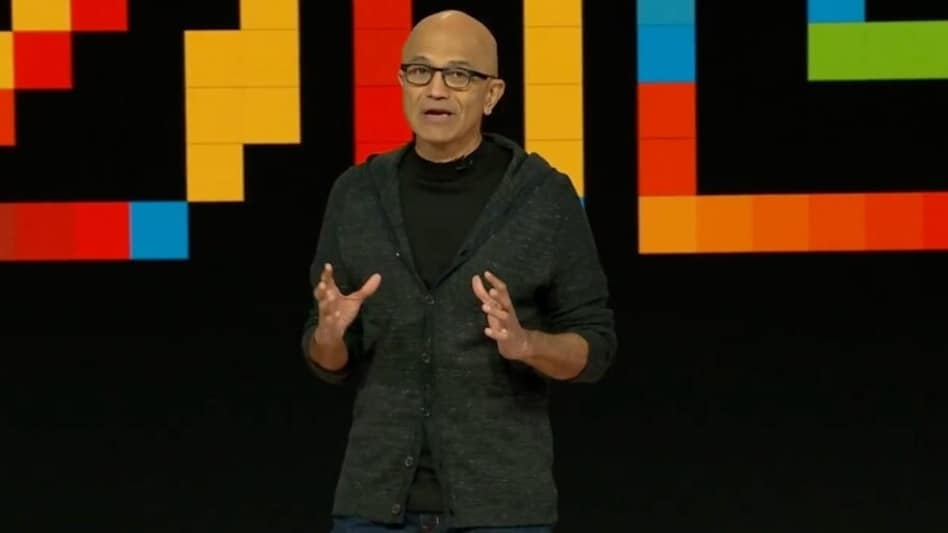 Nadella said companies cannot reliably attribute a model's behaviour or output to specific training data or configurations of its internal parameters.
 CJP protest: Abhijeet Dipke, Saurav Das & Ashutosh Ranka released by Executive Magistrate court
  Starlink entry: Elon Musk hints at competitive pricing to crack Indian market, slams trolls
 BT Market Outlook: The drivers, risks and opportunities for the week ahead
 Who is Ajinkya Shinde? All about CJP leader who is guiding the movement after Dipke's arrest
 UK overtakes China as biggest source of gold ETF inflows in 2026: What is driving the surge?
 Should You SIP In REITs During A Market Downturn? Key Risks & Asset Allocation Explained
 REIT Returns Explained: Income, Capital Gains & Risks Investors Need To Know
 REIT Risks Explained: Key Factors Investors Must Check Before Investing In Commercial Real Estate
 Will IRDAI’s Broker Commission Crackdown Make Insurance Cheaper For Consumers?
 5 Reason Why Cheap Premium Insurance May Not Be The Best Choice
 Market on the back foot, opportunities ahead: where should investors put their money?
 Poonawalla Fincorp Q2 earnings: Net profit zooms 405%, NII at Rs 1,589 crore
  Vedanta, TCS shares to turn ex-dividend; Ola rights issue; 2 stock splits next week
 IPO rush: Rs 50,000 crore worth IPOs to hit Street by Diwali; Jio, Avada to lead fundraise
 India-US trade pact must reflect 'changed circumstances', says Piyush Goyal
 'Concerns misplaced': India slams UN rights body over Delhi protest remarks, demands equal scrutiny
 CJP protest: Imran Khan’s ‘police van drive’ ends at home; Dhruv Rathee also released












