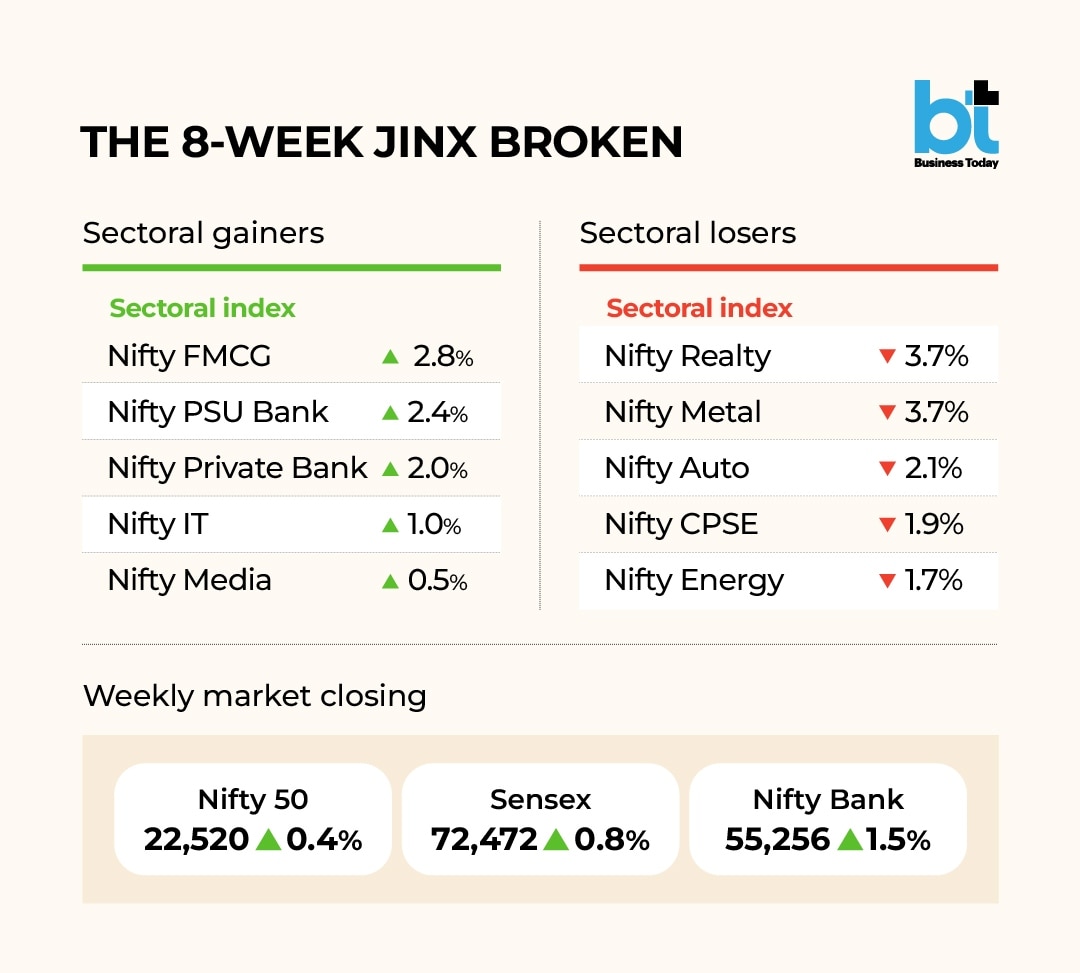
The market's ability to sustain gains above key resistance levels will also be crucial after Nifty slipped to a 52-week low of 22,179.90 during Thursday's intraday trade in the week ended Friday (October 9), with 13 Nifty50 constituents touching their respective 52-week lows.
What to watch out for next week?
Nifty's rebound and the end of its eight-week losing streak provide some relief after a prolonged decline. However, Friday's gains alone do not confirm that the market has established a durable bottom.
The direction of crude oil prices, US Treasury yields, the rupee and FII flows will remain critical alongside September CPI inflation and corporate earnings. A combination of improving earnings, moderating external pressures and sustained buying could support the recovery. Until these signals become clearer, the market's rebound will need to be assessed against the risks that drove the recent correction.
Deven Choksey, Managing Director of DRChoksey Finserv, said the market is making its second attempt to form a bottom since September 24, although confirmation would take time.
"This is the second attempt to form a bottom since September 24, but it will take some time to confirm whether the bottom is holding or whether this is a dead-cat bounce. The recent fall was not driven by panic or capitulation, but largely by a lack of buying and higher selling pressure. If Nifty falls to 21,800 in a hurry, I would view it as the final leg of the correction," Choksey told Business Today.
He added that the correction appeared overdone from a fundamental perspective, with several companies available at attractive valuations. "These valuations could attract large institutional investors. If the geopolitical situation and other factors stabilise, I believe the market could be poised for a strong rally over the next two years," he also said.
Choksey's assessment points to a distinction between near-term market direction and longer-term investment opportunities. However, the durability of any recovery will depend on buying support and the broader macroeconomic environment.
Nifty faces a key hurdle at 22,550
Chandan Taparia, Head of Derivatives and Technical Research at Motilal Oswal, said Nifty entered deeply oversold territory.
"The immediate priority is to negate the prevailing negative structure. If the index sustains above 22,550, it could show signs of stability and potentially rebound towards 22,786-23,000. However, if it fails to cross and sustain above 22,550, the recovery could fizzle out, bringing 22,222 back into focus for a retest. Therefore, the trade setup remains conditional on the index sustaining above 22,550 for a meaningful recovery or rebound," Taparia said.
Therefore, 22,550 will be an important near-term marker. A sustained move above it could support a recovery towards 22,786-23,000, while failure to hold the level could expose the index to another test of the 22,222 level.
Crude oil, bond yields and FII flows remain key risks
Elevated crude oil prices, high US Treasury yields, rupee weakness and continued foreign fund outflows remain important variables for domestic equities.
Crude oil touched around $106 a barrel during the week and was hovering near $102.84 at the last check. Higher oil prices can increase India's import bill and add to inflationary pressures, while a weaker rupee can raise the domestic cost of imports.
The rupee closed broadly flat at 96.73 per US dollar on Friday after weakening to 96.87 during the week. It remains close to its record low of 96.97, touched in May 2026.
Meanwhile, US 10-year and 30-year Treasury yields remained near multi-year peaks. Higher global bond yields can affect investor appetite for emerging-market equities, including Indian equities.
Q2 earnings and inflation data in focus
Vinod Nair, Head of Research at Geojit Investments, said domestic equities staged a relief rally, supported by value buying and short covering after the recent sharp correction.
"IT stocks outperformed on the back of a strong start to the Q2 earnings season and rising confidence in AI-driven revenue opportunities. Sentiment was aided by easing geopolitical concerns following indications that any potential US military action against Iran is unlikely before the midterm elections, helping crude prices moderate. However, persistent FII outflows and elevated global bond yields continue to temper the recovery outlook," Nair stated.
Investors are awaiting September CPI inflation data on Monday for further cues on the interest-rate trajectory following the Reserve Bank of India's (RBI's) shift towards calibrated tightening. The RBI raised the benchmark repo rate by 25 basis points (bps) to 5.5%, marking the first rate hike in nearly four years. The repo rate is the interest rate at which the RBI lends money to commercial banks.
Nair said the actual performance of companies in the September quarter, which is estimated to be good on a year-on-year (YoY) basis, would be critical in determining whether the market rebound is sustainable.
Nifty ends eight-week losing streak
Indian equities recovered sharply on Friday after Thursday's steep decline. The 30-share BSE Sensex pack surged 879.09 points, or 1.23%, to settle at 72,472.33, while the NSE Nifty50 index gained 288.65 points, or 1.30%, to close at 22,520.45.
Broader markets also advanced, with the Nifty Midcap 100 rising 1.56% and the Nifty Smallcap 100 climbing 0.54%.
IT stocks led the recovery, supported by sentiment following bellwether Tata Consultancy Services' (TCS) September-quarter results. The sector's rebound came despite US President Donald Trump's administration suspending eight major technology companies from the Permanent Labor Certification (PERM) programme, which had raised concerns about the outlook for Indian IT companies. FMCG stocks also contributed to the market's gains.
The recovery helped the Nifty end an eight-week losing streak, its longest such run in 25 years. However, the benchmark's weekly performance needs to be viewed alongside the sharp correction that preceded Friday's rally and the fresh 52-week low recorded during the week.
Nifty weekly gainers and losers
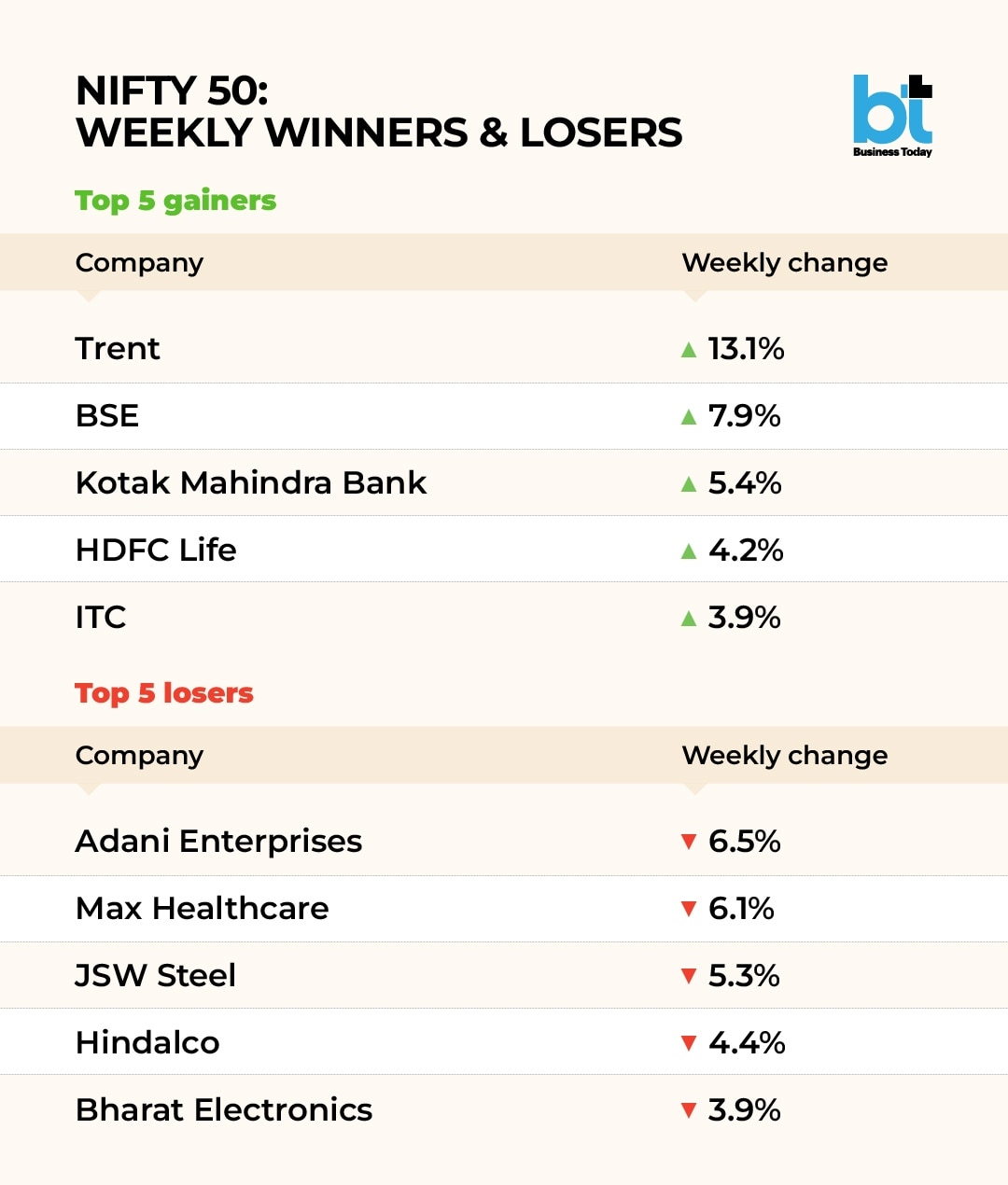
Trent led the Nifty 50 gainers, rising 13.1% during the week. BSE advanced 7.9%, followed by Kotak Mahindra Bank, which gained 5.4%, HDFC Life Insurance Company, which rose 4.2%, and ITC, which added 3.9%.
On the losing side, Adani Enterprises declined 6.5%, Max Healthcare Institute fell 6.1%, JSW Steel dropped 5.3%, Hindalco Industries lost 4.4% and Bharat Electronics slipped 3.9%.
FII selling continues, DIIs provide support
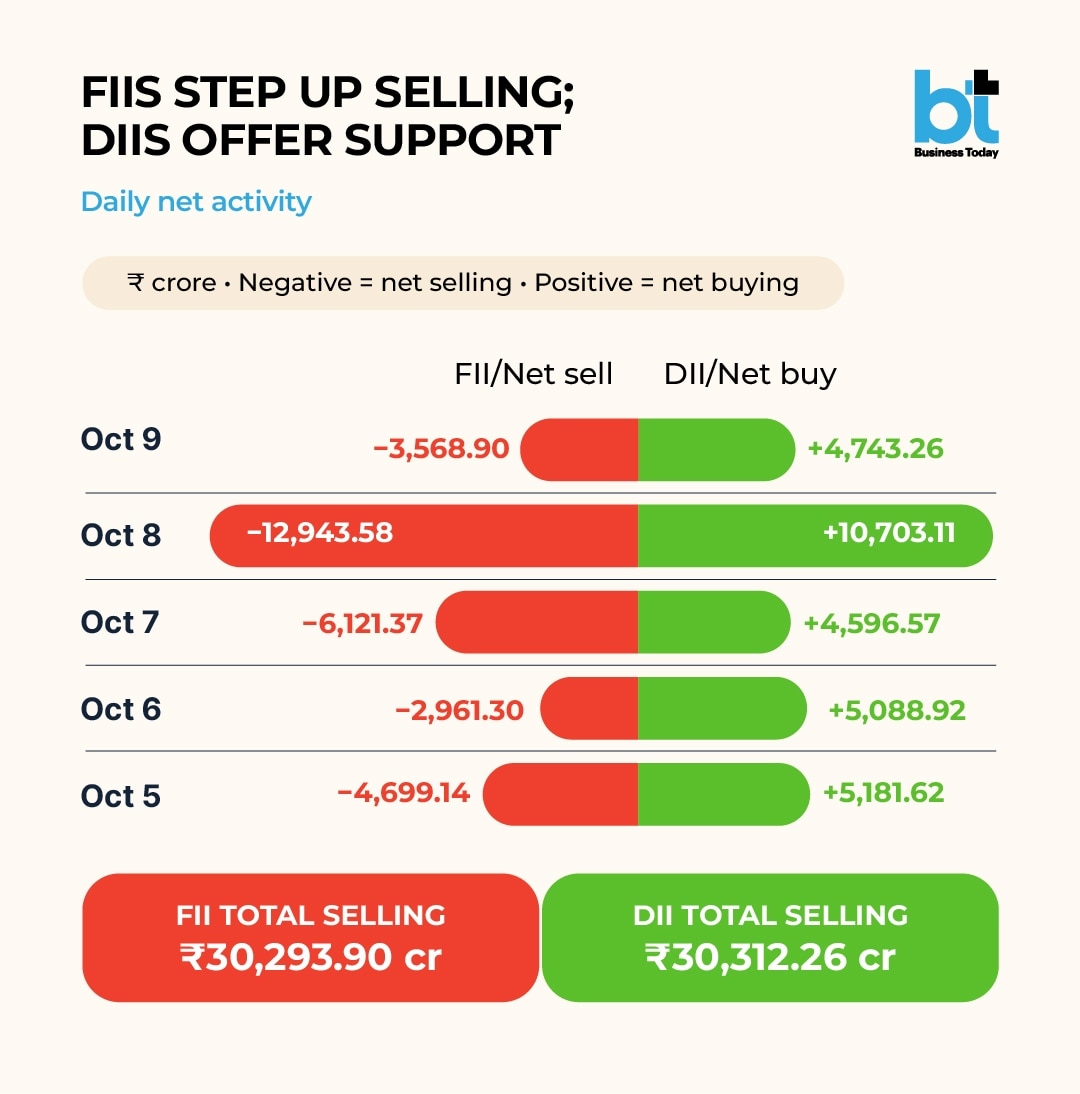
Foreign institutional investors (FIIs) remained net sellers of Indian equities during the week, offloading shares worth Rs 30,293.9 crore. Domestic institutional investors (DIIs) purchased equities worth Rs 30,312.26 crore, providing a counterweight to foreign selling.
The relatively strong domestic buying has helped absorb some of the selling pressure, but the persistence of FII outflows remains a concern. A sustained recovery would be better supported if foreign selling moderates and domestic institutional demand continues.
Rupee, crude oil and bond yields
The Indian rupee closed at 96.73 per US dollar on Friday, broadly unchanged on the day. During the week, it touched 96.87, moving closer to its record low of 96.97 recorded in May 2026.
Crude oil prices remained elevated, with the benchmark touching around $106 a barrel during the week before easing to approximately $102.84 at the latest check. Any renewed increase in oil prices could complicate India's inflation and external-balance outlook.
US 10-year and 30-year Treasury yields also remained high, keeping global financial conditions in focus. These variables, together with foreign fund flows, will remain important for the rupee and domestic equities in the coming week.
Earnings to watch next week
The September-quarter earnings calendar will be a major focus, with results due from companies across IT, banking, financial services, automobiles, capital goods and consumer sectors.
- October 12: HCL Technologies, RBL Bank, Swan Defence, Swaraj Engines.
- October 13: Tata Elxsi, Transformer & Rectifiers.
- October 14: BHEL, ICICI Lombard, HDB Financial Services, MRPL, Tata Technologies, CEAT, Elecon Engineering.
- October 15: Nestle India, Wipro, Tech Mahindra, HDFC Life Insurance, HDFC AMC, L&T Finance, Karur Vysya Bank, South Indian Bank, Angel One.
- October 16: Federal Bank, Bajaj Housing Finance.
- October 17: ICICI Bank, Axis Bank, HDFC Bank, Yes Bank, India Cements.
Investors will look for evidence of earnings resilience, management commentary on demand and margins, and indications of whether business conditions are improving or deteriorating. IT results and commentary on AI-related revenue opportunities will be particularly relevant after the sector's outperformance on Friday.
Key economic data to watch
- October 12: September retail CPI inflation.
- October 13: OPEC monthly oil market report.
- October 14: September wholesale price index (WPI) inflation, April-September WPI data and September industrial production (IIP) numbers.
Primary market action
The primary market will see two mainboard initial public offerings (IPOs) open for subscription next week. HD Fire Protect's public issue is scheduled to open on October 13 and close on October 15, while Fusion CX's IPO will open on October 14 and close on October 16.
Meanwhile, Reliance Industries Ltd (RIL)-led Jio Platforms is likely to offer its shares in the price band of Rs 1,065-1,119 apiece in its upcoming initial share sale, news agency Bloomberg reported on Friday.
















 The direction of crude oil prices, US Treasury yields, the rupee and FII flows will remain critical alongside September CPI inflation and corporate earnings.
 CJP protest: Supreme Court to hold special Sunday hearing on contempt plea against Home Secretary, DMRC
 West Asia tensions: Riyadh airport hit again in fresh assault, multiple injured; flights diverted
 Delhi protest: Police release all detained except CJP leaders; key faces detained & released
 Mahindra & Mahindra announces sale of 51% stake in Novavayu Aerospace to Embraer
 Delhi CJP protest: '₹1.5 lakh loss per shop in a day', says Khan Market traders body
 REIT Returns Explained: Income, Capital Gains & Risks Investors Need To Know
 REIT Risks Explained: Key Factors Investors Must Check Before Investing In Commercial Real Estate
 Will IRDAI’s Broker Commission Crackdown Make Insurance Cheaper For Consumers?
 5 Reason Why Cheap Premium Insurance May Not Be The Best Choice
 Health & Life Insurance: How Much Cover Do You Really Need? Expert Explains
 Market on the back foot, opportunities ahead: where should investors put their money?
 Poonawalla Fincorp Q2 earnings: Net profit zooms 405%, NII at Rs 1,589 crore
  Vedanta, TCS shares to turn ex-dividend; Ola rights issue; 2 stock splits next week
 IPO rush: Rs 50,000 crore worth IPOs to hit Street by Diwali; Jio, Avada to lead fundraise
 Adani Ports, GMR Airports rise up to 5% amid block deal reports; check details
  Canada asylum alert: What unfinished claims must do before November 3
 Infosys co-founder and technology leader Kris Gopalakrishnan’s advice to leaders
 'The Truman Show' star Jim Carrey ties knot third time with girlfriend Min Ah in private ceremony
 India's gender commute gap: Why fewer working women travel beyond 1 km
 Form 121 does not make your EPF withdrawal tax-free: 5 things to check