









 The successful completion of the tests represents another major step towards qualifying the parachute system for human spaceflight.

 The successful completion of the tests represents another major step towards qualifying the parachute system for human spaceflight.
 The Indian Space Research Organisation (ISRO) has successfully completed a critical series of qualification tests for the drogue parachutes that form a key part of the deceleration system of the Gaganyaan Crew Module, marking another important milestone in India’s human spaceflight programme.
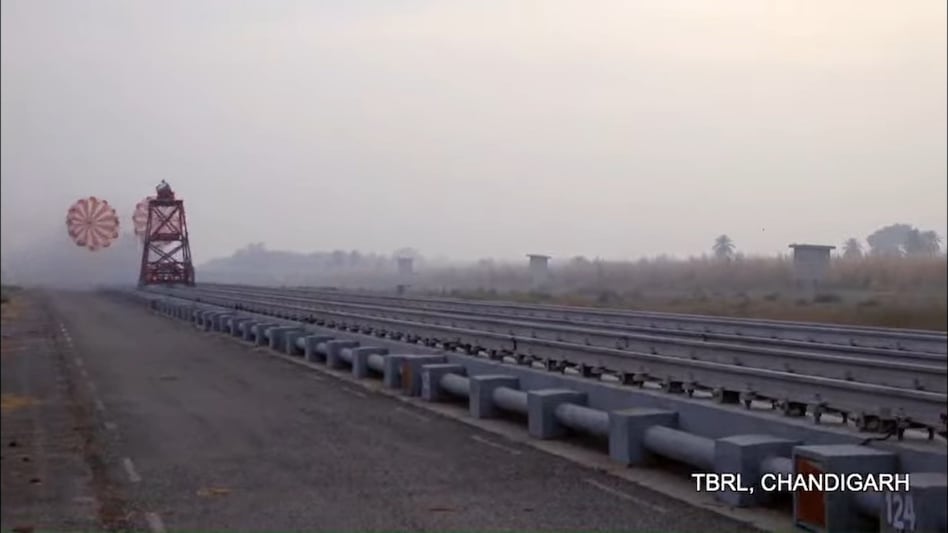
The tests were carried out at the Rail Track Rocket Sled (RTRS) facility of the Terminal Ballistics Research Laboratory (TBRL) in Chandigarh on December 18 and 19. According to ISRO, the objective of the test series was to rigorously evaluate the performance and reliability of the drogue parachutes under extreme and varying flight conditions.
The Gaganyaan Crew Module is equipped with a complex deceleration system comprising 10 parachutes of four different types, designed to ensure the safe return of astronauts to Earth. The descent sequence begins with the deployment of two apex cover separation parachutes, which remove the protective cover of the parachute compartment. This is followed by the deployment of two drogue parachutes that stabilise the module and reduce its velocity during the critical phase of atmospheric re-entry.
Once the drogue parachutes complete their role, three pilot parachutes are released to extract three main parachutes. These main parachutes further slow down the Crew Module, enabling a controlled and safe touchdown.
ISRO said the drogue parachutes are a crucial component of the overall system, as they play a pivotal role in stabilising the crew module and bringing its speed down to safe levels before the main parachutes take over. Both RTRS tests conducted during the two-day campaign achieved all their intended objectives, confirming the robustness of the drogue parachutes even in scenarios involving significant variations in flight conditions.
The successful completion of the tests represents another major step towards qualifying the parachute system for human spaceflight. The test campaign saw active support and participation from multiple institutions, including the Vikram Sarabhai Space Centre (VSSC) of ISRO, the Aerial Delivery Research and Development Establishment (ADRDE) of DRDO, and TBRL, DRDO, underscoring the collaborative effort behind the Gaganyaan mission.
For Unparalleled coverage of India's Businesses and Economy – Subscribe to Business Today Magazine
 'Never seen so many tankers': India's Russian crude imports may hit record high in June
 Delhi EV policy approved: Road tax exempted for cars over ₹30 lakh; ₹50,000 subsidies for EV buyers
 9 shares may enter AMFI largecap list: BSE, Vodafone Idea, Groww, BHEL among probables
 Qatar Emir’s $500 million superyacht Al Lusail returns after luxury refit worth $35 million
 GIFT Nifty logs record open interest, contracts on June 25
 Delhi Unveils ₹15,000 Crore EV Policy: What It Means For Auto Companies And Consumers
 Gold, Silver Or Crude? Where Should Investors Bet Now? | Vandana Bharti
 How India Strategically Managed LPG & Crude Oil Supplies During West Asia War | K. Surana Explains
 Delhi’s Green Revolution: CM Rekha Gupta Unveils Massive ₹15,000 Crore EV Policy To Combat Pollution
 Why Crude Oil Prices Could Stay Under Pressure As China's Demand Weakens And Supply Improves
 Why Jio BlackRock feels hybrid long-short is the perfect fund to launch now as it enters the SIF space
 Where should investors put their money? PL Wealth CEO has some tips
  Axis Bank CFO Puneet Sharma steps down; stock likely in focus on Tuesday
 Apollo Hospitals, Medanta, Healthcare Global, Max Healthcare, Artemis Medicare: Check target prices, outlook
 Polycab: Amid record FII buying, shares at all-time high but brokerages expect more upside