'I can be fired': Jensen Huang's remarks on Nvidia succession resurface amid reports of possible ouster
'I can be fired': Jensen Huang's remarks on Nvidia succession resurface amid reports of possible ouster
An interview with Nvidia CEO Jensen Huang, recorded weeks before allegations surrounding his personal relationships emerged, has resurfaced as the chipmaker's board reportedly weighs his future. With Nvidia shares losing $600 billion in market value this week, investors are debating who could replace the man who built the AI powerhouse.
Nvidia's succession uncertainty deepens amid Jensen Huang controversy, with Ian Buck and Colette Kress emerging as potential replacements.
Nvidia CEO Jensen Huang's remarks about his own potential dismissal have taken on new significance amid reports that the chipmaker's board is considering removing its longtime leader following allegations involving extramarital relationships, including one with a woman suspected by US authorities of being a Chinese spy.
In an interview with Bloomberg journalist Emily Chang, recorded weeks before the controversy erupted, Huang acknowledged that even the founder of the world's dominant AI chipmaker could lose his position.
Advertisement
"And just as I can be fired, the next CEO has to be hired. And I like it that way," Huang said while discussing Nvidia's leadership structure and succession planning.
He added: "And you're always vulnerable, you're always earning it, you're always striving to be better."
Huang wanted to remain CEO for another 20 years
During Chang's interview, Huang also addressed speculation about whether his children, both Nvidia executives, could eventually succeed him.
"They have to go earn it," he said, making clear that family ties alone would not guarantee the position.
Huang expressed hope that Nvidia's next CEO would emerge from within the company while indicating that he had no immediate plans to retire.
Advertisement
"I'm really hoping that the next CEO of the company's already at the company, but 20 years from now, I hope I stay healthy and I hope I continue to earn my keep," he said.
His comments are particularly significant because Nvidia has never publicly named a successor, despite Huang having led the company since its founding in 1993.
Chang also questioned Huang about his unconventional management style, including his preference for numerous direct reports and a relatively flat organisational structure.
Huang defended his approach, arguing that it had helped Nvidia innovate and expand rapidly.
Advertisement
"My management style is what made it possible for the company to grow," he said.
Explaining his philosophy, Huang said he wanted an organisation with as few silos as possible because rigid structures could prevent companies from adapting to change.
He also emphasised personal accountability at the highest levels of management.
"I think you have to hold yourself responsible. You have agency. You're the CEO of the company for God's sakes," Huang said.
Discussing the pressures of leading Nvidia, Huang acknowledged that the position demanded considerable personal sacrifice.
"I'm responsible for an entire industry. And so I think the pressure of being the CEO is high and it's supposed to be high," he said.
Huang also stressed that leadership positions should never be treated as permanent entitlements.
"It shouldn't be a job that you take for granted," he said.
Reflecting on his responsibility to develop future leaders, Huang added: "That's my job is to create that condition."
The remarks highlight the importance Huang places on accountability and leadership development, even as questions emerge about Nvidia's ability to manage a transition without its founder.
Advertisement
Nvidia board weighs Huang's future
According to Reuters, Nvidia's board was scheduled to meet on Wednesday to decide whether to oust Huang as the company grapples with reports of two extramarital affairs involving its longtime chief executive.
Nvidia did not immediately respond to Reuters' request for comment on the reported board meeting.
The uncertainty comes amid significant pressure on Nvidia shares. The company has suffered a $600 billion selloff this week, pushing it into second place among the world's most valuable companies, Reuters reported.
"Jensen Huang is a rockstar in the industry. He's outspoken and synonymous with the Nvidia brand, and a leader like that is very hard to replace," Anna Wu, founder of Floodlines Research in Sydney, told Reuters.
Although Huang has never publicly designated a successor, Reuters reported that analysts and investors increasingly view two senior executives as potential candidates: Chief Financial Officer Colette Kress and engineering veteran Ian Buck.
Kress, 59, joined Nvidia in 2013 and has regularly appeared alongside Huang during quarterly earnings calls. Some board members favour appointing her interim CEO, Semafor reported, citing people familiar with the matter.
Advertisement
"Colette Kress is the obvious choice to steady the ship. She has been CFO for 13 years and fronts every earnings call alongside him, so she's a familiar and trusted voice for the market at a time when it badly needs one," Josh Gilbert, lead analyst at eToro, told Reuters.
However, Buck, who joined Nvidia in 2004 and helped develop its CUDA software platform, is viewed by some analysts as a stronger long-term technology leader.
Buck currently oversees Nvidia's AI hardware and software products for hyperscale AI. His technical expertise could be crucial in maintaining the company's competitive advantage if a leadership transition becomes necessary.
Other names reportedly discussed as possible successors include Arm CEO Rene Haas and Nvidia veteran Jeff Fisher.
Armina Rosenberg, portfolio manager and co-founder at Minotaur Capital, suggested that Nvidia could consider an interim leadership arrangement combining financial and technical expertise.
"The more realistic route is an interim leader from the long-serving inner circle, possibly as a co-CEO structure: one leader to steady the business and the finances, such as Colette Kress, alongside a product and technology leader, such as Ian Buck," she told Reuters.
Advertisement
What the leadership uncertainty means for investors
The controversy has brought attention to Nvidia's dependence on Huang, who co-founded the company in 1993 and transformed it from a graphics-chip manufacturer into the dominant supplier of processors powering artificial intelligence.
"My bigger concern is next decade, because Jensen isn't simply Nvidia's CEO but he's the person who has consistently identified where computing is going," Shay Boloor, chief market strategist at Futurum Equities, told Reuters.
Prediction market Polymarket indicated an 83% probability of Huang resigning or being removed by year-end, although Reuters cautioned that trading volumes were small. Such odds reflect market speculation rather than a confirmed outcome.
For investors, the immediate question is whether Nvidia can maintain strategic continuity, technological leadership and market confidence without the executive who has defined its growth for more than three decades.
With over 16 years of experience in the newsroom, I am currently covering personal finance, banking, financial services, and insurance sector, bullion and metals, sports, and other trending topics. When not chasing interest rates and new-age investment tools, I like to follow and cover climate change trends and environment-friendly initiatives across the world. When not at work, I spend time learning Bharatnatyam from my guru, and baking from my daughter.



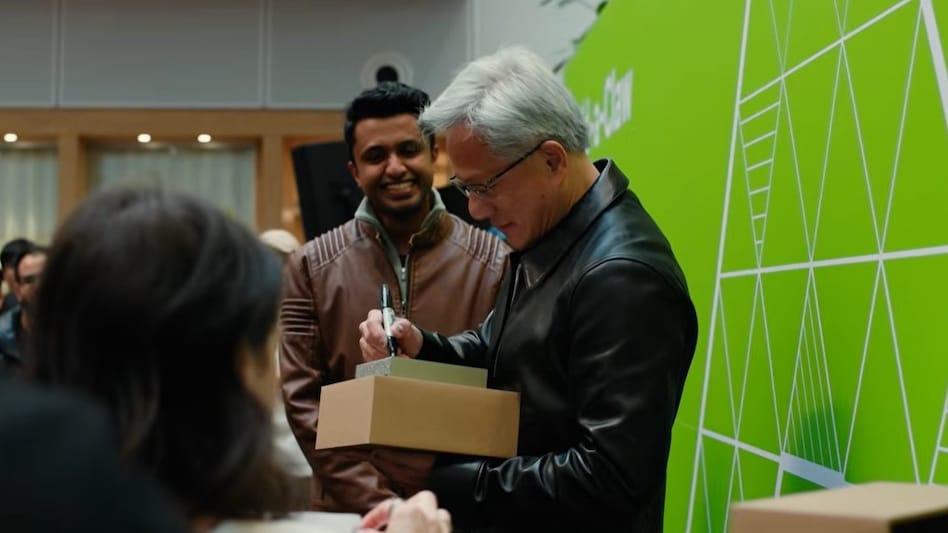 Nvidia's succession uncertainty deepens amid Jensen Huang controversy, with Ian Buck and Colette Kress emerging as potential replacements.

 Nvidia shares: Domestic passive funds take hit as stock slides 27% in just over a month
 Sundar Pichai beats Satya Nadella in Hurun's $15 trillion Global Indians List: What's behind Alphabet's rise?
 Three stops, one agenda: PM’s visit to Canada, US, Brussels in mid-December to boost trade ties
 Will foreign inflows to Indian stock market sustain in coming months? What BofA says
 'Loss of Hyderabad has definitely hurt us': Nara Lokesh on Andhra's emotional setback, bets big on Amaravati
 Mayukh Ray, HBD&O At Texmaco Holdings, Gives His Advice On Tackling Tollygunge Course In Kolkata
 Indranil Basu, Group Chief Brand Officer At Saroj Poddar Group, Explains Why He Plays At BT Golf 26-
 Bihar's Big Fat Wedding: Anant Singh Gifts Daughter a ₹3 Crore Defender, BMW & Horse Race
 War In The White House | Axios Reports Scott Bessent-Howard Lutnick Confrontation On AI Chips
 Jensen Huang Scandal: Could Nvidia’s AI Empire Face A Trust Crisis?

 Gold falls below $4,000, silver slips too: What's weighing on precious metal prices?
 BDL shares fall 4% as Q2 profit drops 15% YoY; revenue rises 45%
 Dilip Buildcon emerges as lowest bidder for Rs 419-crore Gurugram Metro project
 Haldiram Snacks Food plans Rs 10,000-crore IPO in 2027: Report
 ChatGPT Go at ₹99 instead of ₹399? A cancellation surprise could save users ₹900
 Motorola Razr Flex 2027: A wider foldable with 165Hz display could be coming next year












