












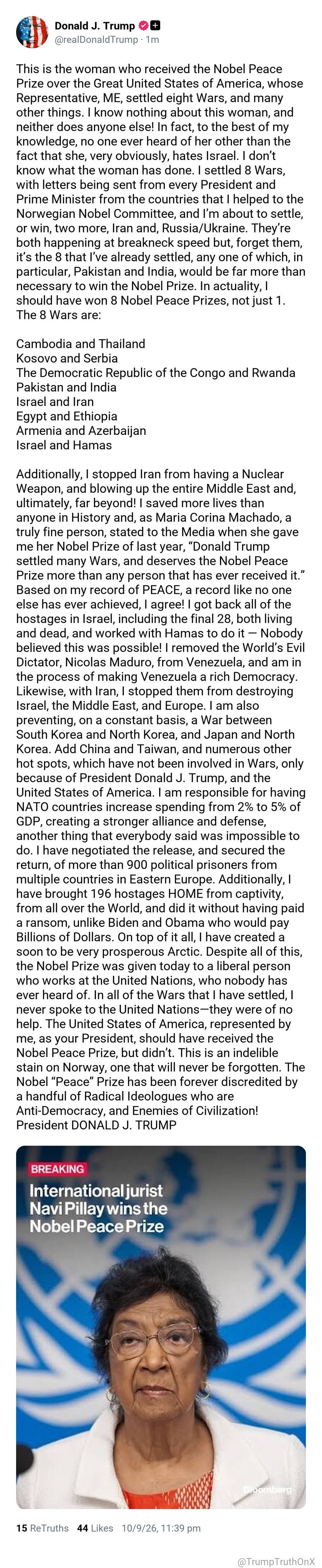



 Trump accused the committee of overlooking his administration’s efforts, questioned Pillay’s credentials.
US President Donald Trump has claimed he deserved eight Nobel Peace Prizes for his diplomatic record, attacking the Norwegian Nobel Committee after it awarded the 2026 Nobel Peace Prize to South African jurist Navi Pillay.
In a Truth Social post, Trump accused the committee of overlooking his administration’s efforts, questioned Pillay’s credentials and alleged she was hostile towards Israel. “The Nobel ‘Peace’ Prize has been forever discredited by a handful of Radical Ideologues who are Anti-Democracy, and Enemies of Civilization!” he wrote, calling the decision an “indelible stain on Norway”.

 'Shame on you Modi, Shah': CJP as Abhijeet Dipke, Ashutosh Ranka, Saurav Das detained from plane
 RBI's rupee defence: Special dollar window for oil firms, tighter forex derivative rules
 JioBlackRock Flexicap down 6.67% in 2026: 19 fresh buys, 18 exits in September reshuffle
 Small finance banks' profitability set to more than double in FY27 as microfinance stress eases
 '300+ calls and counting': Ahead of CJP protest, Saurav Das alleges Delhi Police leaked his mobile number
 Will IRDAI’s Broker Commission Crackdown Make Insurance Cheaper For Consumers?
 5 Reason Why Cheap Premium Insurance May Not Be The Best Choice
 Health & Life Insurance: How Much Cover Do You Really Need? Expert Explains
 Silver Investment Outlook: Why Gen Z Should Watch This Metal's Long-Term Growth Potential
 Gold Price Outlook: Is This the Right Time to Invest? Expert Sees Potential for New Highs
 Market on the back foot, opportunities ahead: where should investors put their money?
 Poonawalla Fincorp Q2 earnings: Net profit zooms 405%, NII at Rs 1,589 crore
  Vedanta, TCS shares to turn ex-dividend; Ola rights issue; 2 stock splits next week
 IPO rush: Rs 50,000 crore worth IPOs to hit Street by Diwali; Jio, Avada to lead fundraise
 Adani Ports, GMR Airports rise up to 5% amid block deal reports; check details Small finance banks' profitability set to more than double in FY27 as microfinance stress eases
 'I should've won 8 Nobel Peace Prizes, not one': Trump miffed at Nobel snub after Navi Pillay wins 2026 award'300+ calls and counting': Ahead of CJP protest, Saurav Das alleges Delhi Police leaked his mobile numberWill IRDAI’s Broker Commission Crackdown Make Insurance Cheaper For Consumers?JioBlackRock Flexicap down 6.67% in 2026: 19 fresh buys, 18 exits in September reshuffle


