


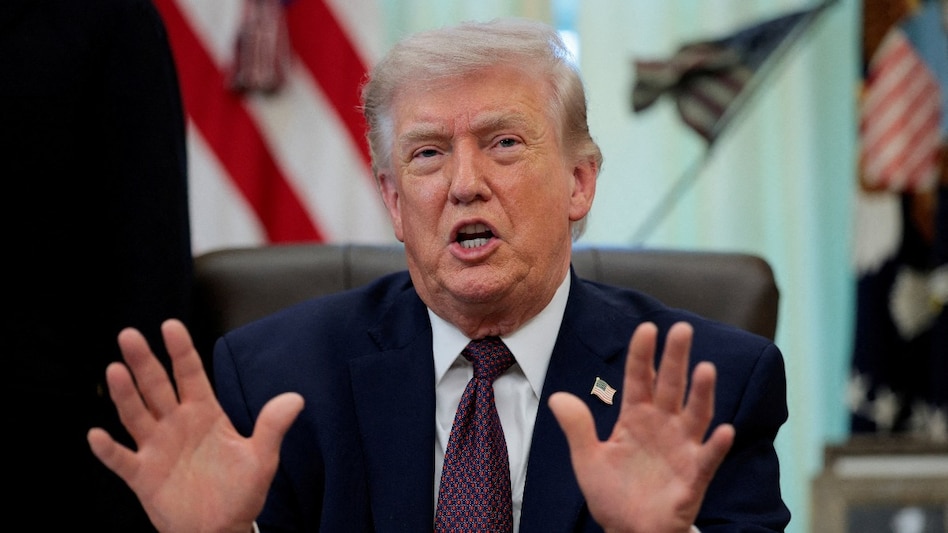
 Donald Trump says there's no rush to sign the peace deal with Iran
US President Donald Trump said on Sunday that there was no hurry to finalise a deal with Iran, saying he had told his representatives not to rush even as disruption in the Strait of Hormuz continued to strain global oil and liquefied natural gas supplies. His remarks came a day after he said Washington and Tehran had "largely negotiated" a memorandum of understanding on a peace deal that would reopen the key shipping route.
Trump wrote on Truth Social that the US blockade on Iranian ships in the Strait of Hormuz would "remain in full force and effect until an agreement is reached, certified, and signed", adding: "Both sides must take their time and get it right." There was no immediate response from Iran's government, but Tasnim news agency, which is linked to Iran's Revolutionary Guards, said the United States was still obstructing parts of a potential deal, including Tehran's demand for the release of frozen funds.
According to a report in Reuters, the two sides still remain at odds on several issues, including Iran's nuclear ambitions, Israel's war in Lebanon with the Iranian-backed Hezbollah militia, and Tehran's demands for sanctions relief and the release of tens of billions of dollars in Iranian oil revenues frozen in foreign banks. A senior Trump administration official told reporters that no agreement would be signed on Sunday, saying the Iranian system did not move fast enough, but outlined what he described as the latest contours of the negotiations.
MUST READ | Iran deal 'largely negotiated', Hormuz to be reopened soon: Donald Trump
The official, speaking on condition of anonymity, said Iran had agreed "in principle" to reopen the Strait of Hormuz in exchange for the United States lifting its naval blockade, and to dispose of Tehran's highly enriched uranium. He said the US understood that Iran's Supreme Leader Ayatollah Mojtaba Khamenei had endorsed the broad template of the deal. There was no immediate confirmation from Iran, and no elaboration on what an "in principle" agreement meant.
The US official said Washington envisaged first reopening the strait and lifting the naval blockade, while negotiations on the details of the nuclear steps would take more time. He rejected suggestions that Iran had not accepted disposing of its stockpiled enriched uranium, saying: "It's a question about how." A second senior administration official said on Sunday that the proposed framework would give negotiators 60 days to reach a final deal.
Iranian sources had told Reuters that in future stages, "feasible formulas" could be found to resolve the dispute over its highly enriched uranium stockpile, including diluting the material under the supervision of the UN nuclear watchdog. Iran has long denied US and Israeli accusations that it is pursuing nuclear weapons and says it has the right to enrich uranium for civilian purposes, although the purity it has achieved far exceeds that needed for power generation.
The US-Israeli war on Iran, which began on February 28, has severely curtailed shipping through the Strait of Hormuz, through which about one-fifth of the world's oil and LNG supply normally passes. Before the war, shipping traffic through the strait averaged 125 to 140 daily passages. Around 20,000 seafarers remain stranded inside the Gulf on board hundreds of ships.
Shipping data showed that an LNG tanker was exiting the Strait of Hormuz and heading to Pakistan on Monday, while a supertanker carrying Iraqi crude for China left the Middle East Gulf on Saturday after being stranded for nearly three months. The vessels are among a handful of supertankers exiting the Gulf this month through a transit route that Iran has ordered ships to use.

 Behind the reduction in workforce in India’s top three private sector banks
  'Eye for an eye': Houthis declare naval blockade against Saudi Arabia
 No proposal to abolish LTCG on listed equities: Govt in Lok Sabha
 Blame it on the IndiGo fiasco? Air ticket refund complaints up 233% in 2025
 'No commitments made so far': CJP delegation meets JP Nadda, seeks Dharmendra Pradhan's removal
  Tatva Up 20%; HDFC, Axis Bank Drop on Weak Q1
 Why Parliament Could Not Function on Day 1 of the Monsoon Session | Full Report
 Is Facial Recognition Actually Secure? | 1X Neo Robot & Ultraviolette X-47 Review | Tech Today
  Jupiter Hospital Opens Dombivli Unit As It Targets A 3,000-Bed Network
 Best Midcap & Small Cap Mutual Funds to Buy Now | Expert Reveals Top Picks
 JSW Steel Q1 earnings: Here's how the stellar show may impact the metal sector
  Kotak Bank, Axis Bank Q1 earnings are out: Expert strategy on trading these stocks
  Sensex falls over 400 pts, Nifty ends below 24,250 as US-Iran attacks, banking results hit sentiment
 Vedanta stocks: Accumulate from a medium-term perspective, says Kranthi Bathini
 Reliance Industries Q1 results: Analysts turn bullish after earnings; is it time to buy?









