Don't Miss: Pakistan used lobbying firms to get US govt’s help to keep it out of FATF grey list
The report says Pakistan's current role as a facilitator in high-stakes negotiations between the US and Iran is the result of years of "backroom maneuvering" by the Texas-based firm, which has worked with successive Pakistani governments and military leadership.
Payne's influence drew attention in 2025, when Pakistan's army chief Asim Munir held a one-on-one meeting with then US President Donald Trump in the Oval Office. The report notes that such access "reveals the potent channels the country has found within the White House."
Don't Miss: India hires new lobbying firm amid tariff tensions with Washington
Payne also urged Pakistani Prime Minister Shehbaz Sharif to nominate Trump for the Nobel Peace Prize, reflecting what the report describes as a strategy of "measured flattery and a communication strategy" that has helped Islamabad gain traction in Washington.
Who is Stephen Payne?
Payne is a controversial Republican lobbyist. He resigned from the advisory council of the US Department of Homeland Security after being caught in a "cash-for-access" sting by a UK newspaper.
In 2008, he faced allegations of offering access to senior White House officials in exchange for donations towards then-President George W Bush's private library. Payne had also accompanied Bush and then Vice-President Dick Cheney on foreign visits.
As the US heads towards presidential elections later this year, the involvement of a Pakistan-hired Republican lobbyist could raise concerns for India, diplomatic sources say, pointing to Payne’s past record.
Payne worked for Pakistan during the regime of Pervez Musharraf following the 9/11 attacks, a period when Islamabad secured major non-NATO ally status and received multi-billion-dollar US aid.
Earlier, Payne also signed a deal with the Libyan National Army, which was followed by a surprise phone call between President Donald Trump and Khalifa Haftar, the force's commander.
Payne-Pakistani Ties
Payne's association with Pakistan dates back to 2001, when he began representing its interests during the presidency of Pervez Musharraf. Through a group known as Team Eagle, his firm signed a formal contract with Islamabad months before the September 11 attacks.
That relationship proved critical in the aftermath of the attacks. Payne's firm supported negotiations that secured a five-year, $3 billion US aid package for Pakistan and helped lift economic and military sanctions, paving the way for Pakistan to be designated a Major Non-NATO Ally in 2004.
Musharraf later acknowledged his role. In a January 2006 letter, he wrote: "The challenges faced by both our countries in the aftermath of September 11, 2001, brought us even closer, in which you played a pivotal role."
Payne has also described acting as an informal conduit during a period of heightened tensions between India and Pakistan. Recalling a phone call from Musharraf on December 30, 2001, he said the Pakistani leader warned he was prepared to use "nuclear weapons against India" if New Delhi launched a ground incursion.
"Musharraf specifically asked me to relay to (former) President Bush that if India crossed that border, he would be the first to use nuclear weapons," Payne said, adding that he contacted a member of President Bush's National Security Council, after which "in seven hours, Bush called Musharraf."
Over the years, the firm's role expanded beyond crisis diplomacy. In 2020, during the government of former prime minister Imran Khan, Linden Government Solutions was tasked with helping Pakistan avoid being placed on the Financial Action Task Force blacklist.
According to the report, it helped address 27 deficiencies, leading to Pakistan's removal from the FATF grey list.
Despite shifts in Pakistan's civilian and military leadership, reliance on such backchannel lobbying has remained consistent. The report notes that representing Pakistan in Washington has been challenging, with surveys showing low favourability ratings in both countries.
Payne acknowledged strains in ties during recent US administrations. "Both administrations have been problematic for Pakistan. The problems were wide-ranging," he said, adding that reduced military exchanges contributed to "obvious miscommunication."
Momentum picked up again in 2024, when Payne's firm signed an agreement with the Islamabad Policy Research Institute, a military-linked think tank, focusing on financial stability and political advocacy.
US-Iran talks
Analysts cited in the report say Pakistan's current diplomatic positioning reflects its ability to engage multiple global powers. Serhan Afacan of the Iran Research Center was quoted as saying, "One of the reasons for Iran accepting Pakistan as the venue for diplomacy is that Pakistan can reach decision-makers via different channels in both China and the US."
As talks between Washington and Tehran continue, the report suggests the outcome will depend not only on formal diplomacy but also on the back channels connecting Islamabad to Washington.



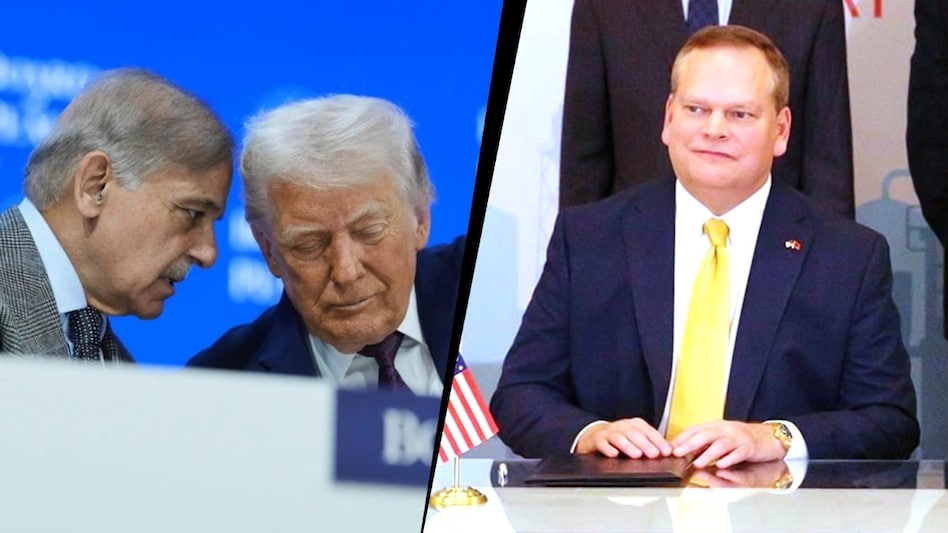 Stephen Payne urged Pakistani PM Shehbaz Sharif to nominate Trump for the Nobel Peace Prize
 Dollar deluge: RBI’s forex scheme draws $136.37 billion
 'Sugar availability is more than sufficient': Industry dismisses shortage fears ahead of festive season
 '125% of GDP kept in frozen savings of gold, silver': Kotak's Nilesh Shah flags India's growth hurdle
 Mahindra-SML merger to unlock sourcing, product platform and service synergies: Vinod Sahay
 'No mechanical boost to GDP numbers': MoSPI's detailed clarification on 7.8% growth
 U.S. May Tighten Child Passport Checks Under Trump, Indians And Birth Tourism Families Face Scrutiny
 Market Commentary | Deven Choksey On Buying Opportunities & Market Trends
 “India Is Certainly Not In Crisis”: Arvind Panagariya On Growth, Investment And Reforms
 Daily Calls: Ask Your STOCK MARKET TODAY QUERIES | Market Update | Share Market News Today
 What’s Hot: Stocks, Gold & Big Money Moves | Daily Markets Show | September 02 | Business Today
 RIL-backed Alok Industries shares hit fresh 52-week low, end slightly higher
 Milky Mist shares surge 10% after Q1 results; brokerage sees more upside potential
 Hero MotoCorp, Eicher Motors shares slide up to 5%; analyst flags key support levels
 Man Infraconstruction shares fall; Rs 169 crore buyback approval in focus
 Brigade Enterprises shares: Analyst on when to exit the real estate counter
  Saved Rs 1.2 crore for daughter's wedding, man loses it to 'digital arrest' scam
 'Magical moment for India': Ex-Finance Commission Chairman hails Japan's A- rating upgrade, defends new GDP methodology
 'Comparing apples to oranges': Amitabh Kant defends India's revised GDP methodology
 'Excited to see Indian startups build the local AI economy': Nvidia CEO Jensen Huang












