












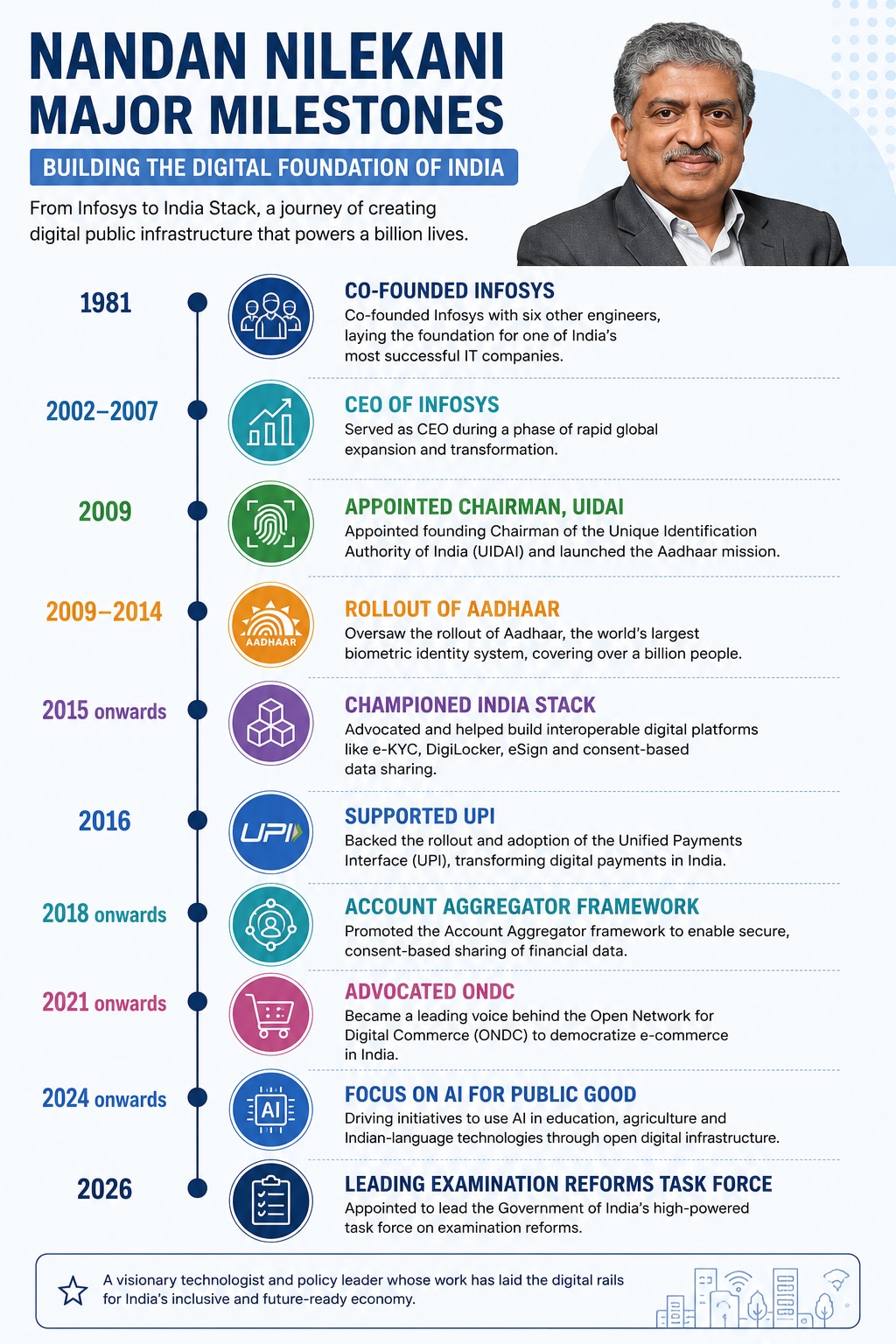


 His work has shaped how Indians prove their identity, receive welfare benefits, make payments, access financial services and, increasingly, interact with the digital economy.
 When India needed a digital identity for more than a billion people, it turned to Nandan Nilekani. When it sought to build the rails for instant payments, paperless governance and open digital commerce, his ideas once again found their way into the country's technology blueprint.
Now, with the government entrusting him to lead a high-powered task force on examination reforms, Nilekani is back at the centre of another national mission — one that adds to a career defined by solving problems at population scale.
 Gold at $5,000 by mid-2027? The forces behind the longer-term outlook
 Anthropic says Claude now leads 26% of its AI R&D work: How fast is AI development accelerating?
 100% tariffs immediately? What Trump’s new Russia sanctions law means for India
 2026 Skytrax World Airline Awards: Air India secures gets Best Airline in India award
  H-1B visa: Trump admin extends $100,000 employer fee till Sept 2027, tightens job-replacement rules
 Corporate Vs Personal Health Insurance: Which Is Better On A Budget?
 Gold Price Outlook: Why Gold Could Rise Despite Global Interest Rate Hikes | Silver Market Update
 Health Insurance: Why Claim Settlement Ratio Is Not Enough When Choosing The Right Insurer
 “Unacceptable And Unprofessional”: MEA Rejects Pakistan’s Claims Over INS Kolkata Collision
  Commodity Trading For Beginners: How MCX & NCDEX Work | Trading Basics | Money Today
 Jindal Supreme, SS Retail, Hero Motors IPOs subscribed up to 181 times on final day; details here
 Sensex, Nifty post sixth weekly loss; TCS, Titan among top laggards, slip up to 4%
 How AI collapse could benefit Indian equity market; Jefferies' Christopher Wood explains
  Banks are no more secular growth story, prefer NBFCs: Chris Wood
 Jefferies' Christopher Wood sees gold at $10,000 'sooner or later'; likes India's small, midcaps
 Samsung Galaxy Z Fold8 Ultra, Fold8 get 25% lower EMIs under Galaxy Forever plan
 Uday Kotak seeks panel on rising gold imports as FY27 bill threatens to touch $90 billion: Report
 Giving cough syrup to your toddler? Big red warning on label may soon flag risks for kids under 4Gold at $5,000 by mid-2027? The forces behind the longer-term outlook
 Caught using ChatGPT in exam, 22-yr old IIT Bombay student dies by suicide


