









 Former Punjab Chief Minister Sukhbir Singh Badal has commenced his religious penance following a directive from the Akal Takht

 Former Punjab Chief Minister Sukhbir Singh Badal has commenced his religious penance following a directive from the Akal Takht
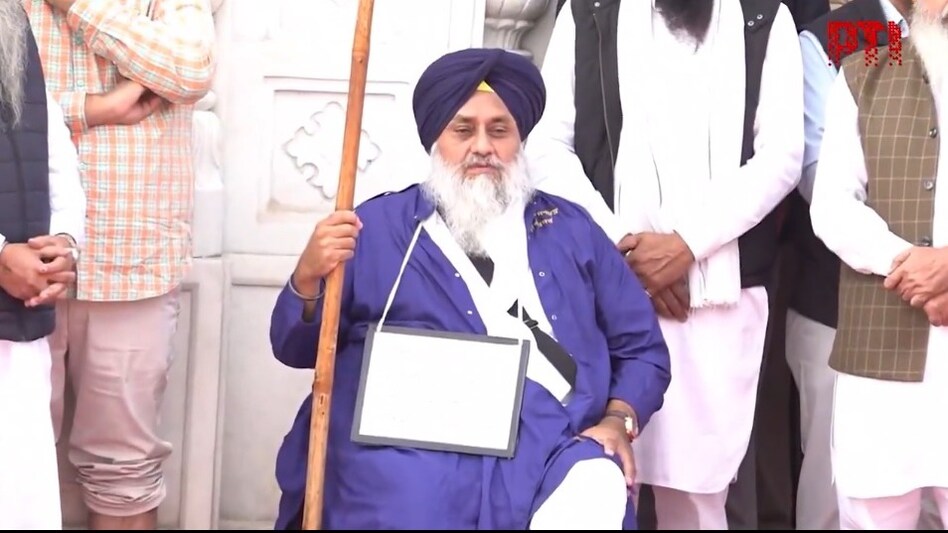
Former Punjab Chief Minister Sukhbir Singh Badal has commenced his religious penance following a directive from the Akal Takht, the highest temporal authority of Sikhs, over his role in a sacrilege case. Visuals from this morning showed the Shiromani Akali Dal chief seated in a wheelchair at the entrance of the Golden Temple in Amritsar, wearing a plaque around his neck and holding a spear as part of his punishment.
Accompanying him, senior Akali Dal leader and brother-in-law Bikram Singh Majithia began his sentence by washing utensils at the Golden Temple. The punishment for both leaders involves serving as sewadars (volunteers) and performing cleaning duties in kitchens and toilets at gurdwaras, including the Golden Temple.
The Akal Takht had found Sukhbir Badal guilty of religious misconduct in August for "mistakes committed by the party during its tenure in power in Punjab from 2007 to 2017." This included favouring Dera Sacha Sauda chief Gurmeet Ram Rahim Singh, who was linked to the 2015 sacrilege of the Guru Granth Sahib, the Sikh holy scripture. Declaring him a tankhaiya (guilty of religious transgressions), the Akal Takht ordered Badal to undertake the prescribed penance.
Sukhbir Badal, who admitted his mistakes and offered an unconditional apology, was sentenced to duties that include cleaning bathrooms at the Golden Temple for an hour daily, followed by a ritual bath and service in the langar (community kitchen). The Akal Takht Jathedar, Giani Raghbir Singh, has also directed the Akali Dal's working committee to accept Badal’s resignation as the party chief.
The punishment comes as a significant moment for the Akali Dal, which has faced criticism for its handling of sacrilege cases during its tenure. The late Parkash Singh Badal, Sukhbir Badal's father and former Punjab Chief Minister, has also been posthumously stripped of the Fakhr-e-Qaum (Pride of the Sikh Community) title, awarded to him in 2011 for his contributions to the community.
The sacrilege cases, involving the Dera Sacha Sauda chief, had caused widespread outrage in Punjab, sparking violent clashes between Sikhs and Dera followers. The controversial decision to pardon Ram Rahim, orchestrated during the Akali Dal's rule, remains a flashpoint in Punjab's political and religious history.
 Same 43°C temperature, different reality: Why Europe's heatwave is more brutal than India's
 'Think of yourselves like stocks': WhatsApp chief Kunal Shah's advice for youth - what he means
 Dixon Technologies shares: Four factors why JM Financial upgraded the EMS stock
  From engineers to product managers: Here's how much Anthropic pays, with salaries up to ₹13.02 crore
 Infosys, Hindalco, Redington: How FPI-heavy stocks fared in June as outflows hit ₹53K crore
 HP EliteBook X G2a Review: An AI PC in 2026 With 64 GB RAM And A Price To Match
 China’s Modern Inequality System | Akshita Nandgopal Unpacks The Brutal Reality Of The Hukou System
 India Food Label Scam Explained By Sneha Mordani | FSSAI Issues Strict Action
 Should You Get Your Heart Check Before Gym? Sneha Mordani & Dr Devi Shetty Explain
 Biggest Water Dispute In Asia | India-Pakistan Indus Crisis Update
 Dixon Technologies shares: Four factors why JM Financial upgraded the EMS stock
  Coforge, KPIT Tech, Cyient among top IT stocks to buy for upto 44% upside amid AI recoveryInfosys, Hindalco, Redington: How FPI-heavy stocks fared in June as outflows hit ₹53K crore
 Last chance next week to buy four Bajaj Group stocks for dividend; check payout, record dates
 Coforge, Mphasis, Persistent, LTIMindtree: Share price targets as IT stocks under pressure