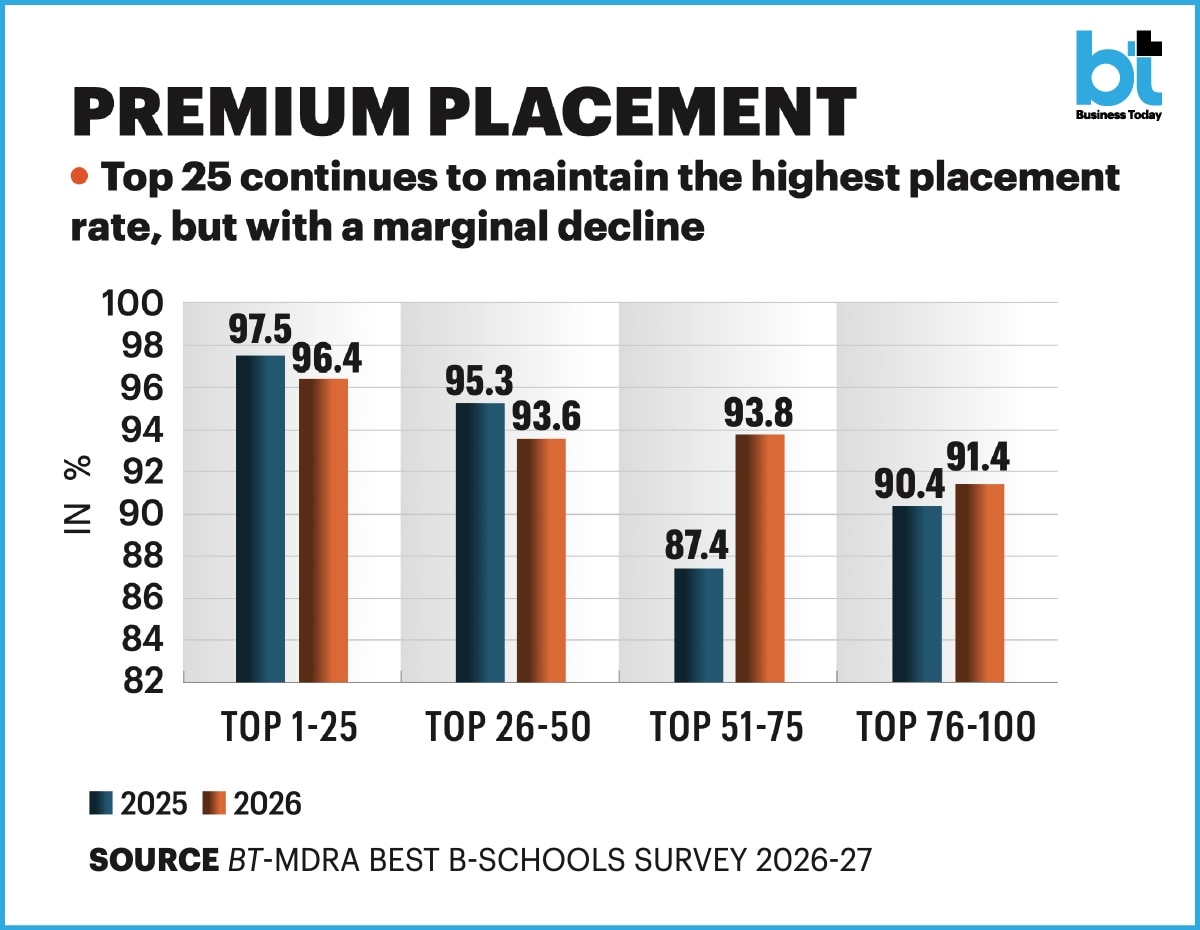
At the Top 25 B-schools, placements fell from 97.5% in 2025 to 96.4% in 2026. But at schools ranked 51–75, the placement rate jumped from 87.4% to 93.8%.
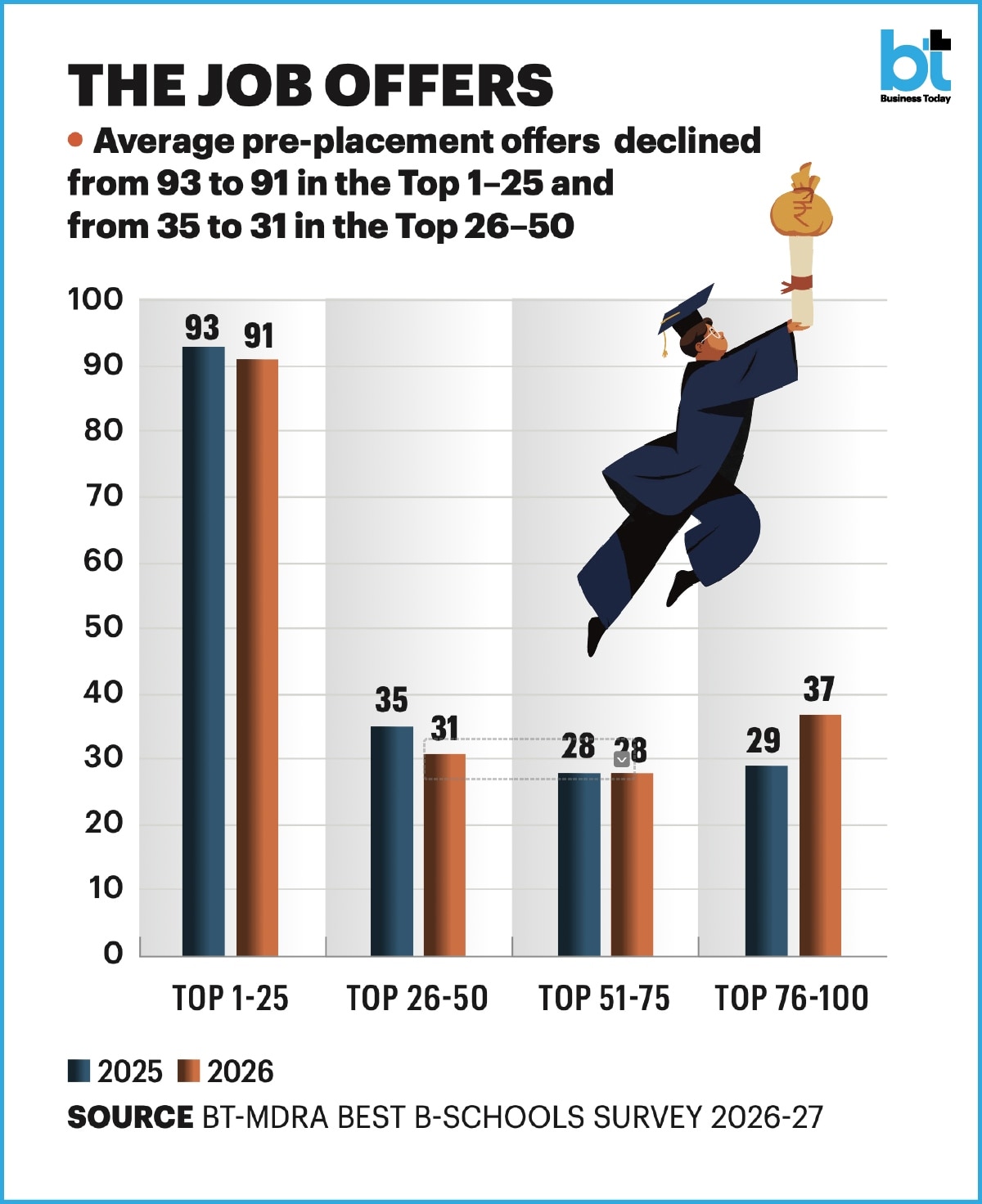
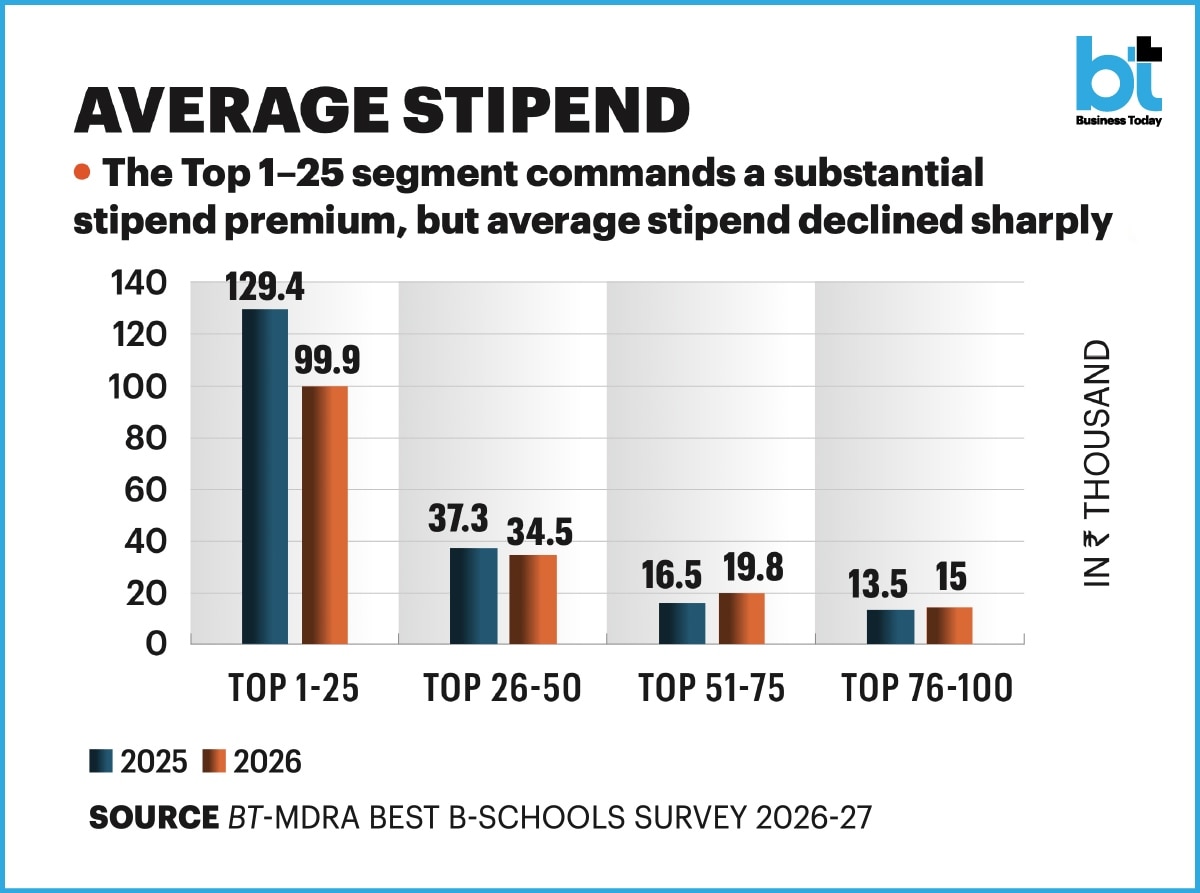
Even the internship market is shifting: average stipends at the Top 1–25 schools fell about 23%, while they rose 20% at schools ranked 51–75 and 11% at those ranked 76–100. PPOs, too, saw a decline, averaging 91 in the Top 1–25, down from 93 in 2025. In the Top 26–50, average PPOs fell from 35 to 31 over the same period.
What is emerging is a more fluid and selective MBA hiring market. Recruiters are widening the campuses they source from, and at the same time becoming more exacting about the roles they need and the candidates they want.
The premium is increasingly going to students who can demonstrate that they can solve a real problem—not simply those with the right degree or a prestigious campus on their CV. Companies, too, are becoming more selective about who they hire, what roles they hire for, and which skills they are willing to pay for.
The result is a placement market that is starting to assess candidates much before the formal placement season begins (through internships and live projects)—with domain expertise, AI readiness, and demonstrable impact increasingly determining who gets hired and at what price.
About 30–60% of MDI Gurgaon’s hiring across domains would be through the PPO route, according to Rohit Sindhwani, Assistant Professor, Chairperson - Student Affairs and Faculty in-Charge - GP Placements, who adds that the hiring mix is moving away from some core IT consulting roles towards domain-led positions in strategy consulting, global capability centres, supply chain, banking and finance, and sales and marketing.
Debashis Chatterjee, Director of IIM Kozhikode, says internships have become “one of the most effective pathways to full-time hiring” because they give organisations an extended, real-world view of a candidate, including cultural fit and the ability to work within teams.
Saravanan Balasundaram, Founder & Group CEO of Bengaluru-based technology and talent consulting firm Han Digital Group, estimates internship-to-PPO conversion at 70–80%, with companies increasingly using internships as an extended assessment of live project delivery, client exposure, problem-solving, and cross-functional collaboration.
“Employers are increasingly reluctant to make a two-year bet on a CV and a few interview rounds. They want to see candidates work before committing to them,” says Balasundaram.
Notably, some sectors continue to recruit during final placements, while others such as FMCG companies, parts of BFSI, and niche finance firms often prefer to see student interns in action before a hiring call, says Mandar Desai, Head of Professional Development & Placement at K J Somaiya Institute of Management in Mumbai.
According to Desai, the school has seen companies such as Goldman Sachs offer PPOs to students, with 100% conversion in the cases cited.
As companies become more selective, this is also creating a feedback loop: leading schools continue to attract the deepest recruiter relationships and the strongest candidates, while lower-tier institutions face greater pressure to differentiate themselves through specific capabilities, local industry links or specialised programmes.
That selectivity is also reshaping the campus market. More recruiters are coming, but they are not necessarily hiring more.
More is less
S. Pasupathi, Chief Operating Officer at HirePro, an AI-powered recruitment and talent acquisition platform, says the number of companies visiting campuses has risen by an indicative 8–10%, but the number of offers is not increasing.
As companies get more selective in signing up candidates, it is also pushing up pay for those seen as particularly valuable. MDI Gurgaon says companies were willing to pay a premium for students they were keen to hire.
To be sure, PPO numbers alone are an imperfect measure of recruiter appetite. A decline in PPOs does not necessarily mean weaker recruiter appetite. If companies are increasing internship hiring while becoming more selective about conversion, the final PPO number may reflect a tighter funnel rather than weaker demand.
Han Digital Group’s data adds another layer to the picture. Its analysis shows the recruiter base across B-schools has increased by up to 15% from last year, with some premium institutions seeing their recruiter base nearly double. Yet greater recruiter participation is not translating uniformly into either higher placements or compensation.
According to Pasupathi, average salaries at premier institutes are in the Rs 22–28 lakh range, compared with roughly Rs 4–8 lakh at lower-tier colleges. Internship stipends can differ by two to three times.
Placement rates at Tier-I and Tier-II B-schools remain in the 85–95% range, according to Han Digital, but average packages at Tier-II institutes are down by roughly 10–15%. The difference is increasingly about the kind of roles being recruited for.
At Tier I institutes, consulting and strategy continue to dominate, with consulting accounting for roughly 40–45% of placements at IIMs, while BFSI and fintech typically account for another 20–30%. At Tier II schools, the mix is broader, with sales and marketing, analytics, HR operations, supply chain, finance and technology consulting emerging as important hiring functions.
Recruiters are also widening their sourcing pools. Tier II institutes are increasingly being tapped for functional roles as companies look beyond traditional Tier I campuses, driven not only by cost but also by retention and cultural fit.
The premium for being at the top
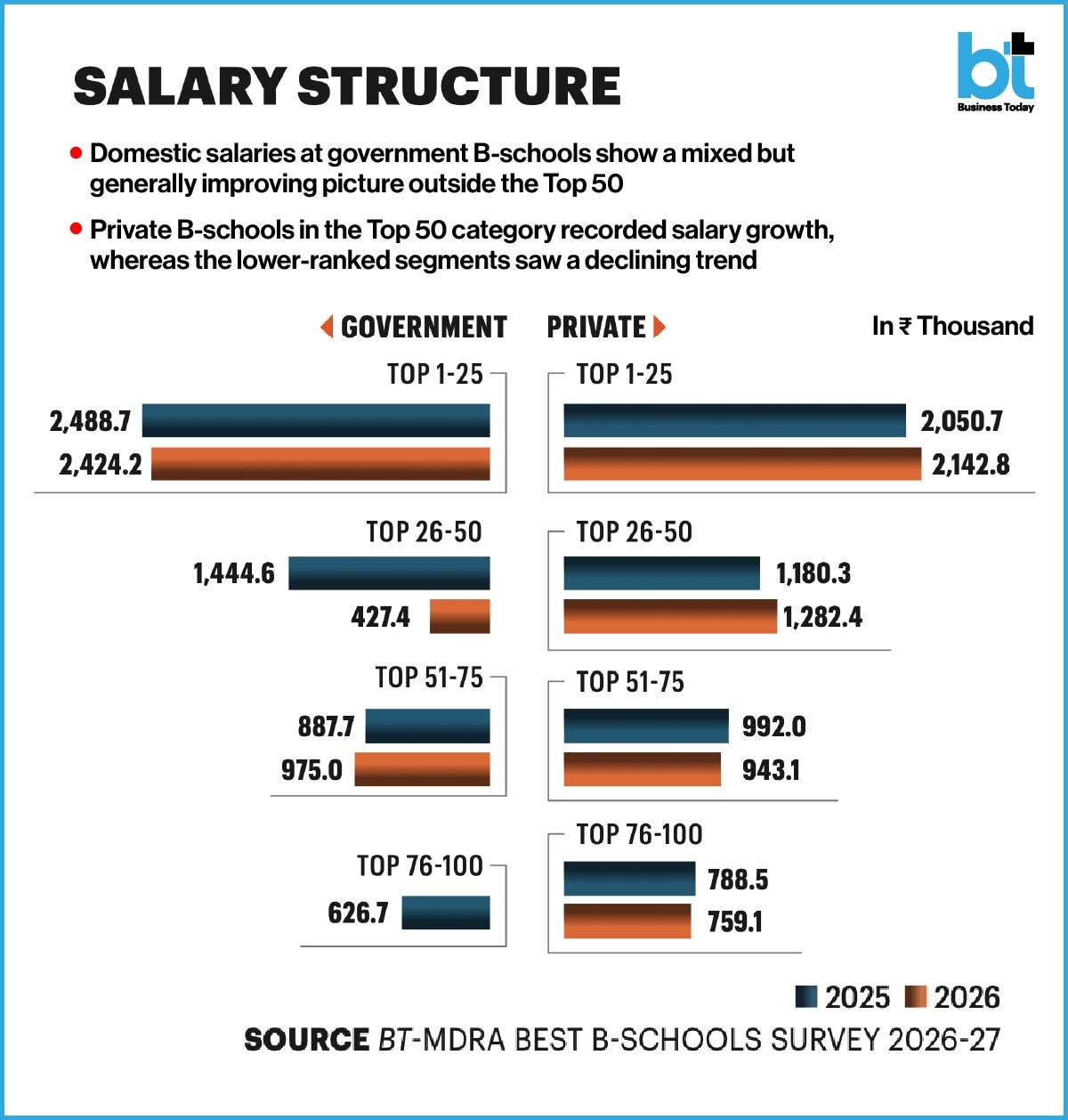
The BT-MDRA survey shows just how sharply the salary gap between the best B-schools and the rest has widened. Average domestic salaries at the Top 10 schools have nearly doubled since 2015, reaching Rs 29.9 lakh this year. Across the Top 100, however, the average rose 67% to Rs 13.26 lakh.
The divergence becomes starker lower down the rankings: while salaries at the Top 10 have risen strongly over the past decade, growth has been much slower among schools in the lower-ranked bands, with the 76–100 group seeing a decline of 5.6% to Rs 7.26 lakh this year.
Government schools, including the IIMs, commanded higher salaries, with an average at Rs 20.3 lakh in 2026, compared to Rs 11.5 lakh for private colleges.
The variation is also visible within individual campuses and for internships. At K J Somaiya, for instance, the 2024–26 final placements attracted a highest package at Rs 29.3 lakh, with the median at Rs 12 lakh. In the 2025–27 summer internship cycle at the same institute, the highest stipend was Rs 3 lakh compared to an average Rs 94,220 for the top 30%.
Proof is the new currency
At K J Somaiya, while recruiters are looking for students who know how to use AI effectively, the bigger shift is towards demonstrable skills. Placement Chairperson Anjali Chopra says simply describing oneself as “AI-enabled” on a CV is no longer enough.
Recruiters want to know whether a student has built a prototype, created a workflow that improved efficiency, used AI during an internship, measured its impact, or completed a project using the technology.
IIM Kozhikode’s Chatterjee says prior work experience, performance during internships and live projects, and functional depth in areas such as finance, consulting and analytics offer evidence that a candidate can hit the ground running after joining a company.
At MDI Gurgaon, students are increasingly assessed through group activities, case evaluations and leadership exercises, while soft skills carry particular weight in client-facing roles. Prior work experience and domain exposure can provide an edge, but freshers still bring qualities such as innovation and out-of-the-box thinking that employers value.
B-schools are responding to the new environment by broadening what counts as employability. MDI Gurgaon says its curriculum has been overhauled to reflect the changing workplace, including programmes in business analytics and banking and finance, alongside live projects, guest sessions and student-driven activities.
And K J Somaiya has an initiative that evaluates students beyond CGPA, including case competitions, extracurricular activities, sports and other forms of engagement.
AI is accelerating this shift. Companies are evaluating which repetitive tasks can be automated, making them more selective about the entry-level roles they create.
According to Chatterjee, organisations are shaping roles around digital transformation, analytics and AI adoption, and looking for managers who can combine business judgement with a working understanding of data and technology.
Han Digital identifies demand across risk management, finance and audit, technology strategy, go-to-market strategy, sales and revenue generation, people analytics, GCC strategy and operations optimisation.
At K J Somaiya, BFSI remains one of the strongest recruiters, but even here roles are becoming more technology led. Product management and business analysis roles are emerging as financial institutions try to bridge traditional banking and fintech.
At the entry level, Chatterjee says AI is redefining roles around judgement, problem framing, stakeholder management and the ability to act on insights as routine analysis and reporting become increasingly automated.
The MBA is not disappearing in the AI era. But the graduate who can connect technology to a business outcome has an advantage over one whose strongest credential is simply completing a management programme.
Puneet Kumra, Vice President, Talent Acquisition–India, Capgemini, describes the market as a “selective recovery”, with greater scrutiny around capability, timing and long-term relevance.
The improvement in placements, he says, should not be mistaken for a return to the hiring environment of a few years ago. “Companies are hiring where they have a clear business need and are concentrating on institutions and talent pools where they see stronger alignment with those needs.”
The employer now has to sell too
As Gen Z enters the workforce, campus recruitment is becoming a two-way pitch. Companies are not only selecting candidates; they are also having to persuade them that the organisation, role and workplace are worth choosing.
K J Somaiya's Chopra says some progressive organisations are moving away from assumptions about Gen Z and instead adapting how they engage with the generation. Recruiters are spending entire days on campus, holding conclaves and explaining their organisations, sectors, roles and workplace culture.
For B-schools, the challenge is shifting from placement outcomes to employability itself: building students who are ready to create value before the final placement process even begins.
Students who can acquire those capabilities can fetch a premium, even as the rules for earning that premium keeps changing.
















 At the Top 25 B-schools, placements fell from 97.5% in 2025 to 96.4% in 2026. But at schools ranked 51–75, the placement rate jumped from 87.4% to 93.8%
 Govt asks Adani Airports to delay shifting international flights from Mumbai to Navi Mumbai
 GST Council set to unveil next-gen reforms: 17-day refunds, simpler registrations, easier input tax credit
 GST Council likely to consider institutional reforms for officers’ committees. Read about the changes
 108 years later, Mahindra team rebuilds piston engine patented by Anand Mahindra's grandfather
 Cabinet clears ₹10,000 crore SME fund to help Indian companies scale, compete globally. How it'll work
 Flyadeal Expands In India Enters Mumbai After Hyderabad
 Market Bounces Back After 8 Weeks Of Fall: Is The Worst Over For Investors?
 Airlines Seek Fuel Tax Relief As High Crude Prices Push Up Flight Costs
 Nifty’s Next Move: Recovery Ahead Or More Pain? Piyush Pandey On Dalal Street
 Jio IPO Valuation Cut To ₹11 Lakh Crore Ahead Of Mega Listing
 Sebi tells SAT that Jane Street has enough data to respond to market manipulation charges
 Sensex, Nifty close higher ahead of RBI monetary policy outcome; capital goods, banks, pharma stocks lead gains
  TCS dividend 2026 record date, dividend history, Q2 results preview, what to watch
 HG Infra shares gain 5% as Karnataka tax authority drops Rs 94-crore tax demand
  IPO valuations, stock market correction, Q2 earnings: Anand Rathi's Samir Bahl on what investors should watch
 Maharashtra’s water crisis puts India’s economic powerhouse under pressure
 Navratri 2026: Free entry at United Way Garba, Atul Purohit to perform as Vadodara eyes Guinness World Record
 Vietnam’s LNG gamble hits a roadblock as 22.5 GW power plan stalls
 Financial Horoscope Today, October 7, 2026: Taurus Signs Must Control Financial Behaviour, Know the Status of All Signs
 Russian gold finds new route to China through Hong Kong as Western sanctions reshape trade