The visit also brings into focus the role of Reliance's Jamnagar complex, one of the world's largest refining hubs, at a time when the United States is seeking greater energy cooperation with India. Reports have also pointed to US interest in Reliance processing more Venezuelan crude and exploring potential oil production opportunities in Venezuela, although the precise commercial arrangements and any proposed commitments need to be established independently.
The broader context is captured in Morgan Stanley research titled The Oil Bottleneck Has Shifted Downstream, which argues that refining capacity and the balance between crude and petroleum-product trade are increasingly determining countries' exposure to energy-market disruptions.
Why is the global oil bottleneck shifting downstream?
The oil supply chain has two distinct stages: producing crude oil and converting it into usable fuels.
Crude oil must be processed in refineries to produce diesel, petrol, aviation fuel, liquefied petroleum gas and other petroleum products. Different crude grades also require different processing capabilities, making refinery configuration an important factor in determining which facilities can efficiently handle particular supplies.
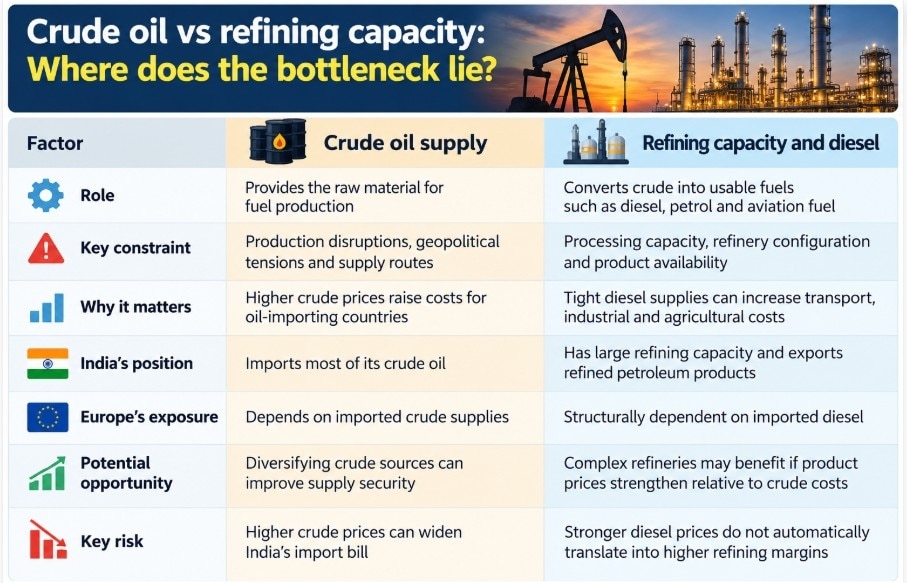
Consequently, an increase in crude production does not automatically translate into an adequate supply of every refined fuel. If refining capacity is constrained, or if the available facilities cannot efficiently process the crude on offer, supplies of particular products can remain tight even when crude is available.
Diesel is particularly important because it powers freight transport, agricultural machinery, construction equipment and industrial activity. A shortage can therefore affect transportation costs, supply chains and the broader economy.
Morgan Stanley's analysis examines countries' net crude and refined-product exports relative to domestic demand, alongside diesel consumption and trade dependence. Its central implication is that energy vulnerability cannot be assessed solely by looking at how much crude a country produces or imports. Refining capacity and the ability to supply the right products matter as well.
MUST READ: Marco Rubio arrives in Jamnagar to visit Reliance refinery as India-US trade deal moves closer to final agreement
Why does Jamnagar matter to the US?
Reliance Industries' Jamnagar refinery complex is a major component of India's petroleum-processing infrastructure. Its scale and complex processing capabilities allow it to handle a range of crude grades and produce fuels for domestic and international markets.
This matters when global crude flows change. A refinery capable of processing different grades of crude can potentially provide buyers and suppliers with greater flexibility, depending on feedstock availability, economics and operating constraints.
Venezuelan crude is generally heavy and relatively difficult to process compared with lighter grades. Refineries equipped to handle heavier crude can be commercially relevant when supplies of such oil become available, although suitability depends on the specific crude blend and the refinery's configuration.
Reliance also has a history of involvement in the international crude trade, including purchases of Venezuelan oil when permitted under applicable US sanctions and licensing arrangements. Any renewed expansion of this trade would depend on the prevailing regulatory framework, commercial terms and the company's own decisions.
Rubio's visit is therefore significant in the context of broader energy diplomacy. However, the visit itself should not be taken as confirmation of a new crude-processing agreement or an arrangement for Reliance to invest in Venezuelan oil production.
Don't Miss: ‘China is no longer a reliable business…’: Expert on Beijing’s export controls on tunnel-boring machines and why it matters to India
Why is diesel the critical link?
Diesel connects the global oil market to the real economy more directly than crude prices alone might suggest.
When diesel supplies tighten, prices can rise even if crude production remains relatively stable. Transport operators, manufacturers and farmers then face higher operating costs, which can feed into the prices of goods and services.
Morgan Stanley's research highlights differences in countries' exposure to diesel trade. Europe remains structurally dependent on imported diesel, while countries with substantial refining and export capacity can play a different role in supplying the market.
The Netherlands, for instance, combines crude imports with exports of refined petroleum products, illustrating how a country can be dependent on imported raw materials yet remain an important exporter of processed fuels.
India presents a similar distinction. It imports most of the crude oil it consumes but also exports refined petroleum products, including diesel. This gives its refining industry an international role that is not apparent from crude-import dependence alone.
However, India's ability to export fuels does not insulate its economy from a global oil shock. Higher crude prices can increase the import bill, put pressure on the current account and raise domestic inflation risks. The overall impact depends on crude costs, product prices, domestic fuel pricing and refining margins.
Must Read: 'All our embassy does is...': Marco Rubio jokes as he attends 2nd US Independence Day celebration in 5 month
Could Reliance benefit from the shift?
The changing market dynamics could create opportunities for complex refiners such as Reliance, but the outcome is not automatic.
Refining margins depend on the difference between the value of petroleum products produced and the cost of crude and other inputs, adjusted for operating expenses and other factors. If diesel prices rise faster than crude costs, refiners may benefit from stronger diesel margins. If crude costs increase more rapidly than product prices, profitability can instead come under pressure.
Access to competitively priced crude, including suitable heavy grades where legally available, can also influence refining economics. But discounts on crude do not necessarily translate into higher profits if processing costs, freight, regulatory constraints or product-market conditions offset the advantage.
Investors therefore need to distinguish between a rise in oil prices and an improvement in refining profitability. The two are not interchangeable.
For Reliance, the relevant indicators include refining margins, crude sourcing costs, product demand, export economics and the utilisation of its refining facilities. Any potential Venezuelan crude opportunity would need to be assessed against these factors rather than assumed to be immediately beneficial.
What does this mean for India's energy security?
India's refining capacity offers a strategic advantage by allowing the country to convert imported crude into fuels for domestic consumption and export markets. It also gives Indian refiners a role in global supply chains when trade flows are disrupted.
But refining strength does not eliminate the risks associated with dependence on imported crude. A sustained increase in international oil prices can still raise India's energy costs, affect inflation and complicate macroeconomic management.
The policy challenge is therefore twofold: securing reliable and diversified crude supplies while strengthening the ability to process them efficiently and ensuring adequate domestic fuel availability.
Rubio's Jamnagar visit underscores the growing intersection of energy, trade and geopolitics in India-US relations. The Morgan Stanley analysis offers a broader lesson: in an increasingly disrupted oil market, producing crude is only one source of strategic leverage. The capacity to turn it into the fuels the world needs may be just as important.
ALSO READ: Rubio meets Gautam Adani, N Chandrasekaran before visiting Reliance's Jamnagar
















 US Secretary of State Marco Rubio arrived in Jamnagar, Gujarat, on Wednesday to visit Reliance Industries' refinery complex.

 Sensex tanks 1,300 pts from day's high; India VIX surges 8%
 Two HDFC Bank senior executives leaked confidential business information, finds probe
 Jio Platforms IPO becomes fastest subscribed mega-IPO, QIBs lead demand; brokerages remain bullish
 Marco Rubio arrives in Jamnagar to visit Reliance refinery as India-US trade deal moves closer to final agreement
 RIL Shareholders Alert! Want to apply in Jio IPO? How can you maximise your allotment chances
 Market Commentary | Stock Market Strategy | Amit Goel On Market Opportunities
 Home Loan Tax Benefits: Is Buying A House Still A Tax-Saving Strategy?
 What’s Hot: Stocks, Gold & Big Money Moves | Daily Markets Show | October 21 | Business Today
 Redmi Note 17 Pro Max Review: Big Battery, Big Bucks!
 Daily Calls: Ask Your STOCK MARKET TODAY QUERIES | Market Update | Share Market News Today

 Eternal Q2 earnings: Net profit rises 92%, revenue at Rs 24,138 crore
 Adani Green Energy Q2 results: Net profit rises 15% to Rs Rs 673 crore; stock reacts
 YES Bank shares: 57 lakh investors hit as AT-1 verdict raises RoA doubts; target prices
 BT Explainer | Jio IPO — Everything you need to know! A complete guide
 Jio Platforms IPO: Shareholder, employee portions fully subscribed; QIB quota sees 6.7x bids
 80 kg of gold, 12 elephants and a 21-gun salute: Mysuru Dasara's grand finale is a royal spectacle
 Planning to study in Canada? Indian applicants now face a 7-week study permit wait - check details
 Google Gemini in Android Auto can now use your Gmail and Photos to answer personal queries


