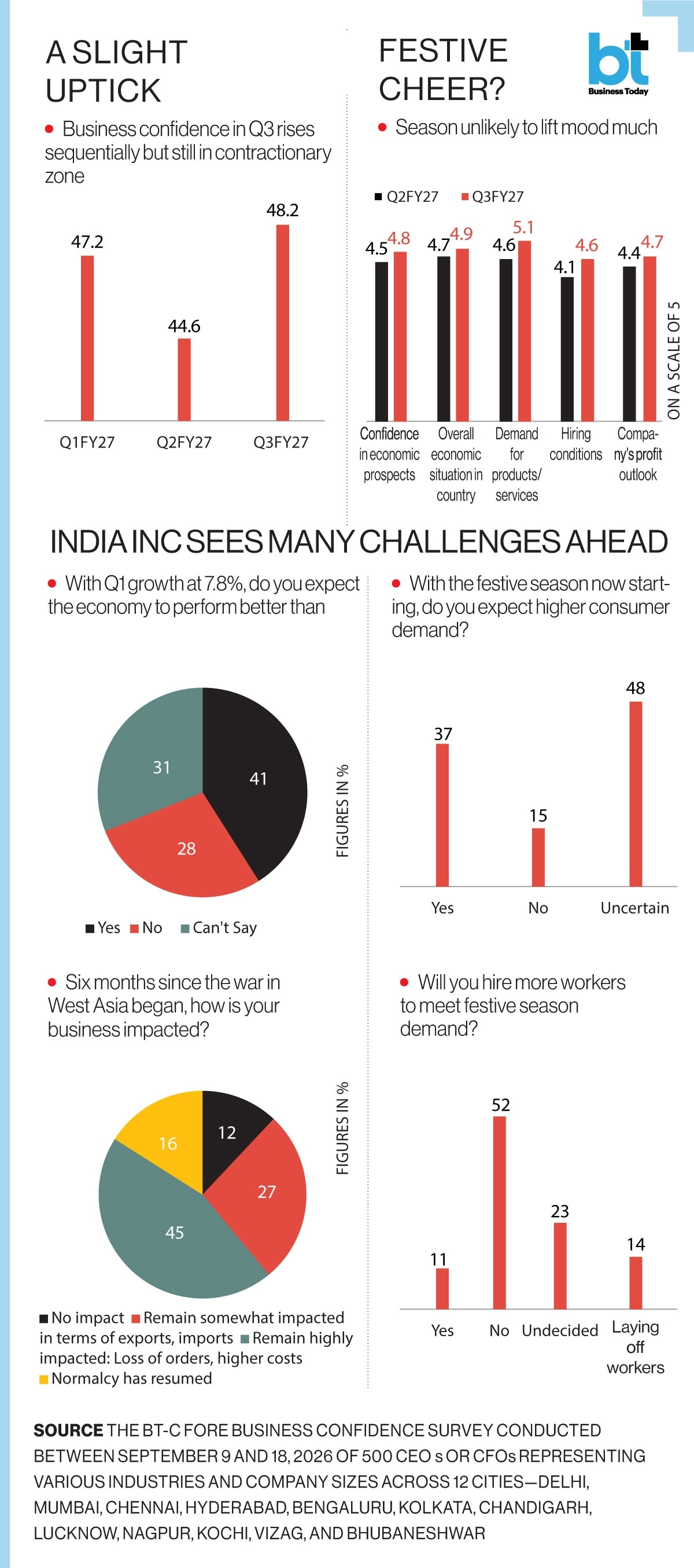
Companies are wary about the renewed conflict in West Asia, with crude oil prices trading above $100 a barrel, while deficient rains have raised concerns about rural incomes and inflation. A fresh risk has also emerged from the possibility of 100% US tariffs on countries buying Russian crude, including India.
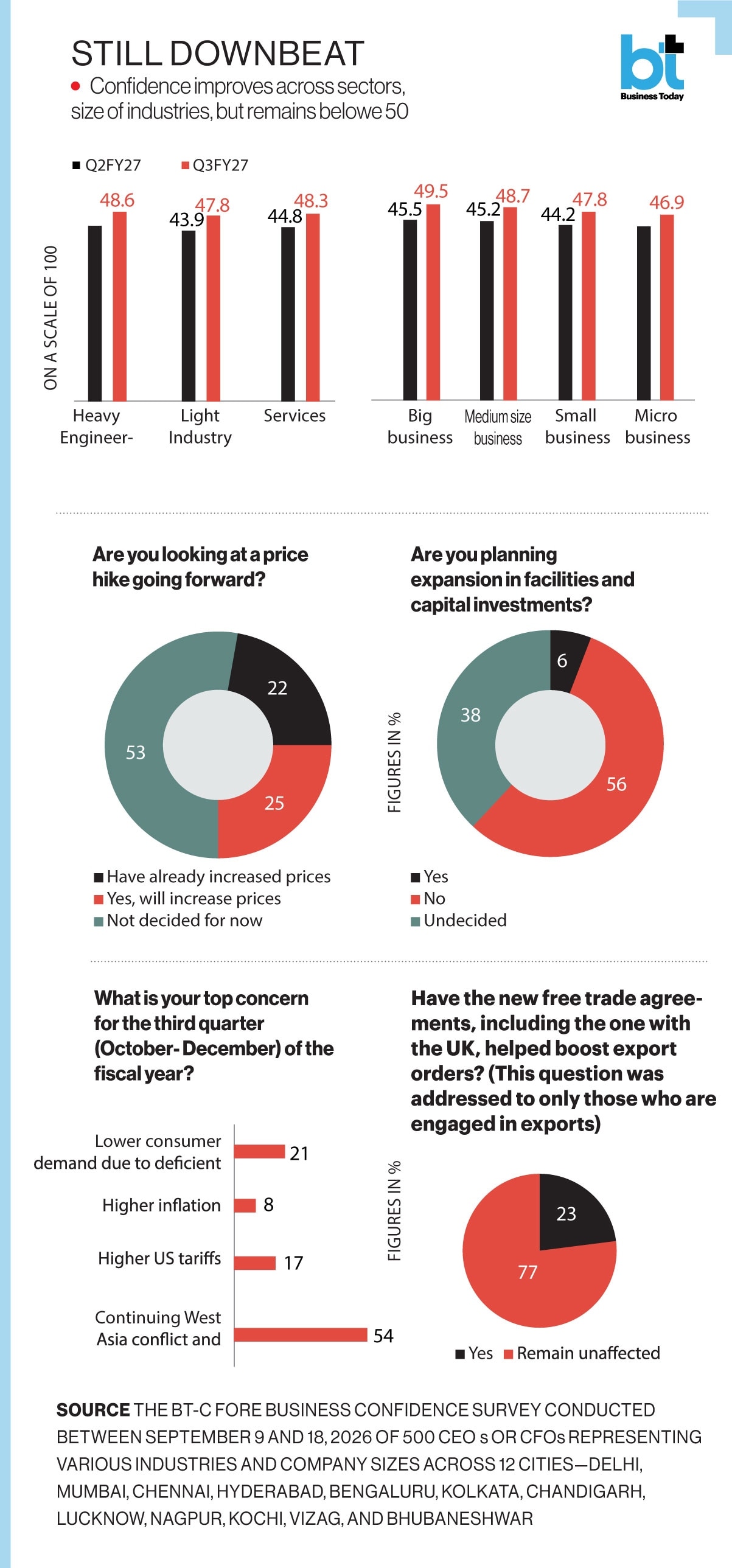
The caution is evident in what companies plan to do. Only 11% of the 500 chief executive officers and chief financial officers surveyed plan to hire more workers for the festive season, while 14% say they are laying off workers and 52% have no plans to hire. On the investment front, just 6% plan to expand facilities or increase capital investments.
There is also pressure on prices. While 22% of companies surveyed have already increased prices, another 25% plan to do so. The rest remain undecided, suggesting that companies are still assessing how much of the rising cost burden they can pass on to customers.
The survey was conducted between September 9 and 18, as the festive season was getting under way with Ganesh Chaturthi. That makes the subdued confidence notable: experts say the third quarter typically brings greater optimism as companies anticipate higher sales and profitability.
Oil squeeze
Even as the West Asia conflict’s fresh escalation led to a surge in global crude oil prices—Brent touched a high of $109.97 per barrel on September 11 and remained largely above $100 per barrel— the average price of the Indian crude oil basket also shot up as supply constraints and higher transport costs impacted prices. The Indian basket, which had averaged $82.04 a barrel in July—the lowest this fiscal—averaged $116.09 in September, an increase of 41.5%. It had risen further to $117.58 per barrel by October 6.
“It takes about 45-60 days in terms of shipping time, leading to higher transportation costs. It has been difficult to find tankers and 94% of oil imports are through foreign vessels. Insurance costs have also risen, all of which have added to the higher price of India’s crude oil basket,” says energy expert Narendra Taneja, while noting that India has diversified crude oil imports beyond the Gulf countries.
The impact is visible in the BCI survey: 54% of businesses identified the West Asia war as their top concern going into the third quarter, and nearly two thirds remained impacted by it to varying degrees. While 27% said they remain somewhat impacted by the conflict in terms of exports and imports, 45% reported being highly impacted with loss of orders and higher costs.
Growth outlook
Despite the caution, businesses remain relatively optimistic about economic growth this fiscal year, with 41% of those surveyed saying that the economy will do better than anticipated in FY27 following the 7.8% GDP growth in the first quarter.
Agencies like the World Bank, Asian Development Bank, and the OECD have scaled up their growth forecasts for India for FY27 to 7% and even higher in recent weeks, but it remains below the 7.8% real GDP growth in FY26.
Madan Sabnavis, Chief Economist at Bank of Baroda, also expects the economy to grow by 7-7.2% this fiscal and underlines that the economy is much bigger in size compared to a decade ago and better placed to absorb shocks. However, while Q1 and Q2 growth are seen to be on the higher side partly due to the base effect, he says growth may slow down in Q3FY27.
According to Sabnavis, the third quarter is a critical time as it is marked by several festivals and is also the post-harvest time that determines rural income and consumption. “With large parts of the country registering poor rains, there is apprehension about crops and income that will impact rural spending,” he says.
Reserve Bank of India Governor Sanjay Malhotra, in his monetary policy statement on October 7, also underlined the resilient private consumption and strong investment activity but said global economic uncertainty and strong El Nino conditions pose concerns. However, the MPC upped the growth forecast to 7.1% in FY27 from its earlier forecast of 6.7%.
Demand uncertain
Consumer demand is also keeping some businesses wary. While 37% said they expect higher demand, 21% identified lower consumer demand due to deficient rains as their chief concern for the third quarter.
Free trade agreements, meanwhile, appear to have had a limited impact on exporters’ sales. Among businesses engaged in exports, only 23% said the trade deals have helped boost their sales.
Inflation, meanwhile, could add to the pressure on consumption demand. Retail inflation has been on the upward curve in recent months, rising to a 20-month high of 4.82% in August from 2.74% in January.
Malhotra also noted that it is clear that inflation and its outlook are not benign as they were last year. The RBI has pegged retail inflation at 5.2% for FY27 and the MPC unanimously chose to hike the repo rate by 25 bps.
Sabnavis says there is expectation of higher inflation from deficient rains, which could impact discretionary spending. If oil prices continue to remain above $100 per barrel, the government could consider increasing retail prices, but it is unlikely to do so immediately.
Taneja believes any such decision may be taken only after mid-November. “There is talk of another US-Iran ceasefire, which will help to immediately bring down prices in the international markets,” he says, adding that the government would also like to shield customers in the festive season, at least until Diwali.
A sustained easing of tensions in West Asia and greater clarity on rural incomes could determine whether India Inc’s cautious stance gives way to stronger hiring and investment.
















 Indian businesses cautiously optimistic for Q3 FY27; limited hiring expected this festive season
 Crude oil may hit $110, India's import basket could touch $130 in 10 days: SBI Research
 Retail inflation hits 21-month high, set to squeeze your household budget further
 Nifty may fall another 5%? Market expert flags key risks for Dalal Street
 India's retail inflation rises to 5.54% in September; food inflation hits 7.74%
 BT EXCLUSIVE | India not unique in satellite licensing process; compliance rules apply globally, says Eutelsat OneWeb's Neha Idnani
  India's Next Connectivity Leap? Tata Communications Bets On Satcom & Smart Villages
 Motorola's Shivam Ranjan Speaks To Business Today About Motorola's Upcoming Flagship @ IMC26
 Is The AI Boom Sustainable? The Debate Over Investment Returns, India's AI Future And Job Disruption
 India-UK Trade Ties Set for Fresh Push? Goyal Calls for Faster Business Cooperation
 Rahul Gandhi Vs Gyanesh Kumar: 200 Officers Claim Escalates Election Commission Row
 Emerging markets lag US stocks in 2026: What India's equity market and FPI flows reveal
 HCLTech Q2 results: Profit up 21% at Rs 5,132 crore; announces Rs 12 per share dividend
 L&T Technology Services launches AI lab with NVIDIA for digital manufacturing, stock gains
  CG Power shares: Analyst says book profit on rallies and buy on dips
 Dwarka Expressway to Bengaluru–Mysuru: How AI is changing highway management
 Maruti Grand Vitara gets ₹2.65 lakh discount in October 2026: Check specs, features, mileage
 Food inflation hits 7.74%: Why the next inflation spike could hurt household budgets
 Ahead of 100th birthday, Kerala HC designates veteran lawyer P B Menon as senior advocate
 Can adding gold and debt to equities boost long-term returns while reducing portfolio drawdowns?