












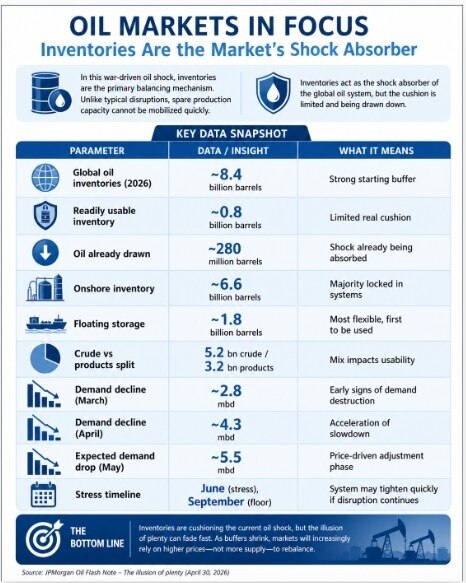



 The key risk is not that the world runs out of oil, but that it runs low on working inventories — the oil needed to keep supply chains functioning smoothly.
The global oil market appears stable — but the source of that stability has shifted. Instead of fresh supply, it is inventories that are quietly absorbing the shock.
“In this war-driven oil shock, inventories have become the market’s primary balancing mechanism. Unlike a typical disruption where spare production capacity can be mobilized quickly, the location of the shock and the scale of current supply losses mean the immediate adjustment has to come from barrels already in storage. Put simply, inventories are acting as the shock absorber of the global oil system. The crisis began with stocks in relatively strong shape. Global inventories surged in 2020 and 2021 during the COVID demand collapse, then drew sharply through 2022 and 2023 as economies reopened, Russia invaded Ukraine, and markets tightened. That tightening phase reversed in 2024 and 2025, when supply once again outpaced demand, allowing stocks to rebuild.”

 'Private sector must invest, must hire and compensate fairly': CEA Nageswaran asks India Inc to step up
 UPI MDR of 0.4% on transactions above ₹2,000 from October 15: What you need to know
 Apple under pressure in India over iOS 18 screen damage and warranty claims: All details
 India exports 500 tonnes of hilsa to Bangladesh as fish trade flow reverses
 'Sher aaya, sher aaya': Ex-HCL CEO says AI doomsday warnings are hype, won't kill humans
 Crude Oil Price Surge: Will Petrol And Diesel Prices Rise In India?
 Market Commentary: Sharad Avasthi On Nifty, Stocks & The Next Big Move
 RBI Files Caveat In Bombay HC Ahead Of Tata Sons Appeal | Tata Group Stocks | Tata Chemical Shares
 NSE IPO Explained: Price Band, Valuation, Growth Potential And Key Risks
 Stock Market Falls As Crude Oil Nears $110 & Weak Rupee | Stock Market News
 UPI MDR revision from Oct 15: Mutual funds, securities, stockbrokers to attract 0.02% charge; check details
 CDSL shares slip 4%; brokerage upgrades stock to 'Buy': Check revised target
 Paytm, One Mobikwik shares: How UPI fee fears may affect sentiment in fintech players
  Sensex tumbles 778 points; Nifty briefly slips below 22,900 amid CAS volatility; what's ahead?
 Hindustan Copper, Garware Hi-Tech Films, Vijaya Diagnostic Centre among stocks to turn ex-dividend on September 16
 'This is not how successful industrial policy is run': ISB professor on new UPI charges
 Paying for fuel via UPI? Here's how much you'll be charged at petrol pumps
 Are you paying electricity, water or piped gas bills through UPI? Check charges above ₹2,000UPI MDR revision from Oct 15: Mutual funds, securities, stockbrokers to attract 0.02% charge; check details
 Jio users can get Canva Premium free for 12 months: Check plans, eligibility and how to claim


