Over 40,000 jobs lost as AI restructuring intensifies
The month opened with a jolt. Oracle laid off more than 30,000 employees globally, including over 12,000 in India, setting off a wave of anxiety across the tech workforce.
Social media platforms like LinkedIn, Reddit and X (formerly Twitter) were quickly flooded with accounts from affected employees. Many described abrupt exits and little communication. One widely shared post described a 30-week pregnant employee being laid off with “No call. No meeting. No manager. No warning.” Read here.
The layoffs did not stop there. Companies including Meta, Snap and Walt Disney also cut jobs through April, taking total layoffs in the tech sector to more than 40,000.
While companies have not attributed cuts to AI, the broader trend is clear. Firms are restructuring to prioritise automation, reduce costs and redirect capital toward AI infrastructure and development. The result is a growing disconnect between rising tech investments and shrinking workforce stability.
From layoffs to fears over powerful AI systems
As concerns over jobs grew, attention quickly shifted to another AI-driven risk. Cybersecurity.
Anthropic drew global attention with a preview of Claude Mythos, a cybersecurity-focused AI model that can detect zero-day vulnerabilities across critical systems. But instead of broad access, the company opted for a tightly controlled rollout.
The restricted release raised questions about the model’s potential power and risks. Governments in the US, UK, Canada and India initiated discussions with cybersecurity experts and financial institutions to assess safeguards and possible misuse.
Must read: BT explainer: Inside Claude Mythos, the AI is forcing a rethink of global cybersecurity
Currently deployed under Project Glasswing, Mythos is accessible to a limited group of companies, including Apple, Amazon, and Microsoft. Wider access is expected only after further evaluation, reflecting a growing trend of “controlled deployment” for high-risk AI systems.
On April 23, India’s Finance Minister Nirmala Sitharaman held a security meeting with Ashwini Vaishnaw, bank leaders, and stakeholders to discuss the growing concern of AI-driven cybersecurity risks.
Sitharaman, as per ANI inputs, said, “The new challenge, which is coming in the name of Mythos, about which not much is known, not very many people have tested or tried.” She emphasised on the preparedness, saying that “we need something new and something far more versatile to be able to counter the newer threats which are likely to come.”
India's quantum ambitions
Amid global uncertainty, India made a strategic push into next-generation computing. The country launched its first open-access quantum computing test beds in Amaravati, positioning itself in the early stages of the quantum race. Andhra Pradesh Chief Minister N. Chandrababu Naidu called it a “historic moment” for the state and the country. Read here
The test beds, developed by QBit Force at SRM University in Amaravati and Medha Towers in Gannavaram, are designed as experimental environments where researchers and companies can test and refine quantum hardware. Read more here.
The initiative aims to build a domestic ecosystem for quantum technologies, allowing controlled experimentation before large-scale commercial deployment.
Apple leadership reset signals next phase of AI race
April also marked a turning point for one of the world’s most valuable companies. Tim Cook announced he will step down as CEO of Apple on September 1, 2026, ending a 15-year tenure that saw the company grow into a nearly $4 trillion giant.
Must read: Tim Cook's legacy: Services, chips and wearables that reshaped Apple
He will be succeeded by John Ternus, Apple’s hardware chief, who is expected to bring a more product-focused approach as the company intensifies its push into AI.
Cook will remain as executive chairman, ensuring continuity during the transition. The leadership shift is widely seen as part of Apple’s effort to stay competitive in an AI-driven landscape where product innovation cycles are accelerating.
Also read: Apple's next chapter: From Steve Jobs to Tim Cook, now John Ternus takes charge
Google’s $15 billion India bet
Google laid the foundation for a $15 billion AI data centre hub in Visakhapatnam, marking one of the largest foreign direct investments in India’s history. Union IT Minister Ashwini Vaishnaw said the project could transform the city into “AI-Patnam,” signalling India’s growing role in global AI infrastructure.
Spread across 600 acres, the facility will start with 1 GW capacity and scale up to 5 GW over time. It will also include a subsea cable landing station, strengthening global connectivity and data transfer capabilities.
Andhra Pradesh IT Minister Nara Lokesh described the investment as a milestone moment. “We are rewriting history,” he said, calling it the country’s largest FDI since Independence.
Beyond infrastructure, the project is expected to generate thousands of jobs, offering a counterpoint to the layoffs seen elsewhere in the industry.
In addition, Reliance Industries Ltd (RIL) has reportedly planned to invest over Rs 1.6 lakh crore (over $17 billion) to build a 1.5GW data centre in Vizag. The project is said to span across 935 acres, with 300 acres to be built in the first phase and 635 acres in the second phase. The project is expected to start its commercial operations in October 2028.



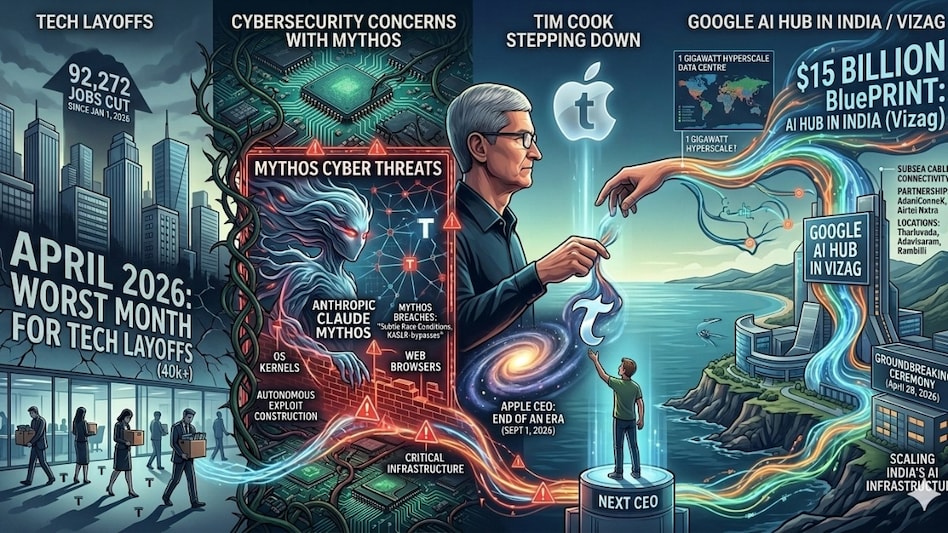 April 2026 tech recap
 'Methodology is very robust': Former statisticians back GDP base year revision
 FCNR deposit bonanza: Economists explain why deft liquidity management will be key
 ‘Painful to hear allegations of data jugglery’: MoSPI secretary Saurabh Garg says every data is verifiable
 ₹1,800 crore Ultravolt bet: Aditya Birla Group enters wires and cables market, targets top two spot in 5 years
 $136 billion forex inflow gives rupee a lift, takes it to two-month high
 Maruti Suzuki Sees Strong Demand Ahead; ‘No Reason Why We Should Not Sustain Volumes’: Partho Banerjee
 Ultravolt: Birla’s New Wires & Cables Bet | Kumar Mangalam Birla Explains The Opportunity
 Why Did India’s GDP Fall From ₹86L Cr To ₹80L Cr? | MoSPI Secy Dr. Saurabh Garg Explains
 India Back To ‘A’ Rating After 38 Years: N K Singh Explains The Big Economic Shift
 Exposing The GDP Controversy: Why Subhash Garg's Math Is Flawed
 Coal India, Finolex Cables, Gulf Oil, Federal-Mogul Goetze among stocks to turn ex-dividend tomorrow, details here
 Fintech smallcase launches US stock, ETF portfolios for Indian investors
 Sensex plunges over 2,100 points in 3 minutes; what happened in final 5 minutes?
 Britannia, Tata Consumer, Marico: What should investors do as commodity inflation rise
 How EV-themed stocks could impact sentiment on Maruti Suzuki counter
  Why are early warning systems failing in the Himalayas despite rising disaster risks?












