








 The US continues to be the largest source of FPI investments in India.

 The US continues to be the largest source of FPI investments in India.
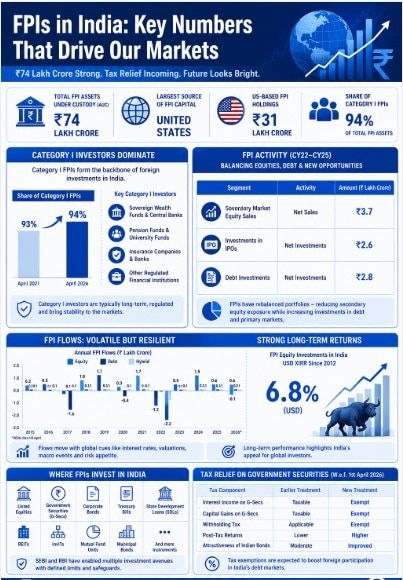
 Foreign Portfolio Investors (FPIs) continue to play a pivotal role in India's financial markets, holding assets worth around ₹74 lakh crore and remaining a key channel through which global capital flows into the country, according to a new report by Edelweiss Mutual Fund. The report also highlights recent tax reforms that could make Indian government securities more attractive to overseas investors.
The study, titled "Decoding FPIs: The Global Capital Behind Indian Markets", notes that foreign investors remain deeply invested across Indian equities, debt instruments and other financial assets despite periodic bouts of market volatility.
One of the most significant developments for foreign investors is the government's decision to exempt capital gains tax, interest income tax and withholding tax on FPI investments in government securities from April 1, 2026. The report says the move is expected to improve post-tax returns and enhance the attractiveness of Indian debt markets.
Largest source of foreign capital
The United States continues to be the largest source of FPI investments in India. Holdings from US-based investors stand at approximately ₹31 lakh crore, substantially ahead of other jurisdictions such as Singapore, Luxembourg, Ireland and Mauritius.
The report points out that the domicile of an FPI does not always reflect the ultimate source of capital, but it remains an important indicator of where investment vehicles are based.
Category I investors dominate
A notable finding is the growing dominance of Category I FPIs, which account for nearly 94% of total foreign portfolio assets in India. These investors include sovereign wealth funds, central banks, pension funds, university endowments, insurance companies, banks and other regulated financial institutions.
Their share has increased from 93% in April 2021 to 94% in April 2026, suggesting that long-term institutional capital continues to form the backbone of foreign participation in Indian markets.
Equity selling offset
The report shows that FPIs have actively rebalanced their portfolios in recent years. Between CY22 and CY25, foreign investors sold around ₹3.7 lakh crore worth of secondary market equities. However, this was partly offset by investments of approximately ₹2.6 lakh crore in initial public offerings (IPOs) and ₹2.8 lakh crore in debt securities.
This trend indicates that while foreign investors have become selective in secondary market stocks, they continue to see opportunities in India's primary market and fixed-income segment.
Volatile flows, strong long-term presence
FPI flows have remained volatile over the years, influenced by factors such as interest rates, valuations, macroeconomic developments and global risk appetite. The report notes that foreign investors frequently shift allocations between equities and debt depending on market conditions.
Despite these fluctuations, FPIs remain deeply embedded in India's capital markets. According to the report's analysis, FPI equity investments have generated an estimated 6.8% annualised dollar-denominated XIRR since 2012, underlining the long-term appeal of Indian equities for global investors.
With India's economy continuing to expand and recent tax incentives improving the investment landscape, the report suggests foreign investors are likely to remain an important source of capital for both the country's equity and debt markets in the years ahead.
 Noel Tata to retire as Trent chairman: A look at the retail empire created by Ratan Tata's half-brother
 Ashish Chauhan, market’s Jackpot Man, takes NSE to the bourses
 ‘They’ll be on the ground’: Trump makes nuclear inspections a red line for Iran deal
 From delivery boy to WhatsApp chief: The inspiring journey of Kunal Shah
 Nine locations, nine red flags: What ED found during its raids on Rajesh Exports
 Why Dinshaw Irani Is Avoiding Largecap Stocks Amid Midcap & Smallcap Rally?
 High NAV Doesn't Mean Lower Returns! Mutual Fund Myth Busted By Expert
 Vijay Vs Udhayanidhi Stalin: Fiery Tamil Nadu Assembly Clash Leaves House In Splits
 12 Indians Killed In Deadly Qatar LNG Plant Explosion | Tragedy At Global Energy Hub
 "Papa, Save Me": The Heartbreaking Stories Behind The Lucknow Coaching Centre Fire
 Knack Packaging IPO opens on July 1; check price band, issue size & other key details
 YES Bank stock nears 52-week high on fundraising plan; fresh share price targets
  Rajesh Exports shares hit 5% lower circuit limit after 41% rally in 7 sessions; here's why
 CSM Technologies IPO opens: Should you subscribe or avoid? Check price band, GMP, reviews
 IRFC share price drops 5% as two-day OFS begins; here's why