

Search
Advertisement
India may need to spend 3% of GDP on climate adaptation, against 0.5% in rich economies: Report

India may need to spend 3% of GDP on climate adaptation, against 0.5% in rich economies: Report

India could need to spend up to 3% of GDP annually on climate adaptation, compared with just 0.5% in wealthier economies, according to McKinsey. With less than 20% of its adaptation needs investment-ready, financing remains a major hurdle.

Business Today Desk
Business Today Desk
  • Updated Nov 4, 2026 2:30 AM IST
India may need to spend 3% of GDP on climate adaptation, against 0.5% in rich economies: Report

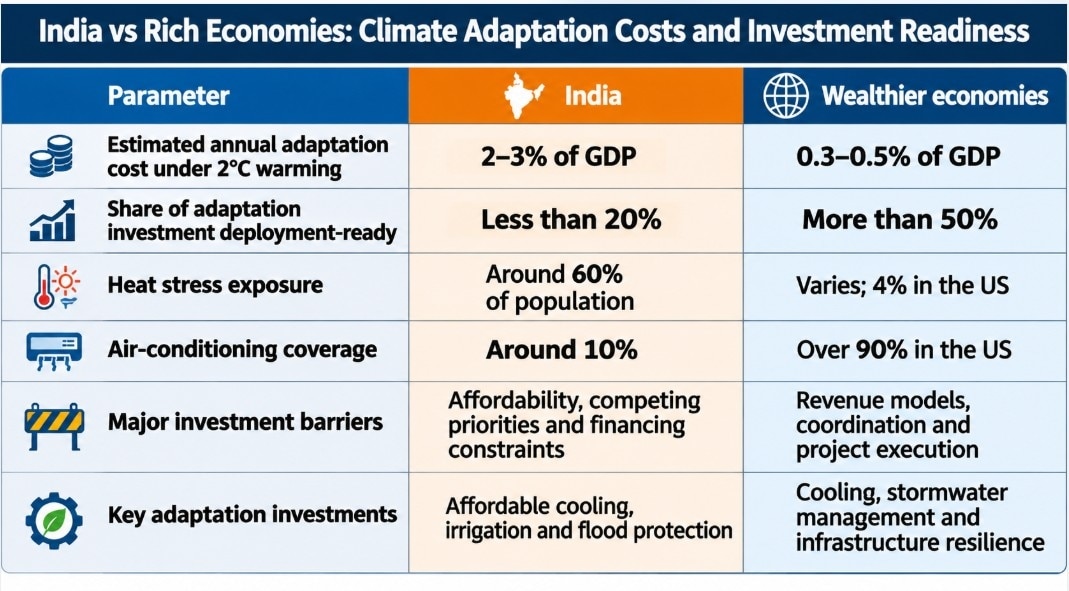
India could face a significantly higher financial burden than developed economies in protecting its population and infrastructure against climate change, with adaptation costs potentially reaching 2–3% of GDP under a 2°C warming scenario, according to a new McKinsey Global Institute (MGI) report. In comparison, wealthier regions such as North America and Europe may need to spend just 0.3–0.5% of GDP.

Advertisement

The November 2026 report, Advancing Adaptation: Breaking Barriers to a Trillion-Dollar Opportunity, highlights how developing economies face greater exposure to extreme weather while having fewer financial resources to invest in protection.

The study examines 20 established adaptation measures addressing heat, drought, flooding and wildfires, including air-conditioning, irrigation, drainage systems and flood defences.

Why does India face a higher adaptation bill?

According to McKinsey, around 60% of India's population already lives in areas experiencing heat stress, yet air-conditioning coverage remains at approximately 10%.

By comparison, only 4% of the US population currently faces heat stress, while air-conditioning coverage exceeds 90%.

This disparity illustrates the scale of India's infrastructure requirements, particularly for affordable cooling, climate-resilient housing and protection for outdoor workers.

Advertisement

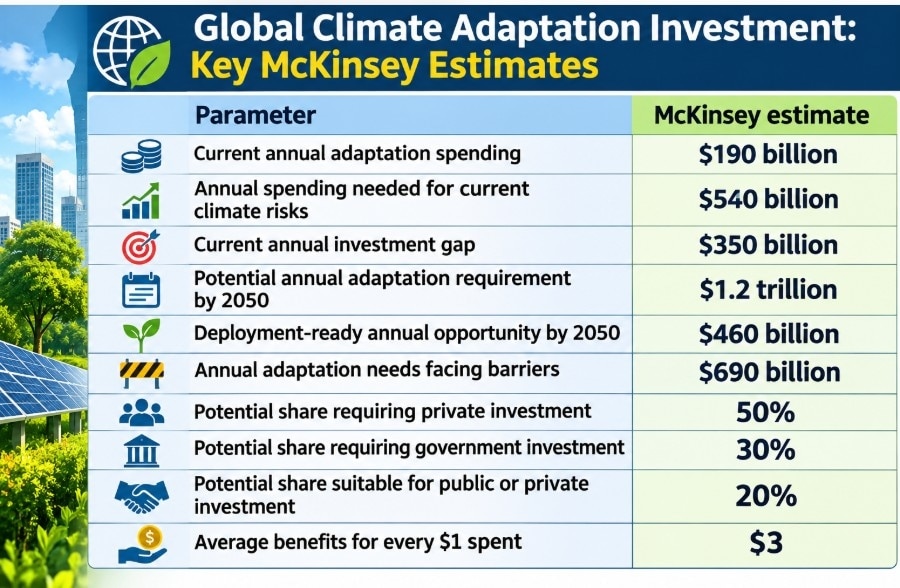
Globally, McKinsey estimates that annual spending required to provide developed-economy protection standards could reach $1.2 trillion by 2050 under a 2°C warming scenario.

Heat stress alone could account for approximately $568 billion, making cooling one of the largest adaptation investment categories.

Why is financing a bigger challenge for India?

The report estimates that less than 20% of India's adaptation investment requirements are deployment-ready, compared with more than half in higher-income regions.

Deployment-ready projects are those with sufficiently clear demand and limited financing barriers to proceed without major interventions.

For India, the remaining investment requirements face obstacles including affordability constraints, competing expenditure priorities and difficulties accessing finance.

McKinsey identifies counterparty risk as a major financing barrier across India, Sub-Saharan Africa and Emerging Asia, affecting measures representing roughly 75% of adaptation costs in these regions.

Advertisement

This makes mobilising capital particularly challenging, even when projects deliver substantial economic and social benefits.

Can private investment bridge the gap?

McKinsey estimates that private companies and households could account for approximately 50% of the world's $1.2 trillion annual adaptation requirement.

Governments could account for another 30%, while the remaining 20% could involve either public or private investment.

However, many climate protection projects do not generate predictable revenues, making them difficult to finance commercially.

The report highlights the importance of innovative financing structures, stronger incentives and measures that reduce implementation costs.

What does this mean for India's economy?

Globally, only $190 billion is currently spent annually on the 20 adaptation measures examined, compared with $540 billion needed to address existing climate risks.

McKinsey estimates that adaptation investments generate benefits worth approximately three times their costs through avoided infrastructure damage, productivity losses and adverse health impacts.

Advertisement

For India, the challenge is therefore not simply identifying economically beneficial projects, but making them affordable and financeable.

Expanding access to low-cost cooling, improving urban drainage and strengthening climate-resilient infrastructure could become increasingly important as the country balances fiscal priorities with rising climate risks.

ABOUT THE AUTHOR

Business Today Desk
Business Today Desk

Business Today brings you the latest news, views and analysis from the world of finance, economy, markets, corporates, startups, tech, and the digital economy. You can find everything from breaking news to deep dives to immersive essays and more on a variety of subjects across all formats - online, magazine, television, data visualisation, et al.

Published on: Nov 4, 2026 2:30 AM IST