


 India’s retail inflation rose to 5.54% in September 2026, while food inflation climbed to 7.74%.
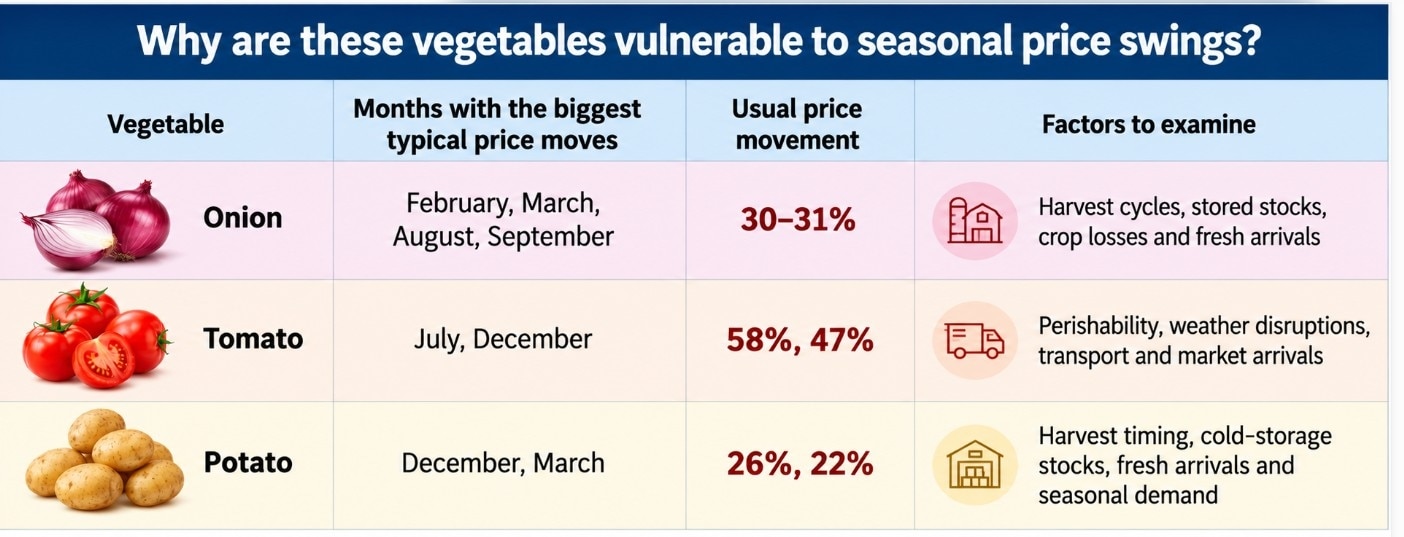
Onion prices typically see their sharpest seasonal increases in February-March and August-September, while tomatoes are most vulnerable to price swings in July and potatoes in December, according to historical wholesale price patterns highlighted by Zerodha Markets. These seasonal movements offer clues to when household budgets may face pressure, particularly as food inflation rises and concerns over India’s monsoon and reservoir levels raise questions about agricultural supplies.
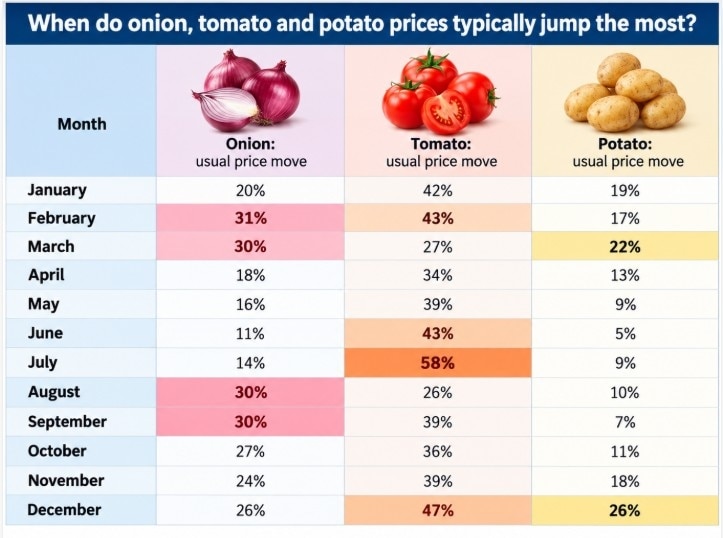
The data, based on usual month-to-month changes in wholesale prices between 2010 and 2022, shows that onion prices typically rise 31% in February and 30% in March. Another 30% increase is recorded in both August and September. For tomatoes, July stands out, with a typical monthly price move of 58%, followed by 47% in December and 43% in both February and June. Potato prices show their biggest typical monthly movement in December, at 26%, followed by 22% in March.

 India needs to focus on securing strong, durable growth with more reforms, says IMF top official
 Why are Indians facing backlash over US tech jobs? How H-1B visas became a flashpoint
 'Indians won't find respect until...': Sridhar Vembu on US mathematician's take on anti-India sentiment in US
 Tata Chemicals gets relief in Kenya dispute as High Court rules it lacks jurisdiction
 'AI could unleash 20 years of disruption': Bill Gates warns of job losses and social upheaval
 Renting Vs Buying A House: Gauri Chaddha Explains Tax Benefits And The Smarter Financial Choice
 Home Loans For Tax Savings? Why Buying A House Needs More Than Tax Benefits
 How To Choose The Right ETF: Sector Outlook, Risk, Benchmark Selection And Long-Term Investing Tips
 LIVE: How Women Leaders Are Taking Legacy Businesses Into The Future | MPW Awards 2026
 LIVE: Can India Build Its Next Manufacturing Powerhouse? | MPW Awards 2026

 Jio Platforms IPO GMP at 21%: What could investors earn on listing day?
 Jio Platforms IPO: Record Rs 4.90 lakh crore in bids, 1.35 cr applications; check allotment odds
 IndusInd Bank Q2 profit at Rs 1,242 crore; NII up 4% YoY
 2. JSW Steel, Jindal Steel Q2 results: Revenue, profit rise; margins tell different stories
 Infosys Q2 profit rises 6% YoY to Rs 7,823 crore; announces Rs 26 dividend per share
 Tata Sons may have to list as upper-layer NBFC; RBI Governor Sanjay Malhotra signals
 No smartboards, no notebooks: Kerala woman's unique sand teaching method wins hearts
 REITs, InvITs and AIFs: Can alternative investments diversify your portfolio?
 'Our shared priority must always be...': Ram Mohan Naidu thanks Tamil Nadu CM Vijay for cutting VAT on ATFRenting Vs Buying A House: Gauri Chaddha Explains Tax Benefits And The Smarter Financial Choice