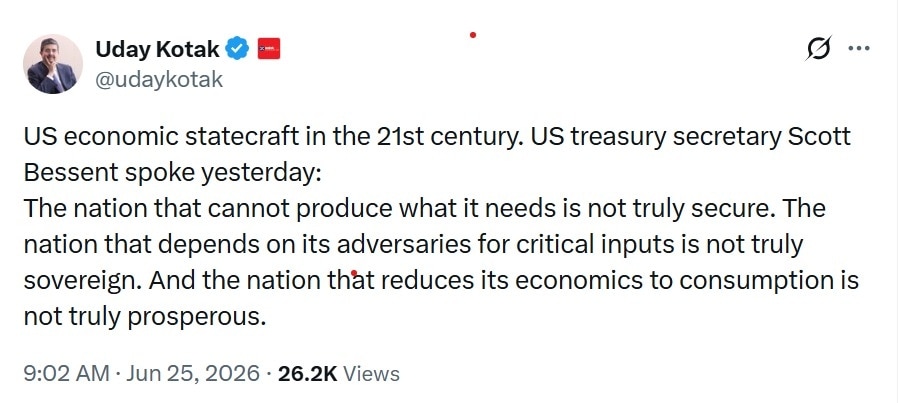
Kotak highlighted a line that was central to the Trump administration's economic thinking: "The nation that cannot produce what it needs is not truly secure. The nation that depends on its adversaries for critical inputs is not truly sovereign. And the nation that reduces its economy to consumption is not truly prosperous."
Don't Miss: 'One hell of a problem for India': Taiwan crisis will be bigger than Hormuz
Under Donald Trump, the US has shifted its approach to trade, manufacturing, and supply chains - and that came after its realisation that outsourcing has not really worked for America.
America's Rethink on Globalisation
In his speech on Wednesday, Bessent argued that the assumptions underpinning decades of globalisation had failed. "We came to believe that access to the American market could be extended without condition -and therefore without consequence," he said.
According to Bessent, the US assumed that deeper economic integration would naturally lead to shared interests and resilient supply chains. Instead, strategic industries migrated overseas, supply chains became concentrated in countries that did not always share American interests, and US companies faced what he described as unfair practices ranging from subsidies and forced technology transfers to discriminatory regulations. "We've emboldened other countries to exploit our dependence as leverage."
The answer, Bessent argued, is not economic isolation but engagement on terms that strengthen American interests through fair and reciprocal trade.
Must Read: China's two red lines: When Beijing may again escalate tensions with India
Economic Security is National Security
At the heart of Bessent's speech was the argument that national power depends on domestic productive capacity.
Invoking US founding father Alexander Hamilton, he said every nation should seek to possess the essentials of national supply within its own borders. "The nation that cannot produce what it needs is not truly secure. The nation that depends on its adversaries for critical inputs is not truly sovereign," Bessent said.
The Treasury Secretary identified semiconductors, artificial intelligence, quantum computing, advanced manufacturing, shipbuilding, critical minerals, and pharmaceuticals as sectors that will define national power in the coming decades. "These are the sources of national power. And America must lead in each of them."
Why supply chains matter
Bessent also argued that governments can no longer judge supply chains solely on cost efficiency.
For years, businesses focused on finding the cheapest source of production. Now, he said, policymakers must ask whether supply chains can withstand wars, pandemics, cyberattacks, and geopolitical coercion. "Can this supply chain survive a crisis? Can it withstand coercion?" he asked.
While he acknowledged that every component does not need to be manufactured domestically, he stressed the need to identify vulnerabilities, diversify supply chains, and avoid dependence on foreign chokepoints.
Bessent, the man who championed higher tariffs on India, is right on this one. To be truly secure and sovereign, you need to have capacity in critical sectors.
The US learnt it the hard way when China threatened to cut the supply of rare-earth minerals in response to Trump's tariffs. China accounts for roughly 60% of global mining output, but processes nearly 90% of the world's supply and produces over 90% of the advanced rare-earth permanent magnets used in electronics, electric vehicles, and defense systems.
India's Make in India Move
Many of the themes outlined by Bessent mirror priorities that India has adopted under Prime Minister Narendra Modi.
India has pushed aggressively to expand domestic manufacturing in strategically important sectors, including defence, semiconductors, and shipbuilding.
Defence Manufacturing
On June 17, the Defence Ministry informed that India's annual defence production had surged to an all-time high of Rs 1.78 lakh crore in the Financial Year (FY) 2025-26 -- a 15.6% growth over the previous fiscal year's output of Rs 1.54 lakh crore and a staggering 110% increase since FY 2020-21 when the figure was Rs 84,643 crore. Indigenous defence production has increased almost four times from Rs 43,746 crore in FY 2013-14.
The government has sought to reduce import dependence by promoting indigenous defence production and advancing projects linked to next-generation fighter aircraft and military technologies.
For fighter jets, New Delhi is working on the Advanced Medium Combat Aircraft (AMCA). AMCA would be the country's first homegrown fifth-generation stealth fighter. So far, Hindustan Aeronautics Ltd (HAL) has been making jets for the country. But on-time delivery has always been a concern for the Indian Air Force.
To get this fifth-generation story right, the government has invited three private players: Tata Advanced Systems, the L&T-BEL-Dynamatic consortium, and the Bharat Forge-BEML-Data Patterns consortium. HAL is virtually out of the race for AMCA.
Semiconductor
The semiconductor sector, long viewed as a strategic vulnerability, has become a major policy focus for New Delhi.
In February this year, the Centre announced India Semiconductor Mission (ISM) 2.0. Rs 1,000 crore was allocated for ISM 2.0 for FY 2026–27.
The Centre's first big move in the semiconductor sector came in December 2021, with a total outlay of Rs 76,000 crore to develop the semiconductor and display manufacturing ecosystem in the country.
In February only, the Centre approved 10 projects with planned investments of about Rs 1.6 lakh crore for 2 fabs and 8 packaging units.
So far, several global firms such as Micron and ASML have formed joint ventures with Indian players to set up semiconductor units.
Last month, Tata Electronics joined hands with Dutch semiconductor equipment major ASML for chip manufacturing in India. ASML is known for its monopoly in lithography equipment, which is critical for the production of advance small size semiconductors.
Micron Technology, an American chip giant, is establishing a semiconductor manufacturing facility in Gujarat with an investment of Rs 22,516 crore. Micron's facility in India will enable assembly and test manufacturing for both DRAM and NAND products and address demand from domestic and international markets.
Energy security
Energy security has also emerged as a key priority of the Modi government.
India has diversified its crude oil import sources and intensified domestic oil and gas exploration.
India imports over 85% of its crude imports.
At one point, India's 55% of crude imports transited through the Strait of Hormuz. That number has come down to under 30%. India now imports crude from over 40 countries, and about 70% of it comes through routes outside Hormuz.
In July last year, Hardeep Singh Puri, Union Minister for Petroleum and Natural Gas, informed that India was doubling down on oil and gas exploration, particularly in offshore regions. ONGC and Oil India Ltd (OIL) had launched an ambitious exploration campaign in the Andaman ultra-deepwater region.
For the first time, drilling operations are targeting depths of up to 5000 metres.
Earlier this month, Puri reported that natural gas was found in Sri Vijayapuram-3, a well in the Andaman Basin. "Initial production testing of the well at a depth of 1900 plus meters in the Eocene formation has established the presence of natural gas through continuous flaring," he announced on X.
The minister also shared that a large number of deepwater and ultra-deepwater exploration wells are planned in offshore basins to fully exploit the country's hydrocarbon reserves.
Shipbuilding and Maritime
In September 2025, the Centre came up with a Rs 69,725 crore package to revitalize the country's shipbuilding and maritime sector. The initiative, according to a Cabinet note, will strengthen national, energy, and food security by "bringing resilience to critical supply chains and maritime routes."
"It will also reinforce India's geopolitical resilience and strategic self-reliance, advancing the vision of Aatmanirbhar Bharat and positioning India as a competitive force in global shipping and shipbuilding."
So yes, India has already begun moving toward securing supply chains in critical sectors. The next challenge is building scale in emerging sectors such as AI, where private enterprise will have to play a leading role.
As Kotak told India Inc earlier this month: "Invest in the future, whatever the present may be."
















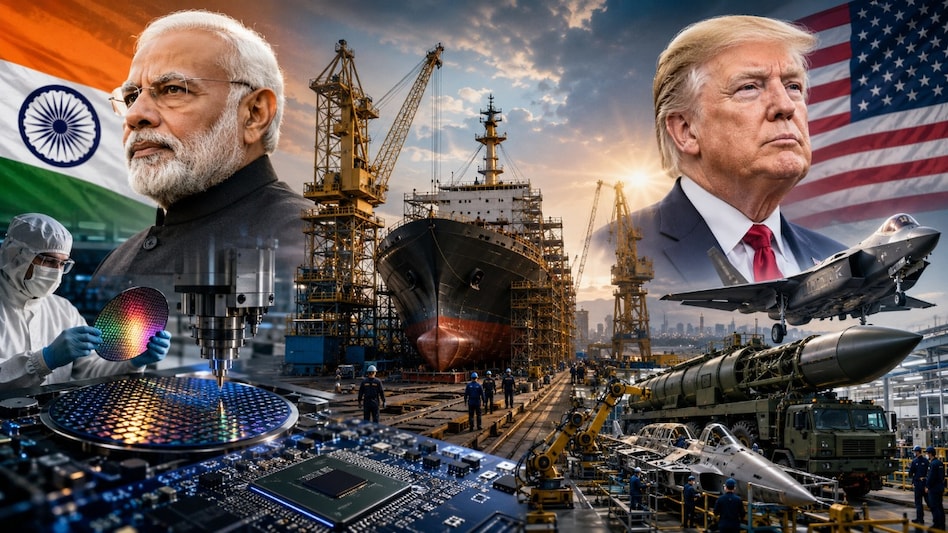 India has pushed aggressively to expand domestic manufacturing in strategically important sectors, including defence, semiconductors, and shipbuilding. (AI generated)
 ‘An Indian consumes 1/10th of an average American’: Amb Kwatra says energy security comes first
 Tata stock to buy: Nuvama bets on unique tech-telecom play, sees 28% upside
  NSE IPO, Hero Motors IPO, SS Retail IPO, Jindal Supreme IPO: GMP of four ongoing issues rises up to 32%
 UPI MDR: BharatPe distances itself from Ashneer Grover's remarks, says UPI to remain free for consumers
 IndiGo shares in focus as baggage, infant fee, priority boarding charges likely raised
 Corporate Health Insurance Vs Retail Policy: Why You Need Personal Health Cover Too
 How India Changed In 12 Years: PM Modi’s Journey From Economic Reforms To Viksit Bharat
 Modi @76: From Twitter To Instagram, How His Digital Outreach Has Evolved
 Stock Picks To Watch: Shibani Kurian Reveals Kotak AMC’s Market Bets
 Gold ETF vs Physical Gold: Know the Tax Rules, Charges and Key Differences
 Tata Chemicals, Tata Investment shares drop up to 8%: Why Tata stocks are falling today
 OnEMI Technology shares in focus as board clears fund raising via preferential route
  Adani Power, Adani Green, Adani Ports, Adani Energy: Jefferies shares target prices
 Kotak Bank, Auro Pharma, GE Vernova T&D: Top stocks to trade — Key levels, target price & stop loss
 What endures: The residential school in a changing world
 Only one Indian-American lawmaker voted in favour of Russia sanctions act: Who is Raja Krishnamoorthi?


