


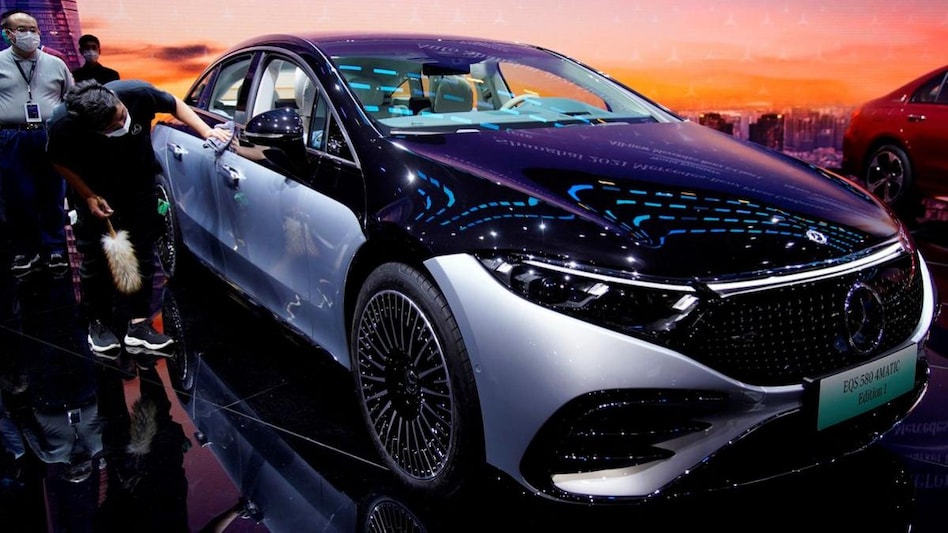
 Martin Schwenk says that Mercedes' manufacturing facility plays a vital role in Mercedes-Benz's CKD network and is the backbone of their India success story.
Luxury car sales in India are nearly 1 per cent of the total market, while in the US it's 15 per cent and it's 17 per cent in China. One of the biggest factors that's keeping them from growing, automakers say, is India's brutal tax structures. Luxury vehicles currently attract the top GST slab of 28 per cent with an additional cess of 20 per cent on sedans and 22 per cent on SUVs, taking the total tax incidence to up to 50 per cent. The way to insulate yourself from global supply fluctuations and battle these challenges, Naveen Soni, president of Lexus India says, is to make it in India. But lack of enough critical mass in the country makes it difficult for automakers to make in India and hence the prices shoot up, experts say. Still, luxury carmakers are inching closer towards assembling more in India.
Lexus' largest-selling product in India, the ES is fully produced in India. "The number of products sold in the mass market and number of products sold in the luxury market is practically the same. Which means per-car sales in the luxury car market has to be much lower and the cost of getting a part in much more. We're trying to go from completely built units (CBUs) to completely knocked down (CKDs)," he said.

 Brief pause ends: US hits Iran again after ballistic missile attack on American troops in Jordan
 Iran wants to bulk up its defence amid war with the US, Israel. China lends a helping hand
 Top stocks in news: Indo-MIM, Eicher Motors, Xtranet, PNB, Dabur, MTAR, Waaree, Lohia Corp
 Waaree, Kalyan Jewellers, Welspun Corp: Stocks to trade— Price targets, stop loss & more
 These two countries consume 70% of the world’s coal…and it’s who you think it is
 Why Ajay Bagga Is Bullish On EMS Stocks | PLI, Semiconductors & India's Growth Story
 Why Term Insurance Is Better For Family Protection Than Traditional Life Insurance
 "RSS Controls Education, Dharmendra Pradhan Is Just A Symbol!": Rahul Gandhi’s Scathing Attack
 KOSPI Crash Explained | ₹152 Lakh Crore Gone, AI Stocks Under Massive Pressure
 PSU Stocks Outlook: Can Defence, Power & Industrial PSUs Deliver Strong Returns Ahead?
 MTAR Technologies share price under pressure, can stellar Q1 earnings lift sentiment?
  Vedanta Aluminium dividend, Q1 results today: Net profit to rise 3x? Share price targets
 Bajaj Finance Q1 results: Key expectations, share price target ahead of earningsWaaree, Kalyan Jewellers, Welspun Corp: Stocks to trade— Price targets, stop loss & moreTop stocks in news: Indo-MIM, Eicher Motors, Xtranet, PNB, Dabur, MTAR, Waaree, Lohia CorpMTAR Technologies share price under pressure, can stellar Q1 earnings lift sentiment?
  LPG, CNG, PNG prices today, July 30: Check latest rates in Delhi, Mumbai, Kolkata, other cities
 Ramayana trailer out: Ranbir Kapoor’s Ram, Yash’s Raavan set the stage for an epic battle; Watch hereVedanta Aluminium dividend, Q1 results today: Net profit to rise 3x? Share price targets
 CBDT's new crypto reporting framework explained: What CARF means for crypto exchanges and investors










