
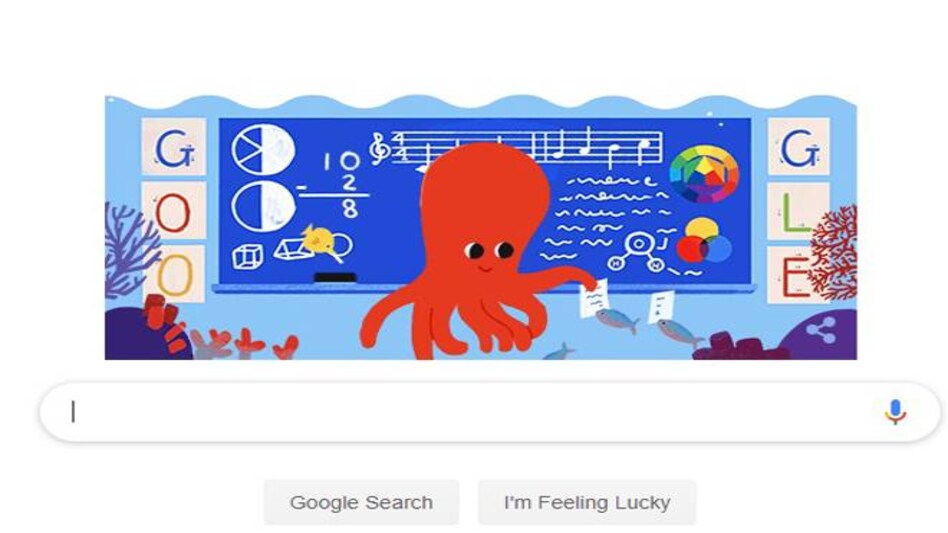
 Teacher's day: The doodle shows an animated red-coloured octopus performing experiments, teaching mathematics with its tentacles.
On the occasion of Teachers' Day, Google has dedicated its Doodle to educators and teachers across the country. The doodle shows an animated red-coloured octopus performing experiments, teaching mathematics and reading book - in short multi-tasking -- with its tentacles. Every year India celebrates Teachers' Day on September 5 as a tribute to former President of India Dr Sarvepalli Radhakrishnan on his birth anniversary. Dr Radhakrishnan, who was also India's first Vice President is known as an exemplary teacher, a renowned philosopher, scholar and a politician. Radhakrishnan's tenure as Vice President lasted for 10 years, from 1952 to 1963. Thereafter, he became the President of the country from 1962 to 1967.
Prime Minister Narendra Modi and President Ram Nath Kovind also extended their greetings to teachers on 131st birth anniversary of Dr S Radhakrishnan.
 BTTV Exclusive: Ashishkumar Chauhan explains why NSE went public now
 Tata Sons rejects Noel Tata objections over N. Chandrasekaran reappointment
 GST Council to take up proposal of MDR on UPI
 SEBI's settlement rules set for a big revamp; experts call for balance between speed and accountability
 SEBI rewrites PMS rulebook, allows IPO, foreign securities and unlisted debt investments
 Meta’s New Gadgets: Camera-Free Glasses, VR Eyewear And AI Handheld Device Unveiled
 MDR Levy: Will Retail Trading Volumes Take A Hit? | NSE Chairman Srinivas Injeti
 NSE Lists At ₹1,800: Exclusive Post-Listing Interview With India's Largest Exchange
 From Mobile Trading To AI: How NSE Plans To Protect Market Integrity
 NSE On India’s Capital Markets Growth | IPOs, REITs, InvITs And More
 SEBI's settlement rules set for a big revamp; experts call for balance between speed and accountability BTTV Exclusive: Ashishkumar Chauhan explains why NSE went public nowSEBI rewrites PMS rulebook, allows IPO, foreign securities and unlisted debt investments
 HSBC plans India equity broking return amid IPO boom, says report
 Whirlpool of India clarifies on promoter stake sale report; stock slips
 Railway UPS pension calculator: How much can you get after 10, 20 and 25 years?
 This 48-year-old doctor quit her 20-year medical career to open a steamed bun shop, says ‘I just want to live a life I love’
 Financial Horoscope Today, September 25, 2026: Increase in Wealth for Gemini, Know the Condition of All Signs
 Top 10 countries for science education: China leads global ranking, Singapore follows
 ‘And that’s it?’: Prince Harry’s AI speech hits a glitch as teleprompter fails mid-address in New York