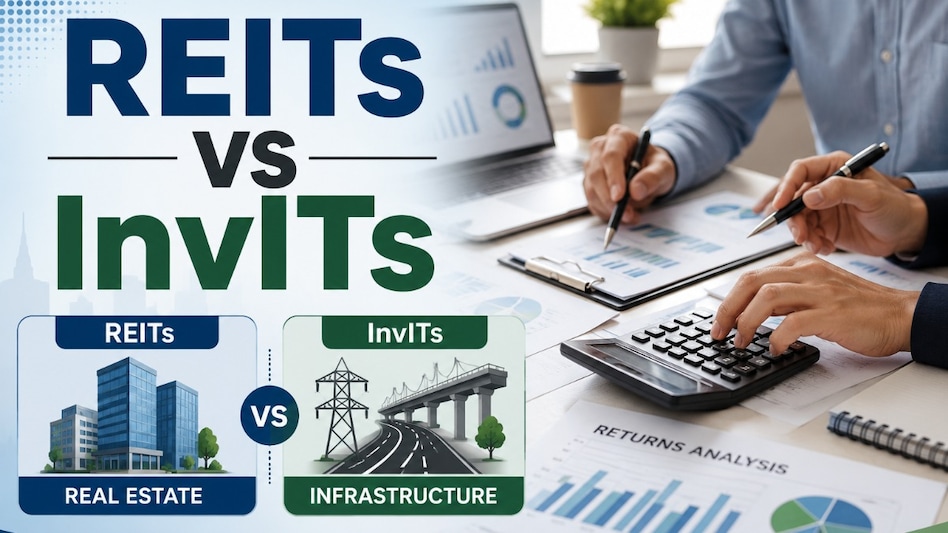
Although REITs and InvITs function on a similar trust-based structure and trade on stock exchanges, they invest in different asset classes and carry distinct risks and return profiles.
Here's a detailed look at what REITs and InvITs are and how they differ.
What are REITs
Real Estate Investment Trusts (REITs) are investment vehicles that pool money from multiple investors to acquire, own and manage income-generating real estate assets. Similar to mutual funds, REITs allow investors to participate in the real estate market without directly purchasing property.
These trusts primarily invest in commercial office buildings, shopping malls, business parks, hotels and other rental properties. Investors benefit through regular distributions generated from rental income as well as potential capital appreciation over time.
What are InvITs
Infrastructure Investment Trusts (InvITs) also pool money from investors but focus on operational infrastructure assets rather than real estate.
Their portfolios typically include highways, roads, transmission lines, power plants, gas pipelines, telecom towers, warehouses and other infrastructure projects that generate stable cash flows. Investors receive periodic distributions from project revenues along with the possibility of long-term capital appreciation.
REITs vs InvITs: Key Differences
1. Investment Structure
Both REITs and InvITs follow a trust-based model and are managed by a sponsor, trustee and investment manager. However, the underlying assets differ significantly.
REITs invest in real estate projects and are required to allocate at least 80% of their assets to completed, income-generating properties. The remaining 20% can be invested in under-construction projects, debt instruments of real estate companies, shares of eligible listed companies, government securities or money market instruments, subject to regulatory limits.
InvITs invest in operational infrastructure assets such as highways, roads, power projects, warehouses and transmission networks. Similar to REITs, they must invest at least 80% of their assets in completed and revenue-generating infrastructure projects.
The balance can be invested in eligible assets, but investments in under-construction projects, infrastructure-sector debt, certain listed equities and money market instruments are subject to prescribed limits.
2. Risk Profile
Although both investment vehicles generate income from operating assets, the risks associated with them differ.
REIT Risks
Publicly traded REITs are particularly sensitive to changes in interest rates. Rising interest rates often reduce investor appetite for REITs as fixed-income investments become more attractive, even if rental income and occupancy levels remain healthy.
Non-traded REITs carry additional risks. Since they are not listed on exchanges, investors have limited visibility into market valuations. They also tend to be less liquid, may have lock-in periods and often charge higher upfront fees that can reduce overall returns.
InvIT Risks
InvITs face risks linked to the performance of infrastructure projects. Future cash flows depend on assumptions such as traffic volumes, power demand or usage levels, making returns vulnerable if projections fail to materialise.
For example, an InvIT operating a toll road may earn lower-than-expected revenue if traffic falls short of estimates or if a competing toll-free highway is constructed.
Infrastructure trusts also face regulatory and political risks. Since many projects operate under government concessions or long-term contracts, policy changes or revisions to concession agreements can significantly affect profitability.
3. Minimum Investment
Market regulator Securities and Exchange Board of India (SEBI) has prescribed minimum investment amounts for these products.
REITs: Minimum application value with a range of Rs. 10,000-15,000 and the minimum trading lot to one unit.
InvITs: Minimum application value with a range of Rs. 10,000-15,000 and the minimum trading lot to one unit.
4. Liquidity
Both REITs and InvITs are listed on stock exchanges, allowing investors to buy and sell units during market hours.
However, REITs generally enjoy better liquidity because of their relatively lower unit prices and wider retail participation. The real estate sector is also more familiar to individual investors, leading to higher trading volumes compared with InvITs, which remain a relatively niche investment category.
5. Returns
REITs
REITs have delivered an annualized total index returns of nearly 8.9% in the last five years.
InvITs
InvITs have clocked a CAGR growth of 12.79% in the last five years.
6. Which One Should Investors Choose
The choice between REITs and InvITs depends largely on an investor's objectives and risk appetite.
REITs may appeal to investors seeking exposure to commercial real estate, relatively stable rental income and higher market liquidity.
InvITs may prove to be suitable for investors looking to benefit from long-term infrastructure growth and predictable cash flows, while being comfortable with project execution and regulatory risks.
Although both investment vehicles provide opportunities to diversify portfolios and generate regular income, understanding their underlying assets, regulatory framework and risk characteristics is essential before making an investment decision.



 Infrastructure Investment Trusts (InvITs) also pool money from investors but focus on operational infrastructure assets rather than real estate.
 Hyundai, Kia parent Hyundai Motor Group to invest $15.5 billion in India till 2032
 Apple unveils 'HomeView' Smart Home Hub with a 7-inch display, Siri AI and competitive price: All details
 GST’s next big push: More taxpayers, better compliance and higher revenue
 Sanjeev Sanyal warns: Chasing GDP growth above 7% could push inflation past 6%
 LTCG, STT debate: FM Sitharaman to 'tread cautiously' on taxation ahead of Budget
 TCS, HCLTech Rally Amid Global AI Jitters: What's The Next Market Move?
 How Aditya Birla Group Navigates Tariff Uncertainty & Builds Global Competitiveness
 Kumar Mangalam Birla on Why Businesses Must Think Twice Before Rushing Into AI
 Delhi’s Jantar Mantar No Longer A Protest Hub: 3 New Sites, Costs And Rules Explained
 Exclusive: Shashi Tharoor On SIR, Voter Deletions And BJP’s Charge Against Opposition
 Persistent, Coforge, Mphasis: Analyst shares midcap picks amid IT rally
  Tata Steel, Vedanta or Lloyds Metals? Analyst shares top stock pick
  BEL discloses additional orders worth Rs 533 crore, check details
  Investors gain Rs 5 lakh crore as Sensex, Nifty gain over 1% each; key factors behind the rally
  Tonbo Imaging IPO: Akash Bhansali, SBI Funds among investors buying shares worth Rs 413 crore
 Tata dispute has created anxiety in family businesses, firms reviewing independent directors: Harsh Goenka
 Amit Shah's Sharp Attack On Rahul Gandhi: 'You Can't Become The Voice Of The Nation'












