






Search
Advertisement
India-Mauritius tax treaty: What the new PPT means for grandfathered investments and capital gains

India-Mauritius tax treaty: What the new PPT means for grandfathered investments and capital gains

The amended treaty introduces an anti-abuse test for claiming tax benefits, but eligible capital gains on shares acquired before April 1, 2017, remain subject to specific grandfathering provisions, according to tax expert CA (Dr.) Suresh Surana.

Basudha Das
Basudha Das
  • Updated Oct 25, 2026 5:30 AM IST
India-Mauritius tax treaty: What the new PPT means for grandfathered investments and capital gainsDividends, interest and other income may face separate scrutiny under the amended tax treaty.

India’s revised tax treaty with Mauritius has introduced a Principal Purpose Test (PPT) to prevent investors from using cross-border structures primarily to secure unintended tax advantages. For foreign investors holding Indian assets through Mauritius-based entities, the key question is how the new test affects existing investments, particularly capital gains on shares acquired before April 1, 2017.

Advertisement

The amendment does not automatically withdraw treaty benefits from every Mauritius-based investor. Instead, it allows tax authorities to examine the purpose of an arrangement or transaction and potentially deny a treaty benefit if obtaining that benefit was one of its principal purposes.

“The Principal Purpose Test (PPT) adds an anti-abuse condition to the India–Mauritius tax treaty. A Mauritius-based entity will not automatically qualify for treaty benefits merely because it is resident in Mauritius,” Surana said.

He added that treaty benefits could still be available if granting them is consistent with the purpose of the relevant treaty provisions. The PPT does not itself change tax rates; it determines whether an investor can claim a particular treaty benefit.

Capital gains on shares

Advertisement

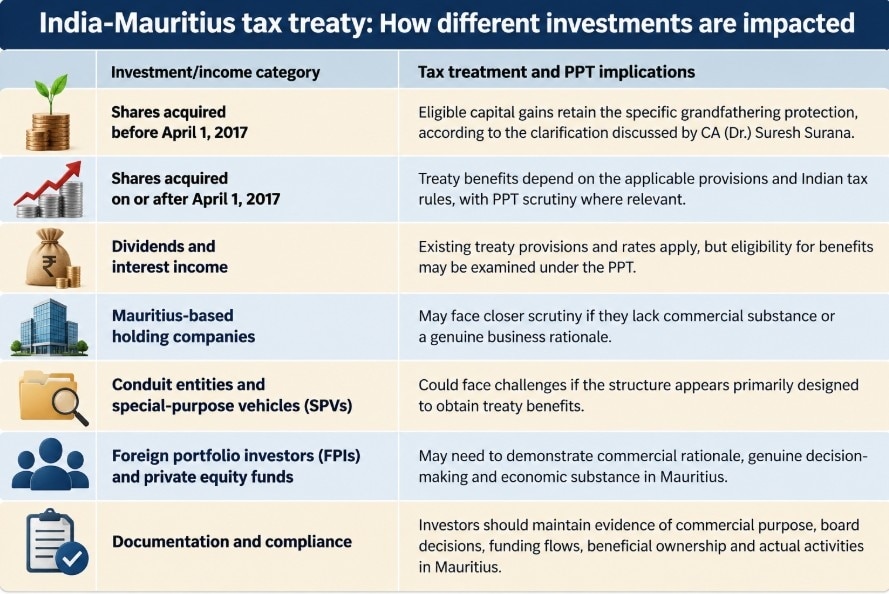
The 2016 Protocol to the India-Mauritius Double Taxation Avoidance Agreement (DTAA) introduced changes to the taxation of capital gains on shares in Indian companies. Under its grandfathering provisions, eligible shares acquired before April 1, 2017, retained the earlier treaty treatment.

MUST READ: RBI forex reporting rules: Freelancers, service exporters face confusion over EDF filings

Surana said the Central Board of Direct Taxes (CBDT) has clarified that this specific grandfathering protection remains outside the PPT.

“Therefore, an eligible gain from selling such shares should not be denied treaty protection solely under the new PPT. This protection concerns the specified capital gains; it is not a blanket exemption for every income stream connected with the investment,” he said.

This distinction is important for foreign portfolio investors (FPIs), private equity funds and other investors with legacy holdings in Indian companies. While qualifying capital gains may retain their grandfathered treatment, investors should not assume that all income generated by those holdings receives the same protection.

Advertisement

Can dividends and interest face the new test?

The amended treaty does not itself change the existing tax rates or rules applicable to different income streams. However, treaty benefits claimed on dividends, interest and other income may be examined under the PPT, depending on the circumstances.

“The existing treaty provisions and rates continue to apply. However, a Mauritius-based entity claiming a treaty benefit for a particular item of income may face the PPT test for that item,” Surana said.

He added that grandfathering for capital gains on shares acquired before April 2017 does not automatically extend to dividends, interest or other income from those investments.

For example, an investor selling eligible grandfathered shares and receiving dividends from the same investment may need to assess the treaty treatment of the capital gains and dividends separately.

MUST READ: RBI's EDF mandate explained: Is it mandatory for all exporters? Exemptions, deadlines & more

Which investors could face greater scrutiny?

The PPT could lead to closer examination of investment structures with limited commercial substance in Mauritius. These include holding companies, conduit entities, special purpose vehicles and multi-layered structures established primarily to obtain treaty benefits.

Advertisement

Surana said the authorities would examine the commercial rationale for the structure, its management and operations, and whether granting the benefit would be consistent with the purpose of the relevant treaty provision.

Factors that may be relevant include the presence of employees and offices in Mauritius, where investment decisions are taken, the flow of funds, the assumption of commercial risks and the identity of the ultimate beneficial owners.

However, using a Mauritius-based entity or obtaining a tax advantage does not automatically make an investment ineligible for treaty benefits. The assessment depends on the facts and circumstances of each arrangement.

What documentation should investors maintain?

Investors should maintain contemporaneous records explaining why a Mauritius-based entity was established or used and how it operates. These may include business plans, investment proposals, board minutes, investment committee records, funding agreements, audited financial statements, beneficial ownership records and tax residency documents.

Surana said the protocol does not prescribe a fixed checklist or numerical thresholds for determining whether an arrangement meets the PPT. The documents should reflect the entity’s actual commercial activities and decision-making.

The India-Mauritius protocol was signed on March 7, 2024, and entered into force on August 10, 2026. The Indian notification giving effect to the amendments was issued on October 13, 2026.

Advertisement

For investors, the key takeaway is that grandfathered capital gains and other income must be examined separately. While eligible gains on pre-April 2017 shares retain specific treaty protection, claims for benefits on dividends, interest and other income may face closer scrutiny under the revised anti-abuse framework.

ALSO READ: IT and consulting firms face new 30-day EDF filing deadline for service exports under FEMA rules

ABOUT THE AUTHOR

Basudha Das
Basudha Das

With over 16 years of experience in the newsroom, I am currently covering personal finance, banking, financial services, and insurance sector, bullion and metals, sports, and other trending topics. When not chasing interest rates and new-age investment tools, I like to follow and cover climate change trends and environment-friendly initiatives across the world. When not at work, I spend time learning Bharatnatyam from my guru, and baking from my daughter.

Published on: Oct 25, 2026 5:30 AM IST