
Search
Advertisement
Delhi workers spend nearly 3 times more than Bihar workers on commuting: Survey

Delhi workers spend nearly 3 times more than Bihar workers on commuting: Survey

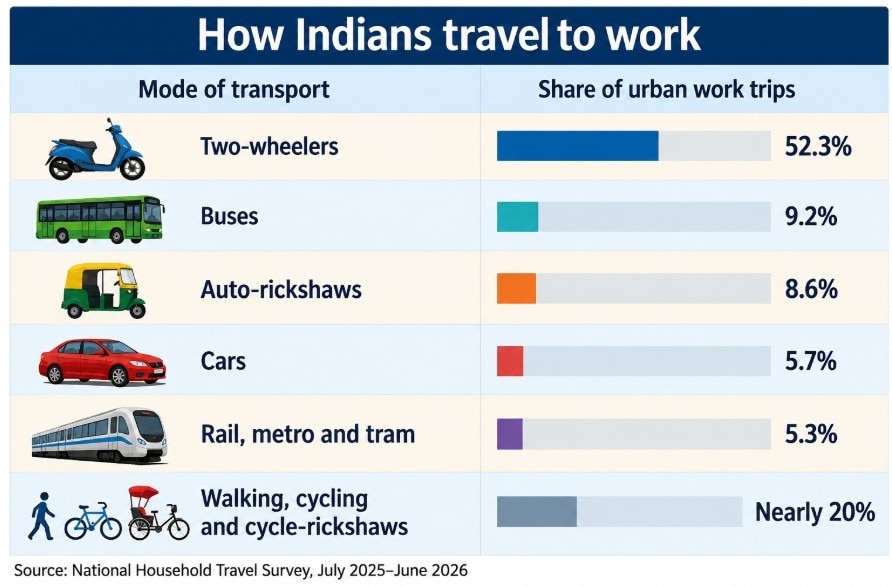
Two-wheelers account for more than half of urban work trips in India, while buses and rail-based transport make up a much smaller share. The survey data highlights how Indians travel to work and the continued reliance on private vehicles for daily commuting.

Business Today Desk
Business Today Desk
  • Updated Oct 25, 2026 3:35 AM IST
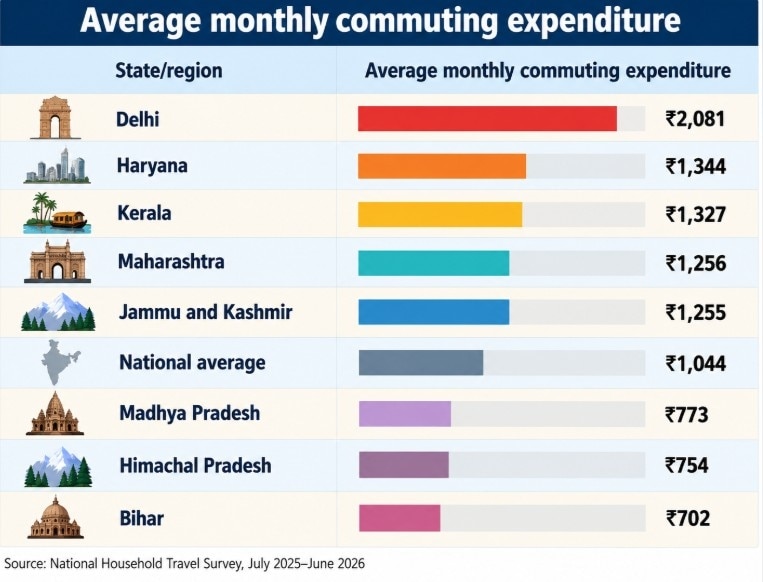
Delhi workers spend nearly 3 times more than Bihar workers on commuting: SurveyDelhi recorded the highest average monthly expenditure on commuting among the states and regions listed in the survey, at ₹2,081. Haryana followed at ₹1,344.

Workers in Delhi spend an average of ₹2,081 a month travelling to work, nearly three times the ₹702 spent by workers in Bihar, highlighting the wide differences in commuting costs across Indian states. The national average monthly expenditure on work-related travel stands at ₹1,044, according to data from the National Household Travel Survey for July 2025 to June 2026.

Advertisement

The findings highlight how the cost of reaching a workplace can vary significantly depending on where people live and work. While commuting is a recurring expense for working households, the amount spent can put additional pressure on budgets, particularly when combined with housing, food and other essential costs.

Delhi tops commuting expenditure

Delhi recorded the highest average monthly expenditure on commuting among the states and regions listed in the survey, at ₹2,081. Haryana followed at ₹1,344, while Kerala reported an average of ₹1,327. Maharashtra and Jammu and Kashmir recorded monthly commuting expenses of ₹1,256 and ₹1,255, respectively.

At the lower end, Bihar had the lowest reported expenditure at ₹702 a month. Himachal Pradesh followed at ₹754, while Madhya Pradesh recorded ₹773.

Advertisement

MUST READ: India's gender commute gap: Why fewer working women travel beyond 1 km

The gap between Delhi and Bihar amounts to ₹1,379 a month. Over a year, this translates into a difference of ₹16,548, assuming the monthly expenditure remains unchanged.

Why does commuting cost more in some regions?

Differences in commuting expenditure can reflect several factors, including the distance between residential areas and employment centres, transport availability, fares and the modes people use to travel.

Workers who live farther from their workplaces may need to spend more on fuel or public transport. In cities where affordable housing is difficult to find near major employment hubs, people may live on the outskirts and travel longer distances to reach work.

Advertisement

Transport choices also influence household expenditure. The survey data shows that two-wheelers account for 52.3% of urban work trips nationally. Buses account for 9.2%, autos for 8.6%, cars for 5.7%, and rail-based transport, including metro services, for 5.3%.

These figures suggest that private two-wheelers play a significant role in daily mobility. However, the financial implications differ depending on fuel prices, vehicle ownership costs, maintenance expenses and the availability of alternatives.

ALSO READ: India’s 25-minute commute: Why short travel times may hide a deeper jobs crisis

Longer commutes add to the burden

The survey also indicates that nearly two in three urban workers, or 64.1%, travel more than 1 km to reach work. The share is higher in Jammu and Kashmir, at 74.8%, and Haryana, at 71%. Himachal Pradesh reported the lowest share among the states cited, at 51.4%.

Longer journeys can increase both travel expenditure and the time workers spend commuting. This can affect household budgets as well as the time available for family responsibilities and other activities.

What does this mean for household budgets?

Advertisement

Commuting is a recurring expense that workers must account for alongside rent, food, utilities and savings. A higher travel bill can reduce the amount available for discretionary spending or financial goals, although the overall impact depends on household income and other expenses.

The state-wise figures also underline the importance of affordable public transport and better connectivity between residential neighbourhoods and employment centres. More accessible transport options could help reduce the financial and time costs associated with daily travel.

However, the expenditure figures alone do not establish whether workers in higher-cost regions face a greater burden relative to their incomes. That assessment would require comparable data on wages, household income, commuting distance and transport modes.

The survey nevertheless highlights a clear difference in the amount workers spend to reach their jobs, with Delhi's reported monthly commuting expenditure substantially higher than Bihar's.

ALSO READ: Just a big toy: China boss gifts top employees brand-new BMWs after seeing their harsh winter commute

ABOUT THE AUTHOR

Business Today Desk
Business Today Desk

Business Today brings you the latest news, views and analysis from the world of finance, economy, markets, corporates, startups, tech, and the digital economy. You can find everything from breaking news to deep dives to immersive essays and more on a variety of subjects across all formats - online, magazine, television, data visualisation, et al.

Published on: Oct 25, 2026 3:35 AM IST