









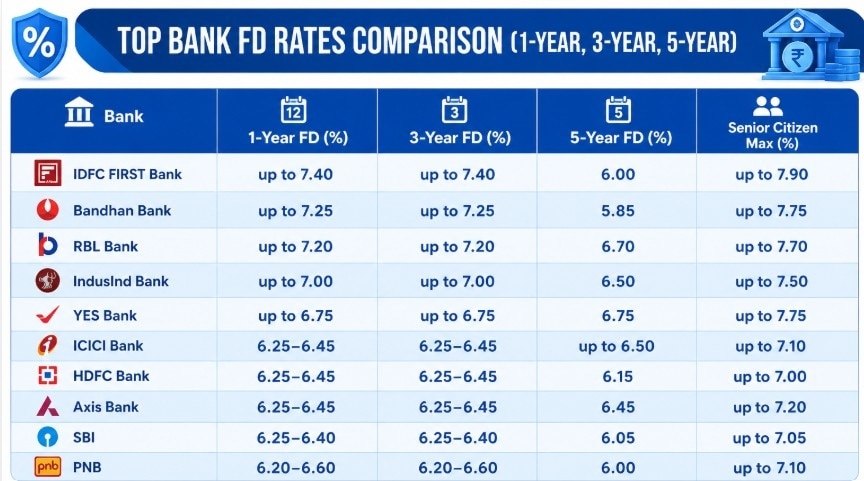



 For short-term investors prioritising liquidity, 1-year FDs offer a balance between accessibility and returns. Among leading banks, interest rates for the general public largely range between 6.20% and 7.40%.
Fixed deposits (FDs) continue to remain a cornerstone of conservative investment strategies, particularly for investors seeking predictable returns and capital protection. In the current interest rate environment, banks — especially private sector and small finance banks — are offering competitive rates across tenures, with the most attractive bands typically seen in the 1-year to 3-year segment. A tenure-wise evaluation provides better clarity on where investors can optimise returns.
1-year tenure
For short-term investors prioritising liquidity, 1-year FDs offer a balance between accessibility and returns. Among leading banks, interest rates for the general public largely range between 6.20% and 7.40%, while senior citizens can earn between 6.70% and 7.90%.
Banks such as IDFC FIRST Bank (up to 7.40%), Bandhan Bank (up to 7.25%), and RBL Bank (up to 7.20%) are offering the highest yields in this segment. Large private banks like HDFC Bank, ICICI Bank, and Axis Bank are offering slightly lower but stable returns in the 6.25%–6.45% range. Public sector banks such as SBI and Bank of Baroda remain in the 6.10%–6.40% band, reflecting a more conservative rate structure.
This tenure is suitable for investors parking surplus funds temporarily or those expecting interest rate changes in the near term.
MUST READ: FD rates: Senior Citizens turn to fixed deposits in May 2026 amid market volatility
3-year tenure
The 3-year FD segment is currently one of the most attractive in terms of risk-reward balance. Interest rates here are broadly aligned with 1-year deposits but often offer slightly better compounding benefits.
Top-performing banks include IDFC FIRST Bank (up to 7.40%), IndusInd Bank (up to 7.00%), RBL Bank (up to 7.20%), and Bandhan Bank (up to 7.25%). Senior citizens can earn close to 7.50%–7.90% in select banks.
Large banks continue to offer rates in the 6.25%–6.70% range, while PSU banks remain clustered around 6.20%–6.60%.
A 3-year tenure is often preferred by investors seeking moderate-term stability without locking funds for very long durations. It also helps in capturing relatively higher rates before any potential rate cycle reversal.
MUST READ: Tax-Saving FDs vs regular FDs: Where should you invest in May 2026?
5-year tenure
Long-term FDs (5 years and above) are typically chosen for stability and tax-saving purposes (in specific schemes). However, interest rates in this segment are slightly lower compared to shorter tenures, reflecting the current yield curve.
For general investors, rates range between 5.85% and 6.75%, while senior citizens can earn between 6.50% and 7.50%.
Among banks, YES Bank (up to 6.75%), RBL Bank (up to 6.70%), and ICICI Bank (up to 6.50%) offer relatively better returns. Public sector banks such as SBI (6.05%) and PNB (6.00%) remain on the lower end, while Bandhan Bank (5.85%) reflects a softer long-term rate structure.
Despite slightly lower rates, 5-year FDs appeal to investors seeking long-term certainty, especially those aligning investments with financial goals or tax-saving needs.
DON'T MISS: Fixed deposits vs equity: Where should investors park money during oil shock?
Key takeaways for investors
Overall, while FD rates remain stable, the optimal strategy lies in laddering investments across tenures to balance liquidity, returns, and interest rate risk.

 NTA sacks 47 officials as Centre launches major overhaul after exam paper leak row
 Tap into Gen Z: PM Narendra Modi directs Union Cabinet to boost Instagram presence
 Dharmendra Pradhan to not resign, issues with NTA to be resolved: Govt sources
 BT Explainer: Anti-paper leak law — What the Public Examinations Act, 2024 says and what's changing
 Axis MF front-running case: Sebi bars former MF dealer Viresh Joshi for 7 years, imposes ₹3 crore penalty
 Manipal Health Enterprises Sets Price Band For Rs 9,275 Crore IPO, Opens July 29
 "Sack Education Minister First": Rahul Gandhi Vs Rijiju Clash Locks Parliament Over NEET Debate
 Anti-Paper Leak Amendment Bill Approved: 10-Year Jail, ₹10 Crore Fine & Fast-Track Courts Planned
 Tech Gear Show | Alexa Dot Max Review, iQOO Z11 Lite Unboxing & Best Phones Under ₹20K
 2026 Maruti Suzuki Brezza Walkaround | Turbo Engine, New Features & Safety Tech
 Sensex, Nifty extend losing streak to fifth day; analysts see cautious trend ahead
 Bank of Baroda Q1 profit slumps 72% to Rs 1,278 crore after one-time exceptional loss
 Tata Consumer Products Q1 earnings: Net profit rises 29%, revenue at Rs 5,349 crore
  Suzlon shares: Is the multibagger's dream run over? What investors should expect next
 PVR Inox shares jump 6% after Q1; Nuvama cites continued debt reductionManipal Health Enterprises Sets Price Band For Rs 9,275 Crore IPO, Opens July 29"Sack Education Minister First": Rahul Gandhi Vs Rijiju Clash Locks Parliament Over NEET DebateAnti-Paper Leak Amendment Bill Approved: 10-Year Jail, ₹10 Crore Fine & Fast-Track Courts PlannedTech Gear Show | Alexa Dot Max Review, iQOO Z11 Lite Unboxing & Best Phones Under ₹20K
 Ravneet Singh Bittu quits Union Cabinet, sets sights on state politics ahead of Punjab polls