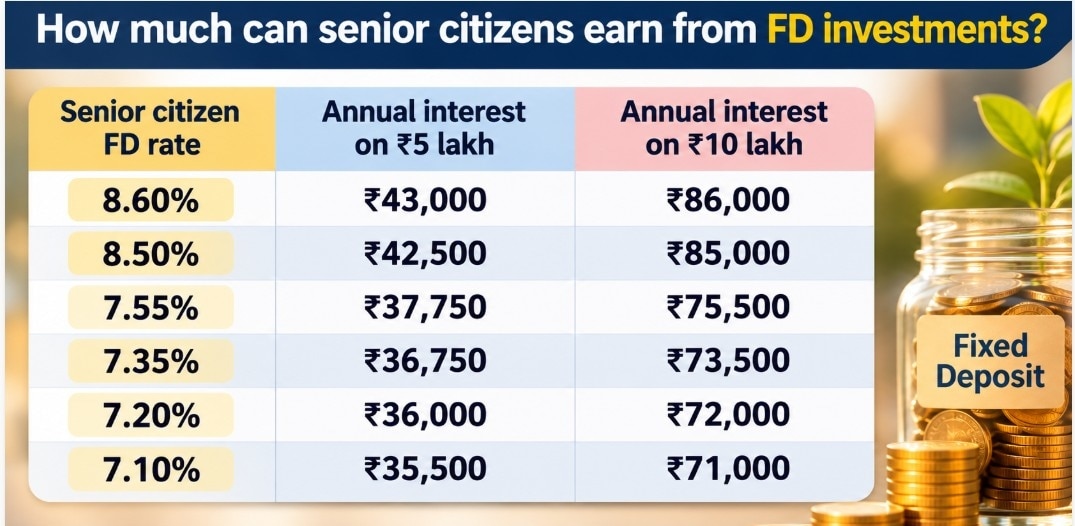









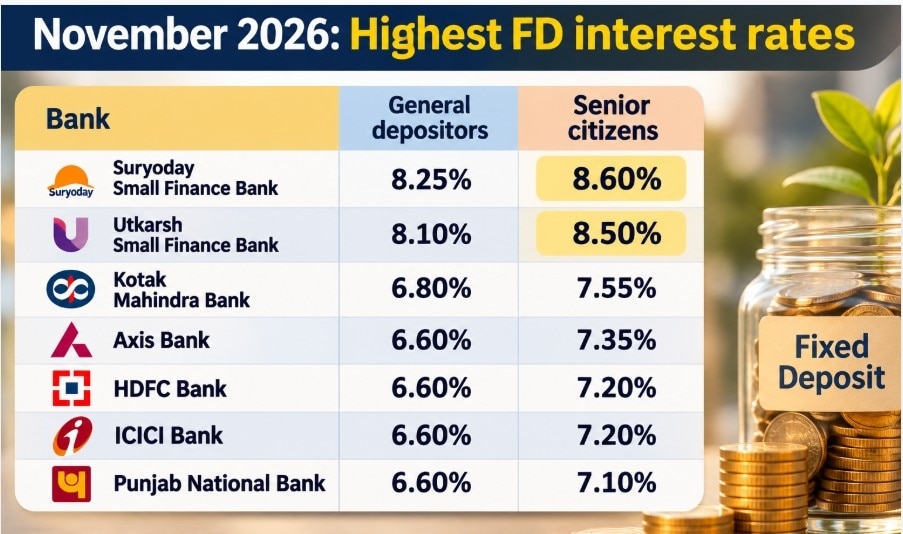



 Suryoday Small Finance Bank currently offers the highest advertised rate among the banks compared, at 8.60% for senior citizens, followed by Utkarsh Small Finance Bank at 8.50%.
Fixed deposit (FD) interest rates have increased across several banks in November 2026, with senior citizens now eligible for returns of up to 8.60% on select tenures. While major lenders such as HDFC Bank, ICICI Bank and Punjab National Bank offer rates of around 7.10–7.20%, small finance banks are offering substantially higher returns, creating opportunities for depositors seeking regular interest income.
HDFC Bank revised its FD rates effective November 4, increasing interest by up to 50 basis points (bps) on select tenures. ICICI Bank and Punjab National Bank (PNB) have also revised their rates, while Kotak Mahindra Bank, Axis Bank and small finance banks have announced changes.

 Myntra, Flipkart lose festive fashion market share as rivals gain ground
 Bharti Airtel overtakes Jio Platforms to become India's second-most valuable listed company after RIL
 Diwali cheer on D-St! Nifty reclaims 25,000 as rally extends to 7th session; investors add over Rs 30 lakh crore
 Diwali 2026 shopping boom: Indians set to spend $16 billion online as festive sales jump 25%
 December deals, CAFE 3 clearance: Better times ahead for car buyers
 "India's First Cathode Material Unit": 12 Electronics Projects Get ₹7,503 Crore Push
 Global Market Bloodbath: U.S. And Asian Stocks Crash, Is India The New Safe Haven For Investors?
 Gold Rush On Dhanteras! Zaveri Bazaar Buyers Defy PM's Appeal Amid Record Prices
 Market Guru | Abhay Agarwal On Samvat 2083: Investment Strategy & Market Outlook
 M&M Q2 Earnings: Auto Business Powers Growth, Farm Segment Faces Pressure | Rajesh Jejurikar

 Zerodha Fund House becomes Zerodha CASE Funds as investor base crosses 12 lakh in three years
 Gold, silver or stocks this Dhanteras? Nifty 500 won 9 years, gold 7 and silver 5 since 2006
 Bharti Airtel shares: Citi remains bullish after strong Q2 despite elevated churn; Rs 299 plan restored
 Vijay Kedia shares formula on how to pick stocks during correction Diwali cheer on D-St! Nifty reclaims 25,000 as rally extends to 7th session; investors add over Rs 30 lakh crore
 Japan's 1,400-yr-old Kongo Gumi to India's Wadia Group: Asia's oldest businesses still in operation
 'Only GPay': Karan Johar's anecdote shows how Google Pay became synonymous with UPI
 India loses $13 billion worth of food annually: How climate change is worsening the crisis
 BYD Yangwang U9 Xtreme reaches 503.17 km/h, sets new hypercar speed benchmarkBharti Airtel overtakes Jio Platforms to become India's second-most valuable listed company after RIL