




Search
Advertisement
Gold ETFs attract ₹3,500 crore despite price correction: Should you increase your allocation?

Gold ETFs attract ₹3,500 crore despite price correction: Should you increase your allocation?

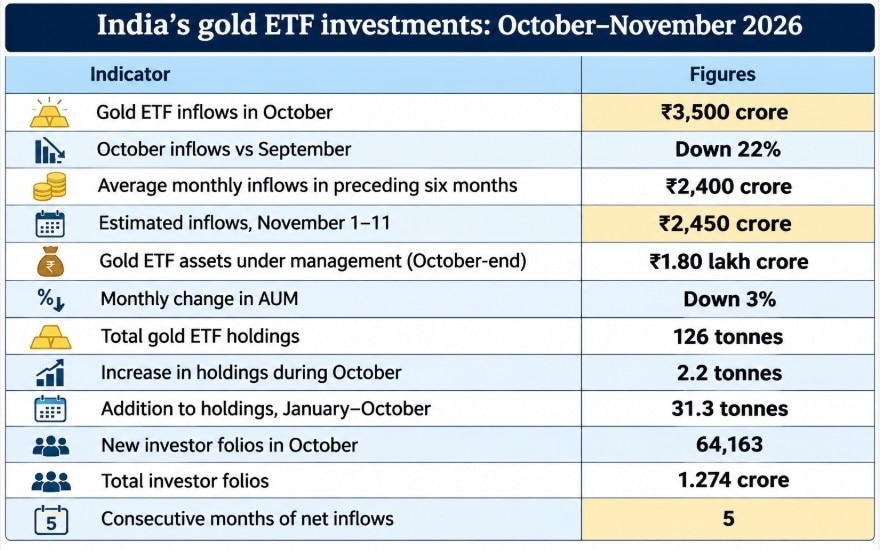
According to the World Gold Council's (WGC) November 2026 India Gold Market Update, gold ETFs attracted ₹3,500 crore in October, marking their fifth consecutive month of positive net inflows.

Basudha Das
Basudha Das
  • Updated Nov 20, 2026 6:07 PM IST
Gold ETFs attract ₹3,500 crore despite price correction: Should you increase your allocation?Gold prices declined 6.3% internationally during October, while domestic prices fell 1.8%.

Indian gold ETFs continued attracting investors despite falling bullion prices, recording their fifth consecutive month of inflows in October. However, a sharp sell-off on November 20 has raised questions about whether investors should buy the dip or wait for prices to stabilise.

Indian investors are increasingly using gold price corrections to accumulate exchange-traded funds (ETFs), even as volatility intensifies across global precious metal markets.

Advertisement

According to the World Gold Council's (WGC) November 2026 India Gold Market Update, gold ETFs attracted ₹3,500 crore in October, marking their fifth consecutive month of positive net inflows.

The momentum continued into November, with estimated inflows of ₹2,450 crore between November 1 and 11, equivalent to an additional 1.75 tonnes of gold holdings.

Why are investors buying despite falling prices?

Gold prices declined 6.3% internationally during October, while domestic prices fell 1.8%. By November 12, international gold prices were down 11% year-to-date, compared with a 4% decline in rupee terms.

MUST READ: Gold trading 72% above fair value: Should investors book profits or continue their SIPs?

Despite these corrections, October ETF inflows remained above the preceding six-month monthly average of ₹2,400 crore.

Advertisement

WGC observed that sustained inflows during declining prices suggest investors are treating corrections as accumulation opportunities.

Gold ETF holdings increased by 2.2 tonnes to 126 tonnes in October. Meanwhile, 64,163 new folios were added, taking the total to 1.274 crore.

What happened to gold ETFs on November 20?

The latest market correction highlighted the risks associated with precious metal investments.

On Friday, November 20, gold ETFs declined by approximately 5–6%, while silver ETFs fell as much as 9%.

Axis Gold ETF, Invesco India Gold ETF and Motilal Oswal Gold ETF were among the funds facing selling pressure.

International spot gold declined 1.9% to $3,551.68 per ounce, while silver slipped 2% to $41.90.

A stronger US dollar, expectations of higher US interest rates and geopolitical tensions contributed to the sell-off.

Advertisement

Higher interest rates generally reduce gold's attractiveness because the metal does not generate interest income.

ALSO READ: Gold at 15% discount, silver at 28%: DSP Mutual Fund explains why it is buying precious metals now

Should investors increase gold ETF allocations?

According to the World Gold Council, gold ETF holdings increased by 31.3 tonnes during January–October 2026, representing a 22% year-on-year rise. This indicates sustained investor interest in financial gold despite price volatility.

The report noted that inflows remained resilient even after domestic mutual funds temporarily suspended fresh subscriptions to gold fund-of-funds schemes in mid-October.

The WGC also suggested that Dhanteras buying extended beyond traditional physical gold into financial gold products, reflecting changing investment preferences.

Looking ahead, the council expects investment demand to remain steady, although gold prices could remain sensitive to global interest rates and currency movements.

For retail investors, gold ETFs can provide portfolio diversification without the storage costs associated with physical gold. However, fresh investments should be guided by existing portfolio allocation and risk appetite rather than short-term price corrections alone.

A staggered investment approach may help manage volatility, while excessive exposure to gold could increase portfolio concentration risk.

DO READ: Gold falls 21% globally but only 15% in India: How the rupee protected investors

ABOUT THE AUTHOR

Basudha Das
Basudha Das

With over 16 years of experience in the newsroom, I am currently covering personal finance, banking, financial services, and insurance sector, bullion and metals, sports, and other trending topics. When not chasing interest rates and new-age investment tools, I like to follow and cover climate change trends and environment-friendly initiatives across the world. When not at work, I spend time learning Bharatnatyam from my guru, and baking from my daughter.

Published on: Nov 20, 2026 6:01 PM IST