








 Flexible staffing in GCCs rose to 25% in the last quarter of 2026, up from 22% in 2025, according to Quess Corp’s GCC Talent Trend Report, reflecting a steady increase in subcontracting and short-term hiring.

 Flexible staffing in GCCs rose to 25% in the last quarter of 2026, up from 22% in 2025, according to Quess Corp’s GCC Talent Trend Report, reflecting a steady increase in subcontracting and short-term hiring.
India’s global capability centres (GCCs) are accelerating their shift towards flexible hiring as demand for specialised AI, data and cloud skills outpaces the ability of traditional hiring models to keep up.
Flexible staffing in GCCs rose to 25% in the last quarter of 2026, up from 22% in 2025, according to Quess Corp’s GCC Talent Trend Report, reflecting a steady increase in subcontracting and short-term hiring.
The shift is being driven by the rapid expansion of emerging technology work within GCCs. The share of projects involving AI, data and machine learning has doubled from 30% to 60%, signalling deeper adoption across industries.
“Till a few years ago, most of the demand for subcontracting staff was for the 0-4 years’ experience bracket; this has now moved to mid-level roles with 4-10 years of experience,” said Kapil Joshi, CEO of IT Staffing at Quess Corp. “Demand is also broad based and across sectors, not just BFSI, healthcare and retail, which means that this will sustain.”
Must read: From hedge to conviction: Why global capital is doubling down on India's real assets
Project-driven hiring reshapes demand
Contract roles are no longer limited to execution support but are increasingly tied to delivery outcomes, particularly in AI-led transformation programmes.
“Contract roles now carry delivery responsibility, not just execution support. The demand pattern drives this. AI hiring is growing at ~60% YoY, but in bursts linked to pilots, releases, and transformation tracks. Permanent hiring cannot expand and contract at that pace without inefficiency,” said Hani Mukhey, Senior Director, People Success Partner – GCCs at Zinnov.
Typically, companies are hiring mid- to senior-level specialists on contracts ranging from nine to 18 months to execute defined programmes.
This reflects a broader structural change in how GCCs operate. Once set up primarily for cost arbitrage, they are now being tasked with high-value work such as AI transformation, cloud modernisation and product innovation.
“GCCs are being called upon to deliver on AI transformation, cloud modernisation and product innovation. That kind of work is inherently project-driven and the skills it demands are evolving faster than any permanent hiring pipeline can respond to,” said Milind Shah, Managing Director, Randstad Digital India.
He added that companies often prefer hiring specialised teams for short durations rather than expanding permanent headcount. “If a GCC wants to build a real-time fraud detection engine, they would rather hire eight highly specialised ML engineers for nine months rather than add to their permanent workforce." Even if contract workers command a premium, the unit economics remain favourable.
Cost pressures and skill gaps at play
The rise in flexible hiring is also linked to macroeconomic uncertainty, prompting companies to remain cautious about adding fixed costs.
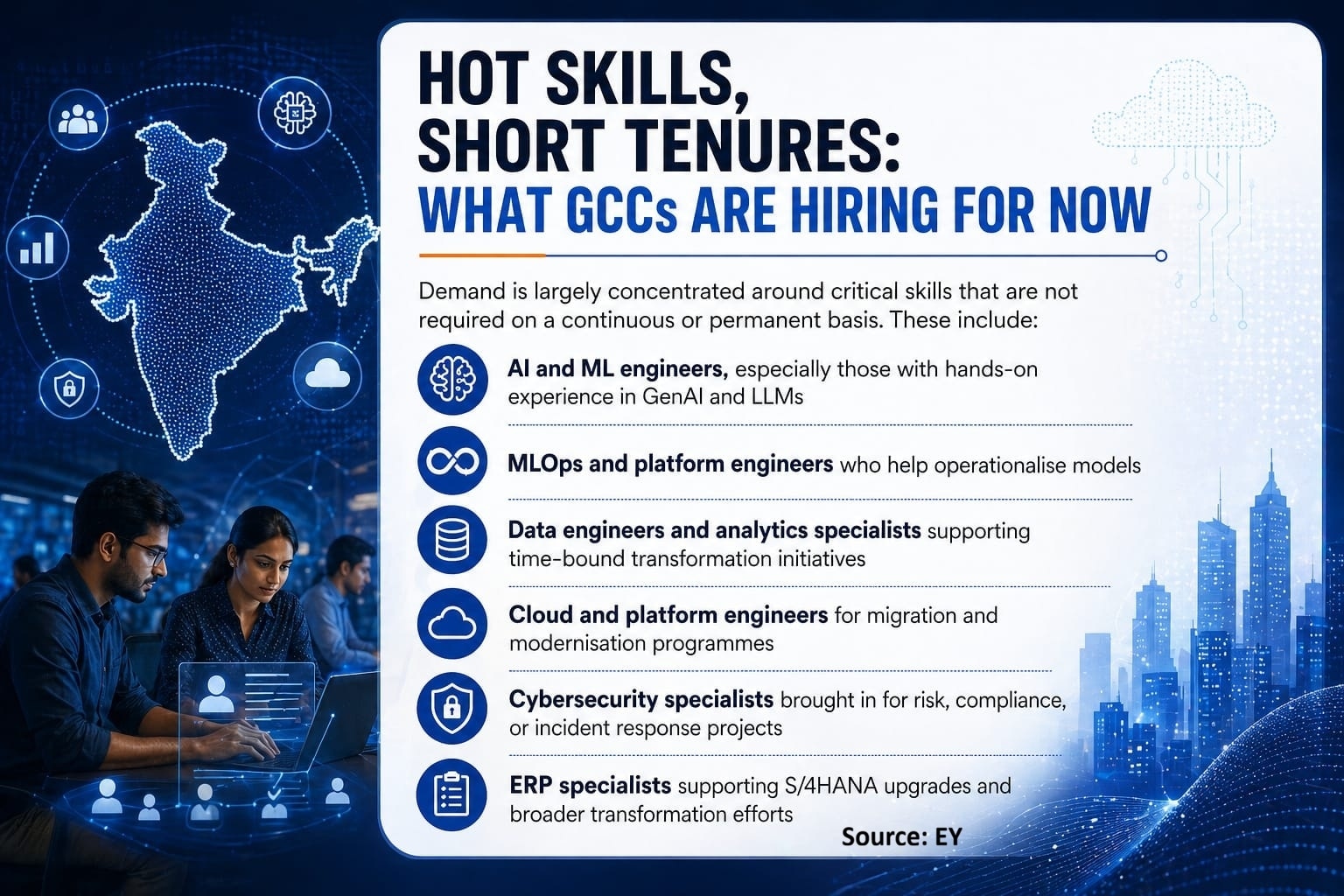
Instead, organisations are increasingly opting to build capabilities on demand, hiring for specialised skills such as AI, data, cybersecurity and product transformation only when required.
There is also a growing recognition that skills hired today may become obsolete within 18-24 months, making long-term hiring decisions riskier.
Must read: Explained: How Budget 2026 data centre and GCC push could reshape office & land demand
A structural mindset shift
Industry experts say the trend reflects a deeper evolution in workforce strategy rather than a temporary adjustment.
“Contract hiring has been gradually increasing from the high teens a few years ago and may continue to rise as transformation programmes become more continuous than episodic,” said Arindam Sen, Partner and GCC Sector Lead – Technology, Media & Entertainment and Telecommunications at EY India.
He pointed out that attrition levels have moderated in recent years, allowing companies to stabilise their core workforce while using flexible talent to manage demand spikes.
Over time, this could lead to a two-layer workforce model.
“That is a sign of maturity rather than stress,” Sen said.
Mukhey echoed this shift in thinking. “Companies are thinking less in terms of headcount and more in terms of capability. Instead of hiring one broad role, they’re breaking it down into specific skills and bringing those in as needed,” she said.
Gen Z churn, backfilling adds to pressure
The trend is also being reinforced by changing workforce dynamics. Nearly 40% of GCC hiring is now driven by backfilling roles, according to the Quess report, indicating continued churn in the market.
Shorter job tenures, particularly among Gen Z employees, are further complicating long-term workforce planning.
“In a sense, the increase in flexible hiring points to a coming together of all these factors, higher attrition, demand for specialised skills and a skills shortage,” Joshi said.
Not a long-term fix
Despite the rapid rise, flexible hiring is unlikely to be a permanent substitute for building internal capabilities.
Estimates suggest contract hiring could rise to 30-40% in the coming years, but companies are also doubling down on reskilling efforts.
“Reskilling has become as important as external hiring. GCCs increasingly recognise that flexible hiring can bridge short-term gaps, but long-term capability has to be built internally, particularly for AI and data skills,” Sen said.
For Unparalleled coverage of India's Businesses and Economy – Subscribe to Business Today Magazine
 Adani, Tata, Mahindra, Godrej double down on NCR real estate market
 'It is time to ride this wave': Ex-Infosys CEO Vishal Sikka launches AI startup Hang Ten Systems
 'Remarkable achievement': Vizhinjam welcomes 1,000th vessel, joins world's fastest-growing ports club
 Gold falls to 12-week low; Robert Kiyosaki says he is waiting to buy more
 Now, govt to bring out a monthly Index of Services Production from July 14
 Did A Reel Mocking Vijay Trigger Police Action? DMK Demands Answers
 Trump-Modi Relationship Set To Reach ‘Next Level’, Says US Trade Representative
 West Asia War Impact: Why This Sector Stocks Are The Ultimate Dark Horse Now!
 India’s Defence Boom Continues, But Execution Remains The Key Hurdle
 Gautam Adani Says India's Future Cannot Wait, Vows To Keep Building
 IRFC OFS oversubscribed 1.86 times on Day 1; government exercises green shoe option
 Vedanta Iron shares surge nearly 51% from listing-day intraday low: What analysts are saying
 Rs 17,000 salary for MD, 40% stock mismatch: ED's explosive findings after raids on Rajesh Exports
 Sensex, Nifty rebound: What's driving the recovery and what investors should watch next
 Adani Power shares: Why Morgan Stanley ups target price by 60% on it?