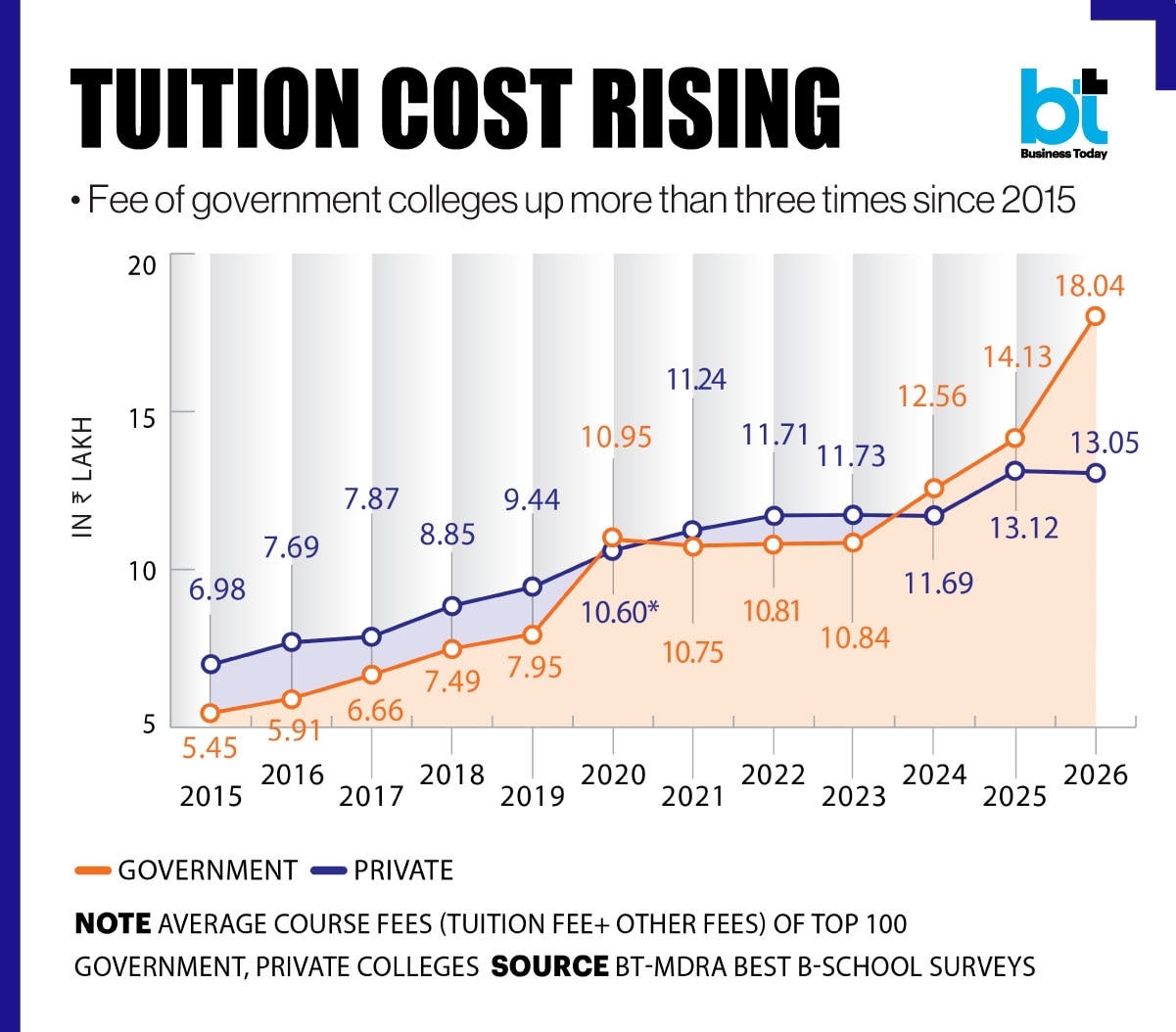
As B-schools’ costs rise faster than their ability to raise funds, they are leaning back on the one revenue line they can reliably turn to—the student fee.
The Changing MDP
At first glance, the trend looks worrying. But people running B-schools describe something more nuanced. “I would describe the market as changing rather than declining,” says Kiran Neti, Director of Corporate and Career Services at Great Lakes Institute of Management in Chennai.
The generic MDP is under pressure as companies have developed their own learning and development capabilities while executives have access to an extraordinary range of digital content. It makes less sense to hire a B-school to hold a conventional leadership programme for a group of managers. So, the corporate question has changed from “Can you run a programme for 30 executives?” to “Can you solve a specific capability problem for us?”
MUST READ: LinkedIn top MBA Programs 2026: ISB ranks 5th globally, 7 Indian B-schools in top 100
However, B-schools that have responded by customised programmes say the demand is strong. IIM Nagpur, for example, completed 17 post-graduate certificate programmes and 50 customised programmes in FY26, reaching 2,807 professionals from 739 organisations and 21 countries. Director Bhimaraya Metri puts the academic revenue for the year at more than Rs 100 crore with roughly Rs 37 crore coming from executive education, MDPs, consultancy and related activities. Its first blended MBA cohort comprises 83 working professionals from more than 20 states and the UAE.
“We are the first in the country to launch a PG certificate programme in Cybersecurity Management. The upcoming Pune campus will deepen our engagement with industry and entrepreneurship. IIM Nagpur is planning to launch a five-year Integrated BTech-MBA programme in collaboration with premier IITs, as well as an Integrated BBA-MBA programme at the Pune campus,” says Metri.
IIM-B is taking a similar route and setting up a campus in Indonesia to deliver an International General Management Programme beginning early 2027. It has taken a step forward by casting the net wider and rolling out an undergraduate programme. At present, IIM-B offers two undergraduate programmes: B.Sc. (Honours) in Data Science and B.Sc. (Honours) in Economics. “Through its undergraduate programmes, IIM-B addresses the growing demand for quality higher education and builds talent to meet key national requirements,” says U. Dinesh Kumar, Director In-charge, IIM-B.
ALSO READ: QS Rankings 2027: Top Indian B-schools slips ranking despite strong employability
The Indian Institutes of Management (IIMs) Act, 2017, declared all IIMs as Institutions of National Importance and granted them the authority to award formal degrees. The market for executive learning is moving away from a templated product towards something closer to professional problem-solving.
For example, CMS Business School at Jain University runs a post-graduate diploma in aerospace safety management and accident investigation with the Indian Air Force, designed for serving defence officers.
“It is a niche, highly specialised programme,” says Karthik Kudkuli, Assistant Professor of Aviation and Aerospace Management and the institutional lead for the programme. The school plans to extend the programme to civil aviation professionals as well.
Research to the Rescue
The second big shift is taking place in research and consulting. The BT-MDRA survey data shows a significant increase in average revenue from research and consulting assignments across top 100 B-schools. The most dramatic change is at the top: among the top 10, average revenue from research and consulting rose from about Rs 5.3 crore in 2025 to nearly Rs 20.9 crore in 2026. Among the top 25, the average has risen from about Rs 3.5 crore to Rs 9.7 crore.
“Investment in research has increased by 34% with focus on faculty-initiated research projects and procuring tech stacks for research,” says Varun Nagaraj, Professor of Information Management and Analytics and Dean of S.P. Jain Institute of Management & Research (SPJIMR), Mumbai.
DO READ: IIM Bangalore MBA stays No. 1 in India for fifth year, moves up to No. 2 in Asia-Pacific
Meanwhile, there has been a huge increase in government-sponsored research and consultancy among the top 25 schools. This means more public money for research, innovation, and large-scale policy initiatives.
Great Lakes’ Neti points to the Anusandhan National Research Foundation and the Rs 1 lakh crore Research, Development and Innovation Fund. Metri says there is a rise in demand for evidence-based policy inputs, impact assessment, capacity building, and supporting rural transformation, climate resilience, infrastructure, digital governance, and skilling programmes. Examples include IIM Nagpur’s work with MITRA, the Maharashtra government's village-development initiative, and its Centre of Excellence for Heat Resilience. These are not just academic studies. They sit at the intersection of research, consulting, public policy and implementation.
The corporate picture is more complicated. Industry-sponsored research and consultancy have contracted, reflecting an environment where companies are scrutinising spending more closely. “The corporate consulting and sponsored-research pipeline is becoming more selective,” says Ashita Aggarwal, Professor of Marketing at SPJIMR.
Companies increasingly want shorter projects with direct connection to business outcomes rather than long-duration research whose commercial payoff is difficult to quantify.
CSR money is moving in a similar direction. Aggarwal says companies are increasingly favouring visible, immediate-impact areas such as skilling, health and livelihoods rather than funding a research centre that may take years to show results.
Metri says the focus is shifting from standalone assignments to co-created, impact-linked partnerships. One example is IIM Nagpur’s collaboration with ONGC Green, covering research, policy inputs and leadership development around green hydrogen, carbon markets and e-mobility. Such partnerships do not always appear neatly under a conventional “consultancy revenue” heading. The old categories of research, consulting, executive education and industry engagement are beginning to overlap.
And that is why the revenue numbers need to be read carefully. Preeta George, Professor of Economics and Policy and Associate Dean of Executive Education, SPJIMR, says executive education has undergone a significant transformation, driven by Covid-19 and, more recently, geopolitical and economic uncertainties. “While organisations are increasingly scrutinising training budgets, we believe those that recognise the strategic importance of capability building and leadership development will continue to invest in learning, particularly as they navigate unprecedented change and uncertainty.”
MUST READ: No MBA wait needed: IIM Bangalore, Mumbai, Lucknow open doors to Class 12 students via JEE
The Tuition Fee
However, one number matters more than any of these shifts—tuition fee. When an institution depends heavily on tuition, every major increase in operating cost—faculty, research, career services—adds to the fee.
This is where Indian B-schools remain vulnerable, say analysts. B-schools across Asia-Pacific, including India, rely heavily on tuition and other student-related revenues. In contrast, institutions in the Americas have a broader financial base, including institutional allocations, government support and endowments.
Indian B-schools have historically underinvested in endowments and alumni donations. Donor-funded academic chairs, which provide leading global schools a relatively stable funding for faculty, are rare.
The biggest cost comes from an area that matters the most—faculty. India’s pipeline of PhDs is thin, and B-schools must compete with industry for experienced professionals and global schools for talent. If a school wants to pay competitively and build a stronger faculty, tuition fee is the only reliable option for funds.
Another change is easy to miss. The B-school is becoming much more capital-intensive. Technology, data, AI-enabled learning, industry engagement and career services require sustained investment. The competitive infrastructure has moved far beyond classrooms and libraries.
Metri describes investments in AI-enabled education, digital studios, analytics tools and hybrid learning platforms. IIM-B, for instance, has introduced new courses to align with emerging technologies. “Rapid developments in technology—such as AI and fintech—require continuous reskilling and upskilling of the workforce. In response, IIM-B offers short- and long-duration programmes in data science, machine learning, and both predictive and generative AI, delivered through offline and online learning channels,” says U. Dinesh Kumar.
Another cost has received less attention. Standalone self-financing management institutes such as SPJIMR award diplomas rather than degrees because they are not universities. The proposed Higher Education Commission of India envisages a new regulatory architecture under which degree-granting institutions will occupy a central position.
ALSO READ: 54% women from non-engineering backgrounds: IIM Indore's 2026-28 batch is its most gender-diverse yet
The IIMs got institutional status through the IIM Act. Standalone private B-schools lack the same statutory route. If the regulatory framework moves towards a degree-oriented system, these schools will need to invest in faculty, governance, infrastructure and other institutional requirements associated with degree-granting status. Again, B-schools will turn to tuition fees to sustain themselves.
The demand for management education remains strong. “A B-school cannot sustainably compete by continuously increasing fees,” Neti says. The more useful question, he argues, is whether the extra money students pay produces a better return on their investment.
That puts the burden back on the school. Until endowments become substantial and donor-funded faculty chairs become routine, B-schools may continue to struggle to tap other income sources.
DO READ: 'MBA era is over': CEA Nageswaran urges youth to learn skills AI cannot replace













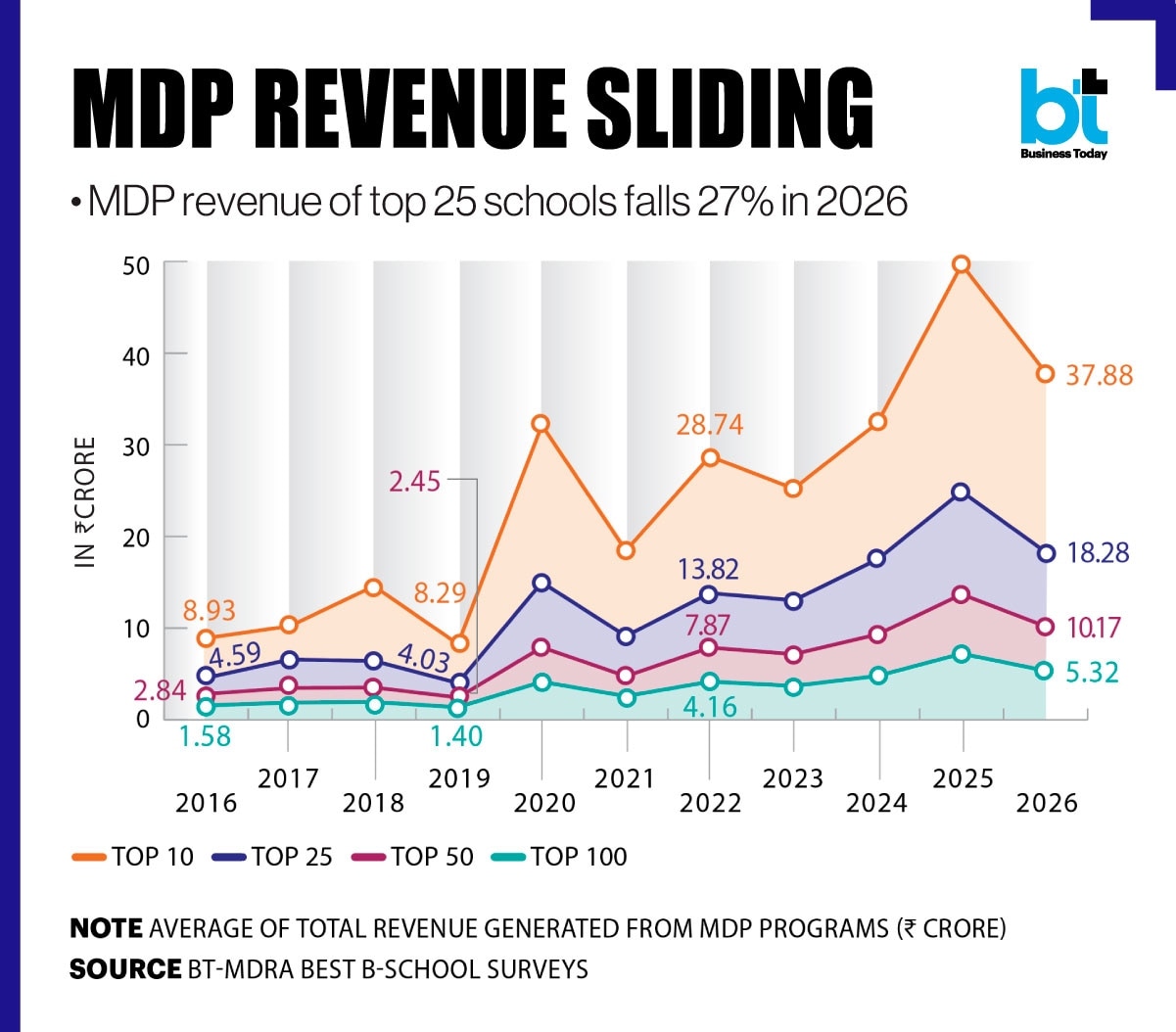


 The average course fee at top 25 B-schools has risen around 3% in 2026, even as revenue from management development programmes (MDPs) has fallen 27% for the top 25 and significantly for the top 100.
 Noel Tata raises key Tata Sons listing concern: What if a group company gets into trouble?
 Shaktikanta Das flags need to cut India's oil import dependence, cites Rs 84,000-crore offshore push
 A prolonged West Asia conflict will increase risks to corporate earnings, says Nomura's Saion Mukherjee
  No social media for under 18s? Centre mulls new safeguards after SC raises concern
 Reliance, Nayara restrict fuel sales as crude hits $107 and retail prices stay frozen: Report
 SEMICON India 2026: Global Chip Giants Announce Major India Investment Plans
 Ep17: How Mira Kapoor Is Building India’s Luxury Wellness Brand | Building A $4 Mn Wellness Business
 PROMO | 27 Years Of BT Golf | BT Golf 2026-27 Tees Off On 19 October 2026
 Supreme Court Questions High Medicine Prices At Corporate Hospitals | Essential Drugs Pricing
 India Seeks Alternate Air Routes Via China, Bhutan To Cut Airline Costs | Pakistan Airspace Ban
 Nilesh Shah on FOMO: Why investors should stop chasing ‘once-in-a-lifetime’ opportunities
 Indian rupee hits two-month low, ends nearly flat below 96 per US dollar
 Stock picks during correction: Coal India, Sona BLW, Blue Star form part of defensive watchlist, says analyst
 Helios Capital on why falling gold prices are not a trigger for renewed interest in yellow metal
  Prestige Estates stock outlook: Motilal Oswal sees 29% upside on strong launches, check target price
 ₹25,000 EPFO ceiling: What happens to employees earning ₹20,000, ₹25,000 and ₹35,000?
 Noida Wish Town 84 towers completed with 42 receiving OCs homebuyers seek action
 Nearly 1.9 lakh cancer cases in India associated with infections: What Lancet study found
 Real estate vs equities, REITs and mutual funds: Can real estate find a place in Gen Z’s wealth creation strategy?
 Financial Horoscope Today, September 30, 2026: Cancer Signs Will Achieve Desired Success, Know the Status of All Signs