










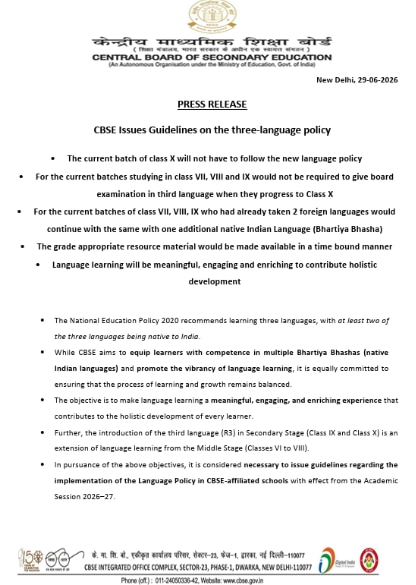



 CBSE said students in the current batches of Classes VII, VIII and IX who have already opted for two foreign languages will be allowed to continue with them.
 The Central Board of Secondary Education (CBSE) has issued fresh guidelines on the implementation of the three-language policy under the National Education Policy (NEP) 2020, giving transition relief to students currently studying in Classes VII to X.
In a press release issued on June 29, the board said the current batch of Class X students will not have to follow the new language policy. It also clarified that students currently studying in Classes VII, VIII and IX will not be required to take a board examination in the third language when they progress to Class X.

 New products, longer-dated contracts, here is how MCX is expanding
  Bank of America to invest ₹18,268 cr in Jio Credit: What the deal means for NBFC sector
 3 hydraulic warnings, 2 autopilot alerts: New details emerge from Air India Phuket-Delhi flight
 Retail inflation rises to 4.45% in July as food prices push up price pressures
 RBI proposes new loan pricing rules: Banks, NBFCs may face tighter interest rate norms
 How WhatsApp Changed Learning At Govt Schools!
 Ex-JPSC Chief Arrested As Mastermind Confesses ₹5.8Cr Fraud; Student Protests Defiant On Day 19
 Kiren Rijiju Questions Opposition: Why Is Congress Avoiding Parliament Debate On NEET Paper Leak?
 PSU Lenders, Metal Stocks Rally In Flat Trade
 N Chandrasekaran Resigns As Tata Sons Chairman: The Road Ahead For Tata Group
 New products, longer-dated contracts, here is how MCX is expanding
  HAL shares hit 52-week high after Q1 results; Nuvama downgrades stock to 'Hold'
 Beyond bullion: How IFSCA aims to position GIFT City as a commodity trading hub
 Lenskart Q1 results: Profit zooms 269% to Rs 222 crore; revenue up 43%
 TMCV Q1 results: Net profit jumps 83% to Rs 2,560 crore; revenue rises 19%
 Ankur Warikoo’s 5-book reading list can help you fix money, focus, productivity and mindset
 20,000 free visas: Abu Dhabi's new India offer comes with a 3-night conditionHow WhatsApp Changed Learning At Govt Schools!
 FD Rates: Bandhan Bank offers 7.45%, IDFC First 7.25% — How much more can you earn than SBI?
 India vs China: Who is driving the next global coal expansion?


