












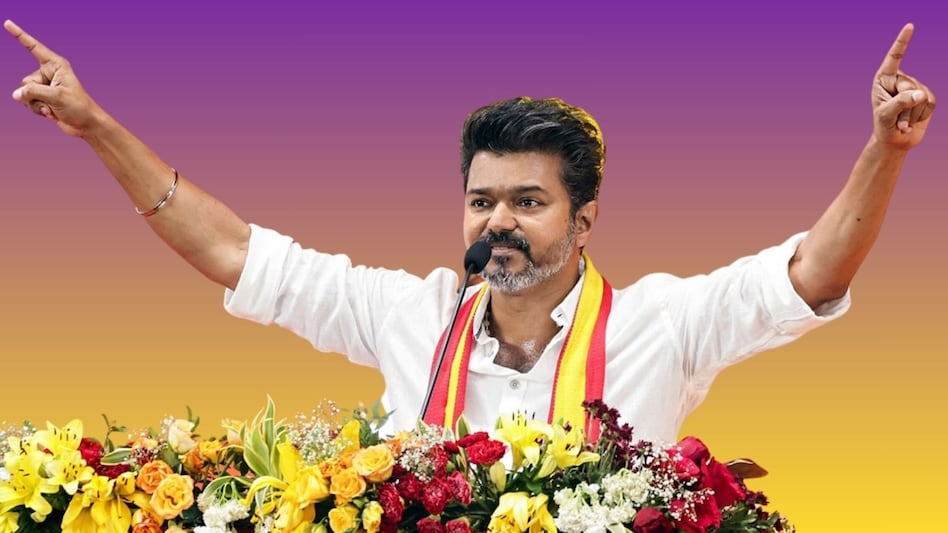
 In a forward-looking move, Vijay also announced plans for an AI Ministry, AI University and AI City.
 In a forward-looking move, Vijay also announced plans for an AI Ministry, AI University and AI City.
Tamil Nadu election 2026: Tamil Nadu’s political landscape is witnessing a shake-up as actor-turned-politician Vijay’s Tamilaga Vettri Kazhagam (TVK) emerges as the single largest party, leading in over 100 seats as per the latest trends on Monday. The debut, while striking, comes with a caveat — the party remains short of the 118-seat majority mark in the 234-member Assembly.
Don't Miss: From mass hero to political Thalapathy: How Vijay broke Tamil Nadu’s old order
TVK has maintained it can form the government "without any support", but the numbers suggest that post-poll alliances could still come into play.
As the results unfold, the party’s manifesto — unveiled ahead of the April 23 polls — offers a clear lens into the welfare-heavy, reform-driven pitch that appears to have resonated with voters.
Women at the centre of the pitch
A significant portion of TVK’s campaign focused on women-centric welfare. Vijay had announced ₹2,500 monthly assistance for women below 60 years, along with 8 gm gold for marriage and six free cooking gas cylinders a year per family.
Indigent brides were promised a quality silk saree in addition to gold, while women-led self-help groups were assured interest-free loans of up to ₹ 5 lakh.
Education and future-ready ambitions
Education featured prominently in the manifesto. To curb school dropouts, mothers or guardians of children studying in government and state-aided schools were promised ₹15,000 annually.
The party also proposed 100 special residential schools named after K Kamaraj, credited with transforming the state’s education system, alongside higher education loans of up to ₹ 20 lakh.
In a forward-looking move, Vijay also announced plans for an AI Ministry, AI University and AI City.
Focus on farmers and rural economy
Agrarian relief formed a key pillar of the manifesto. TVK promised a full waiver of agricultural cooperative crop loans for farmers owning less than five acres, while those with larger holdings would receive a 50 per cent waiver.
It also pledged a Minimum Support Price of ₹3,500 per quintal for paddy and ₹4,500 per tonne for sugarcane.
Jobs, youth and direct support
Targeting unemployment, Vijay pledged to create five lakh government jobs and offer an equal number of stipendiary internships.
Unemployed graduates were promised monthly assistance of up to ₹4,000, a move aimed at tapping into the aspirations of young voters who formed a visible part of his campaign base.
Healthcare and welfare expansion
On healthcare, the party promised a drug-free Tamil Nadu, modernised hospitals and free annual health checkups.
A ₹25 lakh family health insurance scheme was also proposed, along with a ₹3,000 monthly pension for the elderly and differently-abled.
Basic services and household relief
TVK promised 200 units of free electricity, patta regularisation and 100 per cent piped drinking water supply for all households — addressing long-standing civic concerns.
Governance reforms and delivery guarantees
Framing itself as a break from entrenched political systems, TVK assured corruption-free governance.
Key proposals included a legal guarantee for time-bound delivery of essential services such as community certificates and land pattas, as well as doorstep delivery of services like ration supplies.
The party also emphasised ease of doing business, promising issuance of business licences within 21 days.
A campaign against the old order
In the run-up to the elections, TVK positioned itself as an alternative to both the DMK and the AIADMK-led NDA, pitching a narrative of change against decades of Dravidian political dominance.
That messaging appears to have found traction, especially among youth and urban voters. However, with the party still short of a majority, it may now have to engage with smaller regional players, many rooted in the same ecosystem it challenged.
From screen icon to political contender
Tamil Nadu has a long history of film stars entering politics, most notably M G Ramachandran. Others, including Rajinikanth and Kamal Haasan, have struggled to translate popularity into electoral success.
Vijay’s campaign, marked by large turnouts and strong youth engagement, appears to have broken that pattern. Early trends indicate that TVK may have dented the DMK’s support base while also benefiting from anti-incumbency and shifting voter loyalties.
(With inputs from PTI)
 Election Result 2026 LIVE Updates: Didi over Dada in Bengal, TVK invites Congress for alliance
 The 7Ms that failed Mamata in West Bengal: From maa-maati-manush to migrants & more
 West Bengal stocks: BJP lead gives RPSG group, textile, railway shares a lift
 From mass hero to political Thalapathy: How Vijay broke Tamil Nadu’s old order
 Assam Election Results 2026: ‘3Gs’ put to test as might of the Gogois challenged by BJP juggernaut
 Coal India To Britannia: Bengal Election Results Trigger Rally In Key Stocks
 DMK In Retreat? Shocking Scenes As HQ Shuts Down Celebrations Amid TVK Vijay’s Early Lead!
 Think Electrolyte Drinks Are Healthy? Watch This Before Your Next Sip
 Upgrade To Downgrade: Why World Bank Sees India At 6.6% | Aurélien Kruse Explains
 Hormuz Crisis Explained | Oil Hits $126, UAE OPEC Tensions Rise, Global Economy On Edge
 IndiGo global sales head quits; leadership churn continues as stock slips
 Up 45% in a month! Should you buy this chemical stocks post aggressive expansion plans
 NMDC share price target: Should you book profit at current level? Jatin Gedia of Teji Mandi answers
 CESC, Bandhan Bank, Titagarh Rail, Emami - Strategy for West Bengal stocks | Daily Calls on BTTV
 Defence stocks: These 5 firms leading combined order book of Rs 15 lakh cr, says X user