The latest figures underline a significant shift in India's inflation trajectory: rural households, which typically devote a larger share of their expenditure to food, are facing a sharper increase in the cost of everyday consumption than their urban counterparts.
Rural food inflation crosses 9%
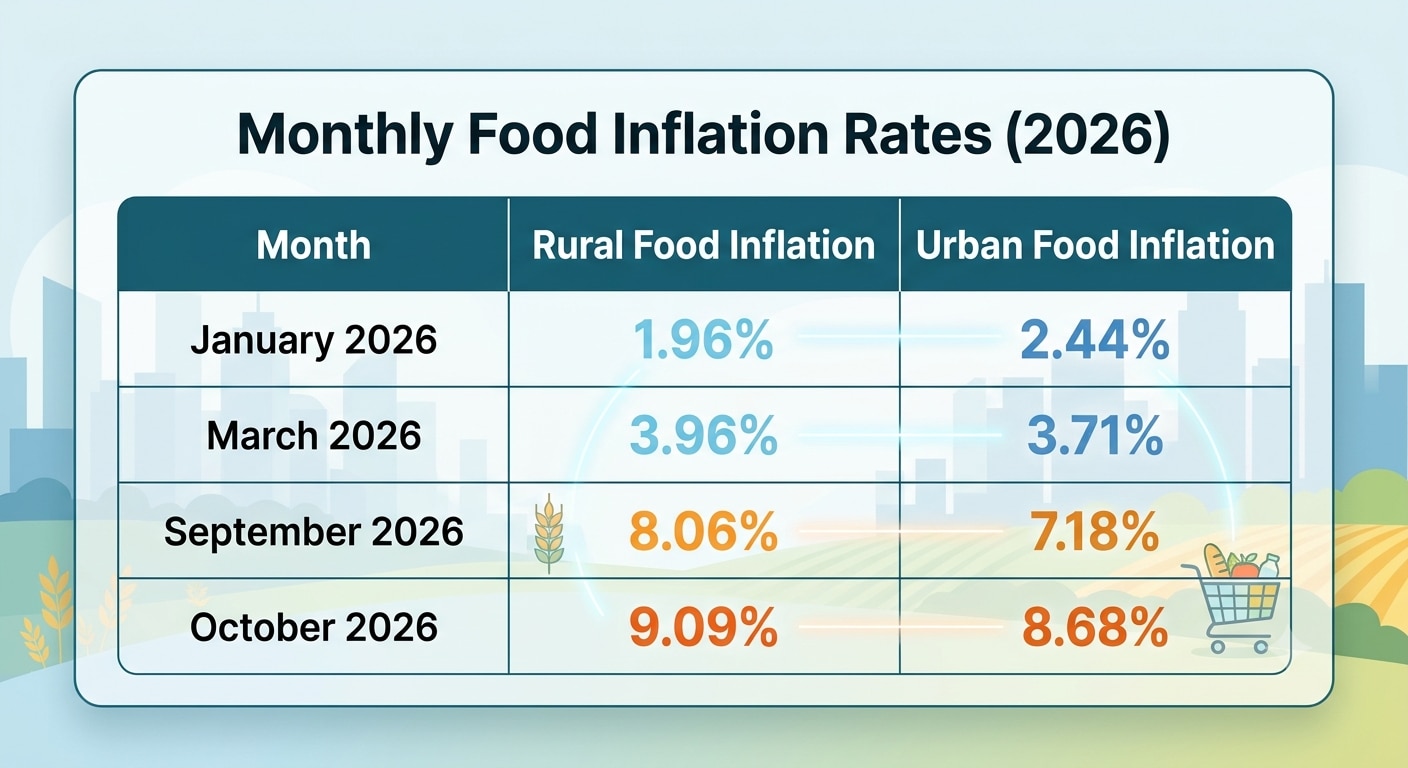
MoSPI's October 2026 CPI release shows that rural food inflation increased from 8.06% in September to 9.09% in October. Urban food inflation, meanwhile, rose from 7.18% to 8.68%.
The rural-urban gap stood at 0.41 percentage points in October. While the difference may appear modest, it reflects a broader pattern of higher inflation in rural India.
The trend is also visible in headline retail inflation. Rural CPI inflation rose to 6.63% in October from 6.08% in September, while urban inflation increased to 5.41% from 4.88%. This means rural India is facing higher inflation not only in food but also across the broader consumption basket.
Onion, garlic, ginger emerge as major pressure points
The increase in food inflation is not uniform across commodities. MoSPI's October data show that several kitchen essentials recorded exceptionally high year-on-year price increases.
Onion prices recorded inflation of 116.22% in October, up from 108.13% in September. Garlic inflation accelerated to 60.74% from 54.62%, while ginger prices rose 48.32%. Lemon prices also increased 47.30% year-on-year.
These increases highlight the pressure coming from specific vegetables and food items, even as some other commodities recorded price declines.
Potato prices, for instance, registered deflation of 14.24% in October, compared with 11.52% in September. Cauliflower prices declined 10.57%, while coconut prices fell 5.60%.
The contrasting price movements show why food inflation needs to be examined at the commodity level. Declining prices of some vegetables have not been enough to offset the sharp increases in other items.
At the broader category level, food and beverages inflation stood at 8.51% in October. The increase was higher in rural areas, at 8.70%, than in urban areas, at 8.19%.
Rural inflation is higher beyond food as well
The pressure on rural households is not restricted to food expenditure. MoSPI data show that headline retail inflation in rural India was 6.63% in October, against 5.41% in urban areas.
Some other categories also recorded higher rural inflation.
- Clothing and footwear inflation stood at 5.61% in rural areas, compared with 3.89% in urban areas.
- Housing, water, electricity, gas and other fuels recorded inflation of 3.73% in rural India, against 2.41% in urban centres.
- Transport inflation was 5.95% in rural areas and 5.71% in urban areas.
This broader divergence matters because households are dealing with price increases across several essential spending categories simultaneously.
Why the same price rise hurts rural households more
One of the biggest reasons rural households feel food inflation more sharply is the proportion of their monthly consumption expenditure devoted to food.
MoSPI's Household Consumption Expenditure Survey (HCES) 2023-24 provides a useful measure of this difference. Food accounted for 47.04% of average monthly per capita consumption expenditure in rural India, compared with 39.68% in urban India.
In absolute terms, average monthly per capita spending on food stood at ₹1,939 in rural India and ₹2,776 in urban India. The difference in spending patterns means that food-price increases can consume a larger share of rural household budgets.
For every ₹100 spent on consumption, rural households allocated approximately ₹47 to food, against nearly ₹40 in urban households. Consequently, a sustained rise in food prices leaves rural families with relatively less room to adjust other expenses.
How the inflation trend changed during 2026
The latest figures represent a substantial reversal from the beginning of the year. MoSPI's Consumer Food Price Index (CFPI) data show that rural food inflation was 1.96% in January 2026, below urban food inflation of 2.44%.
By March, the situation had reversed, with rural food inflation rising to 3.96%, compared with 3.71% in urban India. The gap subsequently widened as food-price pressures intensified.
The progression shows that rural food inflation moved from being lower than its urban counterpart in January to consistently exceeding it in the subsequent months.
Regional disparities add another dimension
The inflation burden is also uneven across states. MoSPI's October data show that Andhra Pradesh recorded the highest food inflation among the states listed in its high-inflation category, at 13.23%. Tamil Nadu followed at 12.37%, Karnataka at 12.16%, Telangana at 11.66% and Kerala at 10.92%.
These figures indicate that food-price pressures are particularly elevated in several southern states, although the national rural-urban comparison remains the broader indicator of the inflation divide.
The acceleration in rural food inflation has implications beyond household grocery bills.
When a larger proportion of household expenditure goes towards food, rising prices can reduce the money available for discretionary consumption. This could affect demand for consumer durables, automobiles, personal goods and other non-essential products, particularly in rural markets.
The impact on purchasing power, however, will also depend on how household incomes and wages move alongside prices. Inflation data alone cannot establish the extent of the decline in real household incomes.
MoSPI's October CPI release is based on the revised CPI series with 2024 as its base year. The National Statistical Office collected prices from 1,465 villages and 1,407 urban markets, including online markets. The response rate was 100% in both rural and urban markets during October. The October inflation figures are provisional.















 The increase in food inflation is not uniform across commodities. MoSPI's October data show that several kitchen essentials recorded exceptionally high year-on-year price increases.

 NSE shares hit fresh peak; market cap tops Rs 5.1 lakh crore
 Paytm stock nears 52-week high on preliminary RBI nod for wallet licence
 Jimmy Tata breaks silence, backs N Chandrasekaran and Tata Sons listing against Noel Tata: Report
 BT BIG STORY: AI helps, but concierge is still a very human business
 No PUC, no fuel & ₹10,000 fine: Gurugram turns fuel pumps into checkpoints with 300 new cameras
 BT India’s Best CEOs Awards 2026 | Jury Meet Evaluates Top Leaders
 PM Modi Highlights 5 Agricultural Revolutions Transforming India's Farming Sector
 FDs Vs Equity: Should Women Rethink Their Investment Strategy To Achieve Long-Term Financial Goals?
 Gold Jewellery vs Gold ETFs: Which Is Better for Investment? Mrin Agarwal Explains
 PM Modi Criticises Past Governments Over Farmers’ Welfare At Agriculture Conclave

 Mahindra Logistics shares tumble 14% as MD and CEO Hemant Sikka resigns
 YES Bank shares gain amid review petition in SC over Rs 8,415 crore AT-1 bonds ruling
 Defence stock: Astra Microwave shares rise 2%; Jefferies sees 21% upside; here's why
 Bank Nifty nears record high, analyst says short-term consolidation likely
 Freshers are not disappearing, their jobs are changing: Cognizant India chief on AI hiring
 Delhi-Meerut commute gets faster: Namo Bharat’s 8 new express trains start today


