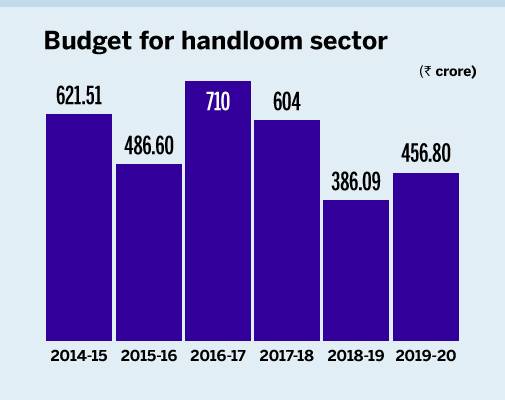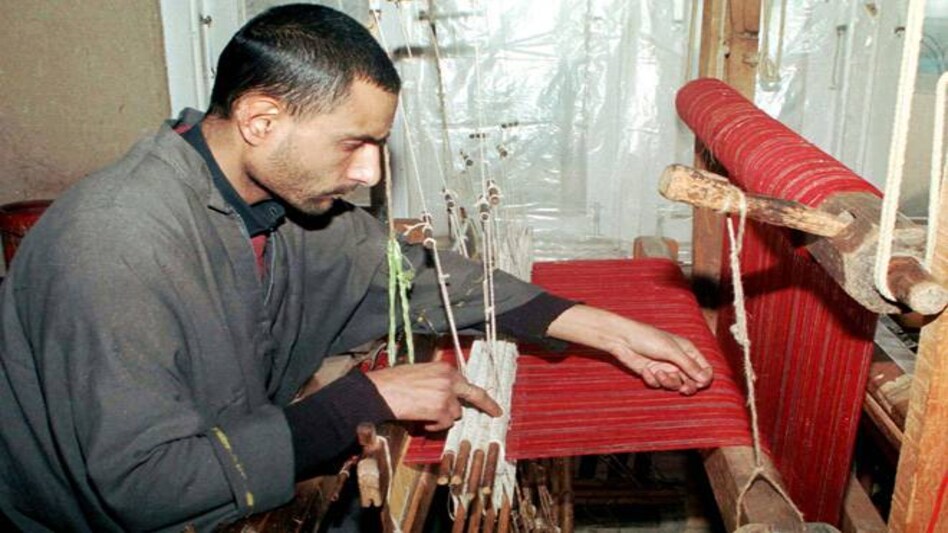
You are not spinning a yarn if you say there have been job losses in the Indian handloom sector. This is the sense we got, talking to people working in the field. Take the case of Vanagari Praveen. The 30-year old Praveen used to work as a handloom weaver, primarily weaving sarees in Narayanapuram, near Pochampally, the handloom hub in Telangana, known nationally for its 'ikat' sarees. Today, Praveen works for a courier company in Hyderabad. He relocated to Hyderabad eight years ago, finding the payment of Rs 500 for weaving a saree quite unsustainable. What is worrying, however, is he sees little incentive in going back home and start weaving again. "I evaluated the job opportunities, got myself trained in DTP (desktop publishing) and joined the courier company. In my current job, I earn Rs 25,000 a month but looking at the economics in weaving, today I will be able to earn at best, anywhere between Rs 13,000 and Rs 18,000 a month. Therefore, despite the added living expenses in a city, I see little benefit in returning to weaving."
Donthi Narasimha Reddy, who runs Chetana Society, an NGO focussed on sustainable development, has been associated with the handloom sector for nearly three decades. He says Praveen is not alone and there will be many like him who have left the handloom sector and sought alternative employment opportunities. Although, he is quick to add that not everyone is as lucky as Praveen. Most of them end up having menial job or no job at all. "Employment in the handloom sector has not increased in the last ten years. In fact, it has decreased," he says. Quoting numbers, he says, there were 43 lakh people engaged in weaving and allied activities as per the third Handloom Census, carried out in 2009-10 as compared to 65.5 lakh, as per the second Handloom Census conducted in 1995-96.
 Closing Auction Session: Why the system expected to reduce volatility is still seeing occasional wild swings
 Silver may be cheaper than gold as 2026 draws to a close: Report
 India paid 29% more for cooking gas after Hormuz strikes: Report
 Nepal faces years-long rebuild and $5 billion bill after devastating flash floods, says billionaire
  Noel Tata, Shapoorji Pallonji negotiate share swap for 18.4% Tata Sons holding: Report
 Explained: How China Is Using Old Chips, New Designs And Robots To Beat The Blockade
 Where Is The Smart Money Moving? Elara Capital Reveals Its Key Market Themes
 Debt Mutual Funds Or Bonds? Understanding Liquidity, Diversification & Risk
 Reasons Why Arvind Could Be A Big Winner In India’s Textile Sector
 “Analogue Paneer Isn’t Fake”: Sanjeev Kapoor On FSSAI Rules & What Consumers Must Know
 Jio Platforms IPO gets SEBI nod: Rs 27,500 crore debt repayment plan, $100 billion valuation in focusClosing Auction Session: Why the system expected to reduce volatility is still seeing occasional wild swings
 RIL-backed penny stock hits 52-week low; firm clarifies on high trading volume
 Happiest Minds shares slip despite IT stocks surge; here's what is weighing on the stock
 BEL, Solar Industries shares remain Nuvama's top defence picks; here's what it said on BDL, Data Patterns, HAL
 From rakhis to smartphones: Indians turn to quick commerce for last-minute Raksha Bandhan shopping
 Mahindra takes battery-as-a-service to entire electric SUV line-up
 Morgues at capacity as Nepal struggles to identify bodies carried downstream by floodsWhere Is The Smart Money Moving? Elara Capital Reveals Its Key Market ThemesExplained: How China Is Using Old Chips, New Designs And Robots To Beat The Blockade