The sudden pause in the countdown shook up the mood inside the launch control centre at Skyroot Aerospace’s Infinity Campus in Hyderabad. Engineers rose from their consoles. Phones turned busy. People scrambled between workstations, checking screens, whispering to one another. The tension was palpable.
Beyond Skyroot’s campus, the hold message sent goosebumps through India’s entire space community. Watching the broadcast in Chennai, Srinath Ravichandran, Co-founder and CEO of Agnikul Cosmos, felt a familiar knot in his stomach.
“We had to abort two launches. One of them was T-129 seconds and the other was T-11 seconds. So, when they had that delay because of a hold, it reminded me of our own launch and our own countdown as well,” says Ravichandran, who co-founded Agnikul in 2017 after leaving a career on Wall Street. “It means a lot to actually be going through a hold when the world is watching.”
For Skyroot, this was the culmination of years of work. The stakes were high. Twice over the previous 14 months, Isro’s own PSLV, the agency’s most reliable rocket, had failed from this same pad: first in May 2025, when PSLV-C61 lost its payload to a Stage III anomaly. This January, PSLV-C62 suffered another Stage III anomaly.
Vikram-1 had to work. Everything had gone to plan. Until five minutes to lift-off.
A software glitch was detected in the automatic launch sequence. The issue was corrected and the launch sequence restarted from T-20.
The countdown resumed. This time, the systems worked perfectly. At 12:05 pm, Vikram-1 lifted off.
“Lift off normal,” announced mission control. The spectators at Sriharikota burst into spontaneous applause, but the faces inside the control centre stayed tense.
T+30 seconds. T+1 minute. As the rocket reached a 22 km downrange, the control room went up in cheer. Stage separation followed, then second-stage engine ignition.
Vikram-1 was flying.
“It still feels like a dream to me,” Skyroot’s Co-founder and CEO Pawan Kumar Chandana told a television channel after the launch. “The next phase is to reliably reach orbit... and then get to commercialisation.” Chandana didn’t respond to BT’s emails and messages requesting comments for this story.
In Bengaluru, Yashas Karanam, Co-founder and COO of Bellatrix Aerospace, was watching the launch at his office, with a team member running live commentary over the feed.
“We were all super excited, wishing that it would be a success, because it sends out a very strong signal to the global ecosystem that India means serious business,” says Karanam. “Having a launch vehicle succeed on the first attempt, at full scale... a lot of countries have actually failed to do that.”
When Vikram-1 reached low-Earth orbit on its maiden flight, it became the first privately developed Indian orbital launch vehicle to fly from Indian soil. It also made India the third country, after the US and China, with private orbital launch capability. Germany joined them on September 5, when Isar Aerospace put its Spectrum rocket into orbit from Andøya Spaceport in Arctic Norway. It was proof that India’s private space industry, which was in the making for decades but opened up for private participation only a few years ago, could convert Isro’s knowhow and its inherited base of suppliers into hardware of its own.
The Isro Inheritance
Much of what private companies are building today rests on six decades of work by India’s state-owned space agency, the Indian Space Research Organisation, or Isro. Before 2020, Isro was India’s only face in space. It designed the rockets and also built various satellites. Since 1979, the agency has done more than 100 launches and put satellites into orbit, and even sent missions to the Moon (Chandrayaan) and Mars (Mangalyaan).
Formed in 1969, Isro succeeded the Indian National Committee for Space Research, which India’s first prime minister, Jawaharlal Nehru, had established under the Department of Atomic Energy in 1962. Born out of the need for communications, weather forecasting, remote sensing and development of a young, and impoverished, republic, it prioritised reliability, frugal engineering and self-reliance.
Over the next six decades, Isro built a base of more than 500 companies — public and private — across India, with dense clusters around Bengaluru, Thiruvananthapuram, Ahmedabad, Hyderabad and Sriharikota.
By Isro’s own estimates, around 80-85% of launch-vehicle inputs come from this network of roughly 500 small to large industries. These suppliers were, and largely still are, geared towards build-to-spec fabrication.
Manish Gupta, general partner at growX Ventures and an early investor in Bellatrix, calls it built-to-print. “Isro developed the designs and owned the technology, it sourced or made the components; vendors received the finalised drawings,” says Gupta. “They had to build it precisely to a drawing or specification handed to them and did a very good job of it.”
That robust supplier base, and its capabilities of building to print, are genuine strengths. But they represent only one part of a space innovation ecosystem. Mission design, system configuration, components development, sensor integration, and the firmware and software that give most subsystems their intelligence were not part of that supplier base’s capability.
The question every spacetech founder in India had to answer was how much of the existing aerospace and defence manufacturing base they could actually use.
For heavy manufacturing, the answer was: most of it. Sanjay Nekkanti, Co-founder and CEO of Hyderabad-based Dhruva Space, started his company in 2012 on top of that base. “If you come to my office, you won’t see CNC machines or PCB printing lines. There are already so many of them in this country,” says Nekkanti. “The same manufacturing guys who build for aerospace also build for defence, industrial, everything. All the ingredients required for a thriving space ecosystem already existed.”
But the base only helped if one knew what to ask it for. “For somebody who’s been there, done that before, it’s relatively fast,” says Nekkanti. “When you don’t know what you want, that’s the problem.”
Beyond the manufacturing base, there were people. Several Isro engineers, including Skyroot Co-founders Chandana and Naga Bharath Daka, became entrepreneurs. Many other retired engineers became advisors to these new-age companies. Some scientists even joined them full-time. Being coached by the scientists who had worked under A.P.J. Abdul Kalam, when Isro was young and short of resources, was invaluable, according to Agnikul’s Ravichandran.
“That generation of people were inspired. Isro was like a start-up then,” says Ravichandran. “That scrappiness, in terms of getting together whatever it takes to build something, fire the engine — that’s what I learned.”
Isro’s name did the rest. When Bengaluru-based Pixxel began selling hyperspectral data to customers in the US, for example, Isro’s legacy did some of the early persuading.
“Isro thankfully had set that foundation and set up that reputation,” says Awais Ahmed, Co-founder and CEO of Pixxel. “As a private company, we were still unproven, but once they saw that we were coming from India and that we had retired Isro scientists as advisors and some Isro scientists who had joined us full-time, we were taken quite seriously.”
The deepest inheritance is the knowhow. Reaching orbit is a capability only a handful of countries hold, and India already had it. “We know what it means to build stuff that works in space. We know how to go to orbit,” says Ravichandran. India was not starting at the beginning.
But the companies still could not own what they made. That changed in 2020, when private players finally got a policy push.
The coming-of-age moment
In May 2020, in the middle of the Covid-19 pandemic, Finance Minister Nirmala Sitharaman announced a series of stimulus measures as part of the government’s Aatmanirbhar Bharat package. Among them was the creation of the Indian National Space Promotion and Authorisation Centre (IN-SPACe) to let private firms use the assets and institutional knowledge of Isro and the Department of Space, and participate in space activities.
Six weeks later, the Union cabinet, chaired by Prime Minister Narendra Modi, approved “far-reaching reforms in the space sector”, explicitly aimed at enabling private-sector participation across the full range of space activities.
The reforms created a route for private companies to design, build, own and operate rockets, satellites, ground systems and launch infrastructure, subject to authorisation.
“It was a big relief,” recalls Ahmed, who co-founded Pixxel with Kshitij Khandelwal at BITS Pilani in 2019. “We could all build a satellite. But before this announcement came, launching a satellite for a private company was basically illegal.”
Isro and IN-SPACe didn’t respond to email requests for comments.
The 2023 Indian Space Policy formalised the new architecture. An Indian company could now design its own rocket or satellite, own the technology, and take it to market. This was followed by the easing of foreign direct investment (FDI) rules in 2024, making way for up to 100% FDI into Indian spacetech.
These changes released pent-up ambition. Government data showed the number of active space start-ups jumped to around 440 by 2026 from a few dozen in 2020, as they spread across almost every layer of the space economy.
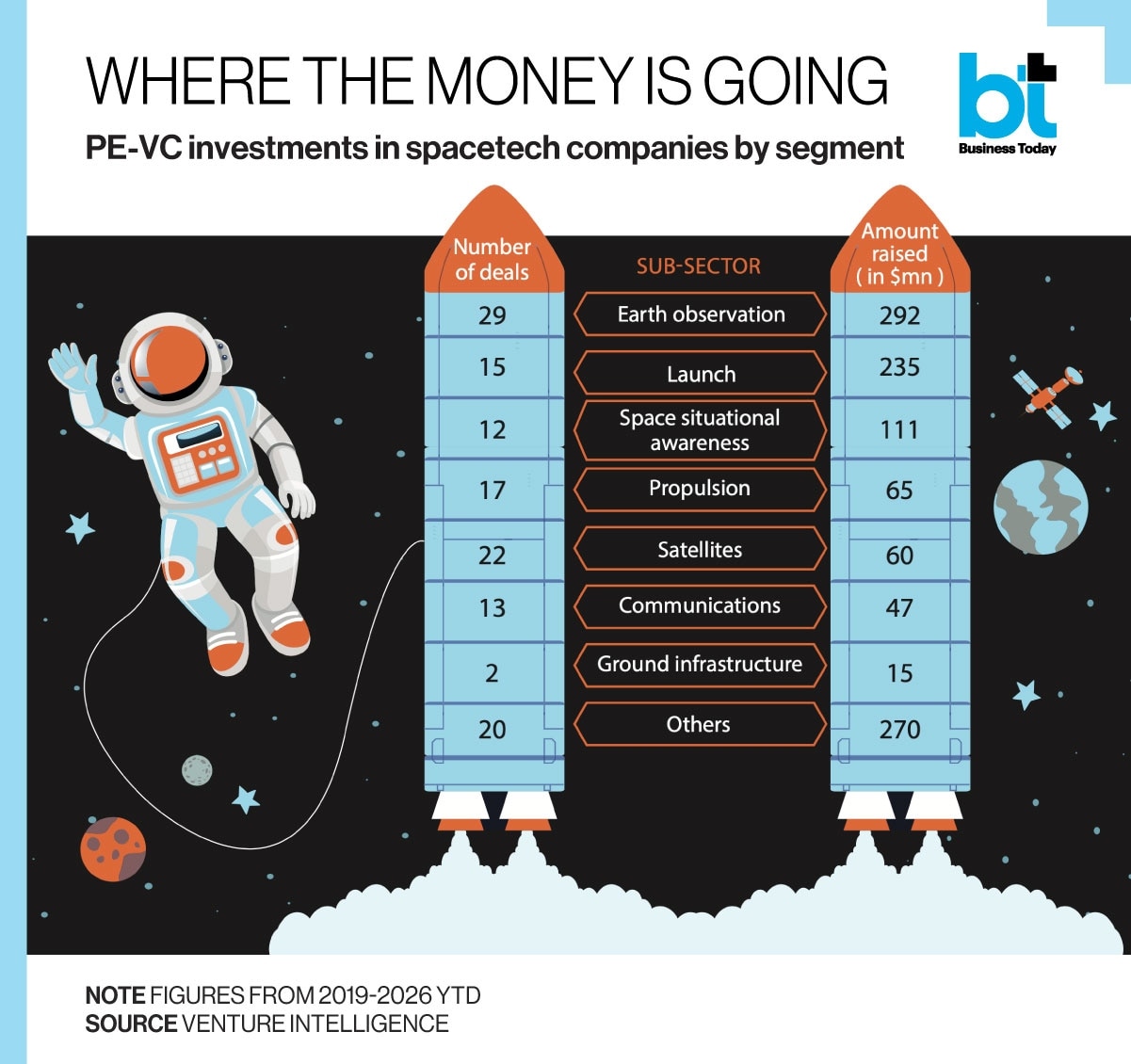
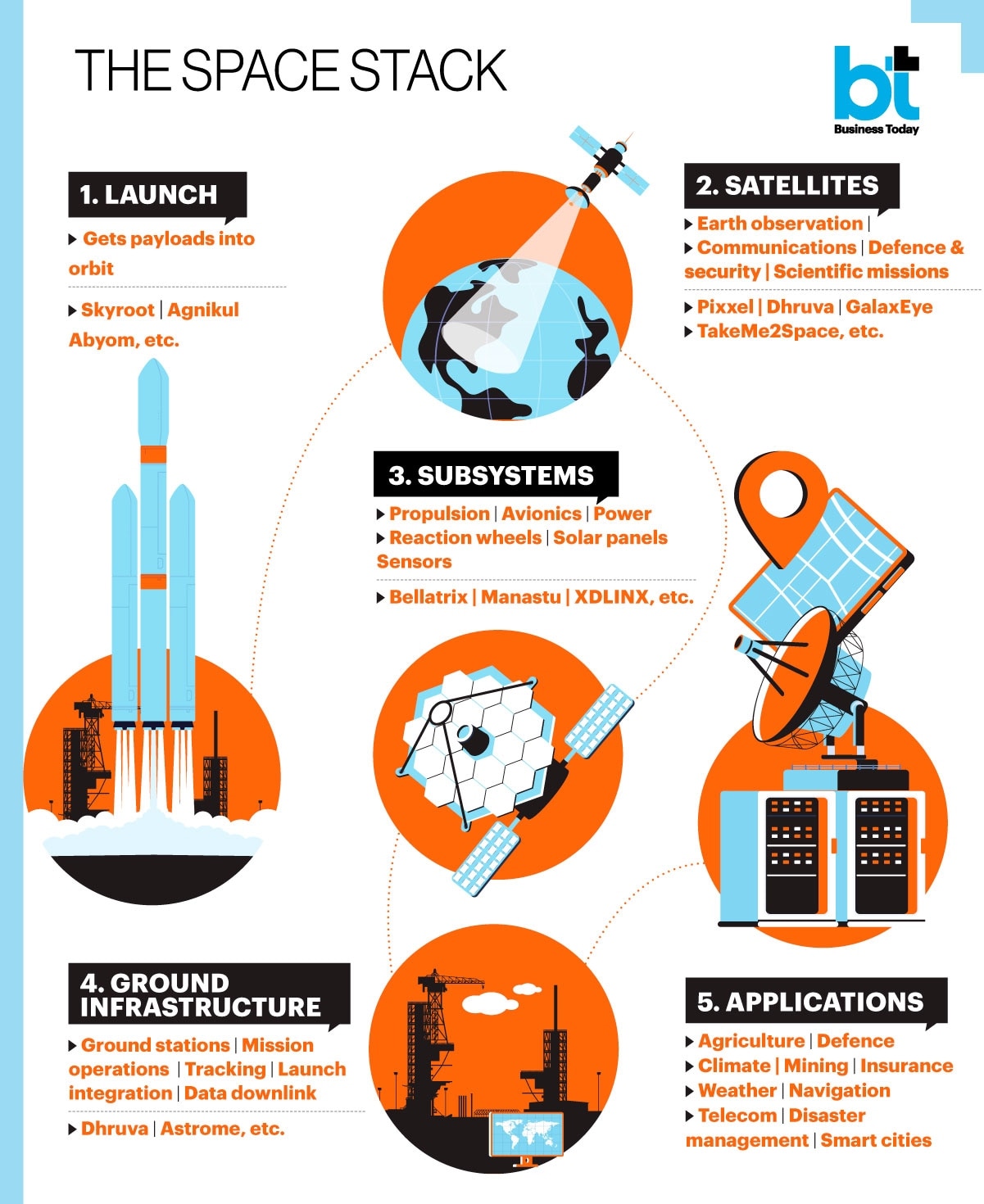
Skyroot, Agnikul and Pune’s Astrophel Aerospace began building rockets, the vehicles that carry satellites into orbit. Hyderabad-based Abyom SpaceTech & Defence started building reusable rockets, advanced space infrastructure and dual-use technologies. Bellatrix went after propulsion, the systems that move spacecraft once they get there. Dhruva Space built satellite platforms and the ground infrastructure needed to receive and process what comes back.
Pixxel built hyperspectral imaging sensors and EON Space Labs, also from Hyderabad, made electro-optical payloads — the cameras and instruments that collect information from space; Bengaluru-based GalaxEye Space combined optical and radar sensing into one. Digantara started with space domain awareness, tracking satellites, debris, and other objects already crowding the orbit.
Together, they form a chain across the space economy, with each layer enabling the next. “Space is the next frontier,” says Jainul Abedin, Founder & CEO of Abyom. “Whether we realise it or not, our everyday lives are becoming increasingly dependent on space. A farmer doesn’t necessarily need to know that a satellite is behind the weather data he uses before sowing, the crop insurance he accesses, or the digital maps that help him navigate. But the infrastructure enabling many of these services increasingly begins in space.”
Today, India operates just over 50 satellites, spread across communication, navigation, earth observation, and strategic applications. By comparison, the US has more than 11,000 active spacecraft — over 10,000 of them in SpaceX’s Starlink constellation — while China’s fleet has crossed the 1,000‑satellite mark and is expanding rapidly with new navigation, earth observation and broadband constellations.
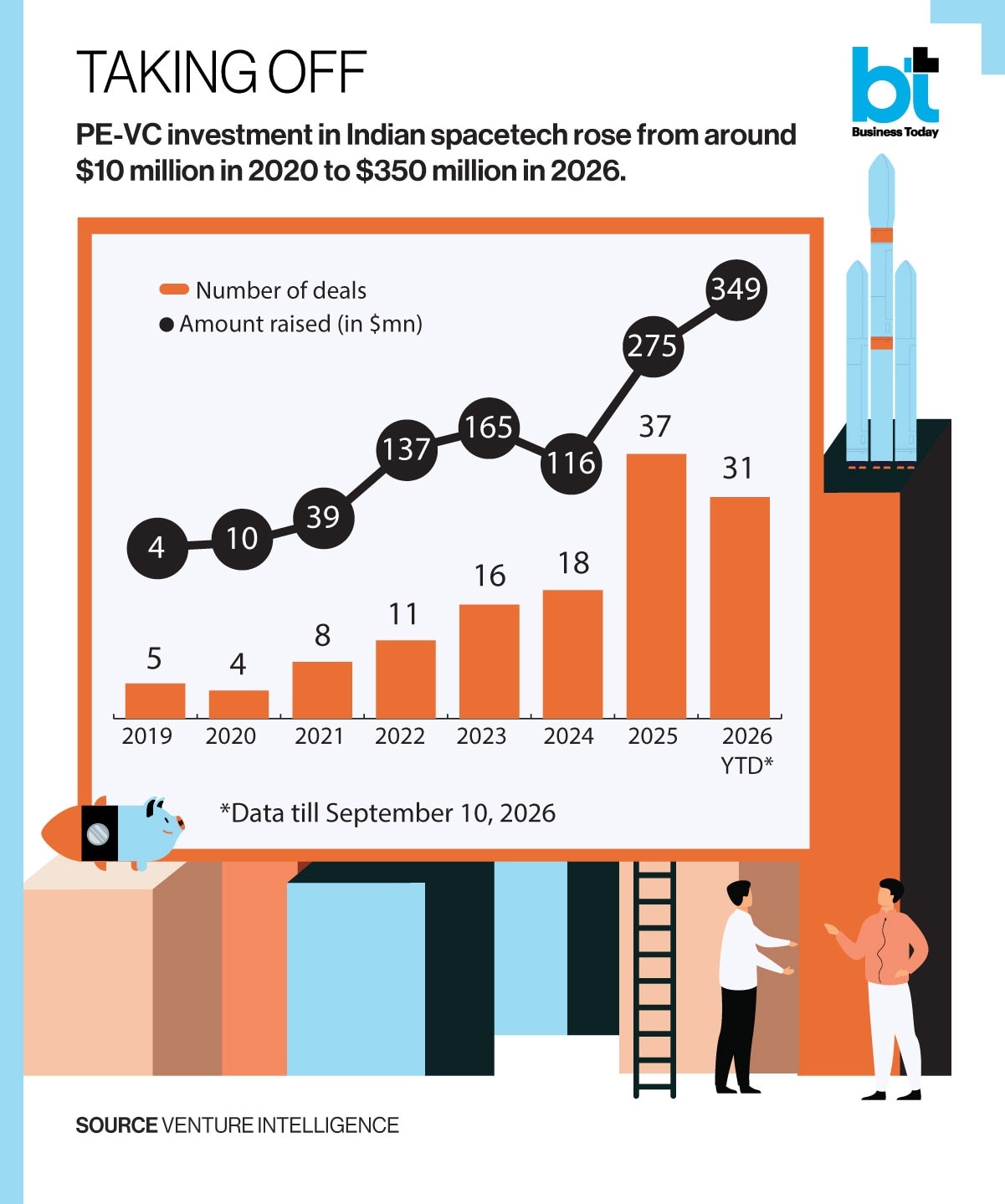
Private equity and venture capital investment in Indian spacetech companies rose from roughly $10 million across four deals in 2020 to about $275 million across 37 deals in 2025, according to funding data from Venture Intelligence. It has reached $349 million across 31 deals this year as of 10 September. IN-SPACe has set a goal of growing India’s space economy from about $8.4 billion now to $44 billion by 2033, raising the country’s share of the global market from 2% to 8%.
To put things in perspective, the global space economy was worth about $630 billion in 2023 and could reach $1.8 trillion by 2035, according to a World Economic Forum-McKinsey report.
Pharma to payloads
On February 3, 2026, a small Indian satellite tracked the International Space Station across the sky and photographed it twice, capturing the orbiting station in 15 angles while both craft moved at roughly 7km per second — fast enough for one to travel from Delhi to New York and back in under an hour. The industry called it in-orbit snooping, a crucial development in modern space security.
The satellite — an 80kg Earth-observation craft called ABA First Runner, or AFR — was launched on June 13, 2023, aboard SpaceX’s Falcon 9, as part of the Transporter-8 mission. It was made by Azista Space, in collaboration with Berlin Space Technologies.
When Azista Industries was founded in Hyderabad in 2014, it made organic food products and pharmaceuticals. From there, it started climbing up the value chain, moving from consumer goods into high-reliability, high-margin manufacturing. Its aerospace business emerged in 2016, initially around space and composites. In 2017, it got its first real exposure to space technology as an Isro subcontractor.
“That experience was invaluable,” says Azista Space Managing Director Srinivas Reddy. “It taught us the quality systems, documentation discipline and process rigour that space demands, none of which you can learn from commercial electronics work.”
For the next few years, Azista Space built hardware to Isro’s drawings, to the agency’s standards, for its national missions. It had two options: keep building to Isro’s specifications and remain a contractor, or venture out on its own. About three years in, it made a call: it would develop its own products for the global market.
Space hardware demands a different kind of discipline. It has to survive an environment that cannot be fully replicated on the ground and not repaired once launched — vacuum, extreme thermal cycling, radiation and severe launch vibration. It has to work the first time, every time.
“That changes everything upstream. We had to build quality systems and traceability where every component, process and test is documented and auditable end to end,” says Reddy. “We had to adopt space-grade parts selection and screening, environmental qualification and testing (thermal-vacuum, vibration, EMI/EMC), cleanroom assembly practices, and rigorous failure analysis and review discipline. Reliability and repeatability, not just a working prototype, become the real deliverable.”
The policy change in 2020 became the catalyst it needed.
A mixed inheritance
“The private sector has always been involved. The only difference now, which is a big difference, is that private people can be mission owners,” says Ravichandran. “We all worked as contractors. We were building something, but the mission was owned by India.”
Isro’s vendor base could make almost any part to a specification, but it was thin where the requirement was to design, qualify and repeatedly manufacture a specialised part of its own: aerospace‑grade valves, cryogenic components, radiation‑hardened electronics, optical glass and coatings. So companies had to build these in-house or import.
Immanuel Louis, Co-founder and COO of Astrophel, maps the gap precisely. “India has strong precision-manufacturing capabilities, but gaps remain in aerospace qualification, traceability and low-volume specialised supply chains,” says Louis. For example, most Indian companies still import high-pressure and cryogenic valves often from Germany, so Astrophel now builds its own. Roughly 47% of the company’s bill of materials by value still comes from outside India.
The harder lesson, Louis says, came after the engineering. “Industrialising the technology is often harder than developing it,” he says. “Aerospace is not only a technology problem in India. It is a manufacturing, supply-chain and execution problem.” The machining India could do. The qualified, specialised supply, it largely could not.
That gap forced companies to build capabilities in-house. Propulsion was perhaps the clearest case, because there was almost no domestic manufacturing base. Bellatrix, for example, set out to build engines for a new generation of small satellites and found the technology had to be reinvented for smaller scale.
“Initially, the industry was largely focused on the GEO market. We recognised the shift toward LEO early and had to re-invent the wheel, thereby developing solutions specifically for lower-orbit satellites. This meant inventing entirely new products for the LEO regime,” says Karanam. “At the time, none of the existing players had strong, active R&D teams—they were primarily manufacturers.” Both the company’s customers and suppliers were based overseas, and, as Karanam puts it, “there were absolutely no suppliers in the country”.
GEO, or Geostationary Earth Orbit, and LEO, or Low Earth Orbit, are the two main types of orbits used for satellites. LEO is closer to earth and satellites in it move quickly, typically at altitudes of 160 to 2,000 km. GEO is much farther away, at about 35,786 km above the equator, where satellites orbit at the same rate as earth’s rotation and, therefore, appear stationary from the ground.
Abyom is another example. A reignitable, throttleable engine didn’t exist in India, and it couldn’t be reverse-engineered. “Rocket propulsion is fundamentally a deep-tech problem. You cannot simply take an existing rocket engine apart and reverse-engineer it like you might with a conventional automobile engine,” says Abedin. “Every element — from combustion and injection to cooling, materials and controls — has to work together under extreme conditions. We have had to build a significant part of this capability ourselves, through continuous testing, iteration and learning.”
The gap was widest where the work was design-intensive. Lenses and sensors, for example, need a specialised supply chain: makers of optical glass, of the fine coatings that go on lenses, of ultra-precise polishing and measurement. Almost none of it exists in India. So EON had to build the know-how itself. “We’re no longer just assembling imported components,” says Co-founder and COO Punit Badeka. “We’re designing and engineering sophisticated electro-optical payloads in India.”
How much a company inherited then depended on which part of space it had chosen. The closer their work sat to hardware Isro had already built, the more there was to draw on; the further it moved into new territory, the less.
Digantara, a space domain awareness and surveillance startup, sits at the far end. “We had to build every bit of infrastructure from scratch,” says the Bengaluru-based company’s founder and CEO Anirudh Sharma. “Isro had built satellites, rockets and missions, but it had never tracked satellites from space.” There was no vendor to call, no scientist to borrow, no expertise anywhere in the country to hire.
Between the two ends sat most of the industry, drawing on what existed and building what did not. The supplier base gave the new companies manufacturing capacity. Isro gave them people, testing infrastructure, engineering experience and credibility. The policy reforms gave them permission to become mission owners. But the technology they now had to own, and the supply chains they needed to make it at scale, had to be built by the companies themselves.
Vikram-1 showed that India’s private sector could assemble an orbital vehicle and put it into space. The next test is whether India’s spacetech companies can compete globally.















 Before 2020, Isro was India’s only face in space. It designed the rockets and also built various satellites.
  BT BIG STORY: How India’s space startups are building on Isro’s blueprint
 Opposition's march to SC: Delhi police announces 30 key route diversions. Check details
 Delhi Metro closes 6 major stations ahead of Opposition's Supreme Court march today
  Commodities steal the show in 2026, surging 47.4% as gold and Bitcoin slip into negative territory
 India Post's ₹1.94 lakh crore opportunity: Can its vast network become a commercial powerhouse?
 REITs & AI Boom: Can Data Centres And AI-Ready Offices Drive Future Real Estate Growth?
 Should You SIP In REITs During A Market Downturn? Key Risks & Asset Allocation Explained
 REIT Returns Explained: Income, Capital Gains & Risks Investors Need To Know
 REIT Risks Explained: Key Factors Investors Must Check Before Investing In Commercial Real Estate
 Will IRDAI’s Broker Commission Crackdown Make Insurance Cheaper For Consumers?
 BT Market Outlook: The drivers, risks and opportunities for the week ahead
 Market on the back foot, opportunities ahead: where should investors put their money?
 Poonawalla Fincorp Q2 earnings: Net profit zooms 405%, NII at Rs 1,589 crore
  Vedanta, TCS shares to turn ex-dividend; Ola rights issue; 2 stock splits next week
 Mental health in India: Why nearly 80% hesitate to seek therapy despite rising concerns
 UAE has changed 5 key rules this October, from new restrictions to hefty fines, here's everything residents need to know