






Search
Advertisement
Government is absorbing the oil shock: Who ultimately pays the bill?

Government is absorbing the oil shock: Who ultimately pays the bill?

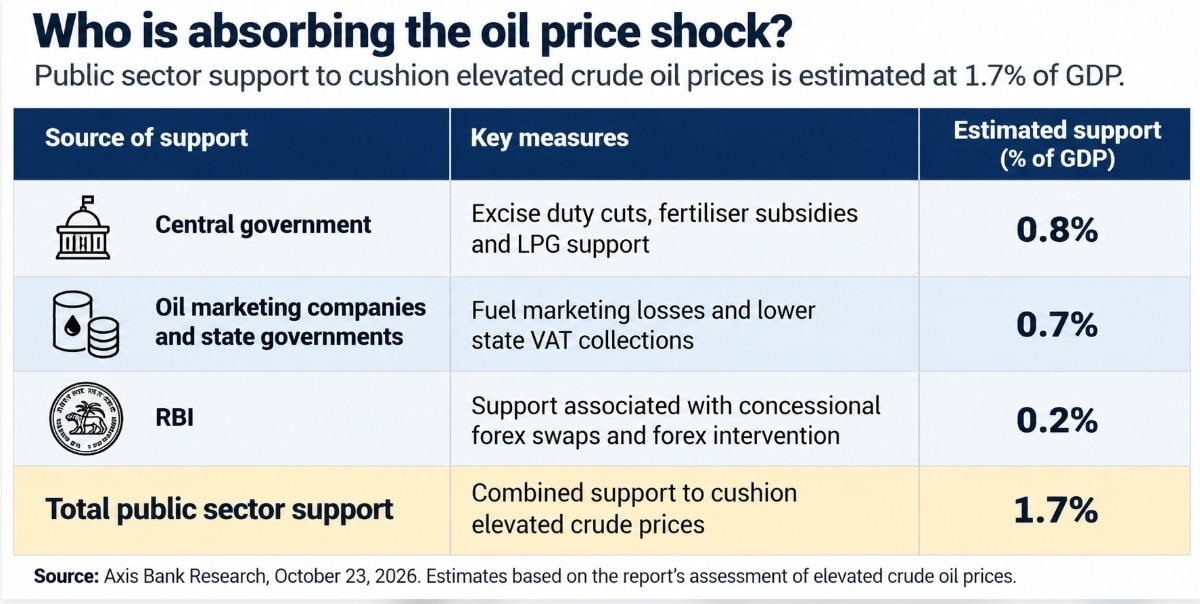
India’s public sector is absorbing an estimated 1.7% of GDP to cushion the impact of elevated crude oil prices, but rising import costs are increasing the pressure on government finances. With India’s crude oil import bill surging 46% in September, how long can the government shield consumers from higher fuel prices without risking fiscal stability?

Basudha Das
Basudha Das
  • Updated Oct 24, 2026 3:20 AM IST
Government is absorbing the oil shock: Who ultimately pays the bill?Axis Bank Research noted that Brent crude had crossed $110 per barrel, while dated Brent had reached $140 per barrel.

The Centre, state governments, public sector oil companies and the Reserve Bank of India (RBI) are collectively bearing a significant part of the burden of elevated crude oil prices to cushion the impact on consumers and the economy. However, the cost of this support is rising, raising questions about how long the government can absorb the oil shock without putting pressure on public finances.

Advertisement

Related Articles

According to an Axis Bank Research report dated October 23, the combined support from the Centre, states, public sector undertakings (PSUs) and the RBI is estimated at around 1.7% of gross domestic product (GDP), assuming average crude oil prices of $100 per barrel this year.

The report estimates that every $10 per barrel increase in crude prices would raise the support burden by 20 basis points of GDP if retail fuel prices remain unchanged.

India’s crude oil import bill surged 46% year-on-year to $15.4 billion in September, up from $10.5 billion, as international oil prices rose amid renewed tensions in the Middle East. Crude oil import volumes increased 7% during the month, while the Indian crude basket averaged $116.09 per barrel, higher than the $114.48 recorded in April.

Advertisement

Between April and September, the import bill jumped 46.3% to $90.6 billion from $61.9 billion a year earlier, largely driven by higher prices. Disruptions to oil supplies from the Middle East and increased shipping risks around the Strait of Hormuz have added to the pressure on India’s crude import costs.

Who is bearing the cost?

The Centre accounts for an estimated 0.8% of GDP in support through measures such as excise duty cuts on auto fuels, higher fertiliser subsidies and relatively modest increases in domestic liquefied petroleum gas (LPG) prices.

Fertiliser subsidies increased 21% year-on-year during April-August, while LPG under-recoveries for FY27 are estimated at ₹57,000 crore.

Oil marketing companies (OMCs) and state governments are expected to contribute further support equivalent to around 0.7% of GDP. This includes marketing losses incurred by OMCs on petrol and diesel and lower value-added tax (VAT) collections by states.

Advertisement

The RBI accounts for an estimated 0.2% of GDP through the subsidy associated with concessional foreign exchange swaps and the impact of foreign exchange intervention, according to the report.

Together, these measures help cushion the immediate impact of high oil prices. However, the cost does not disappear; it is distributed across government finances, public sector company earnings and other parts of the public sector.

How long can the government absorb the shock?

Recent oil price increases have intensified the challenge. Axis Bank Research noted that Brent crude had crossed $110 per barrel, while dated Brent had reached $140 per barrel.

The report estimates that higher gold duties, export duties designed to capture windfall gains on petroleum products and the Economic Stabilisation Fund could create fiscal room equivalent to 0.6% of GDP.

These buffers could help limit the Centre’s fiscal slippage to around 20-30 basis points of GDP in FY27.

However, the outlook depends on how long crude prices remain elevated. If the shock becomes more permanent, the report argues, the optimal level of government support should decline, allowing a greater share of the higher costs to be passed on.

Advertisement

For consumers, that could mean reduced protection from fuel price increases if the government and public sector can no longer absorb the full burden. For public finances, the challenge will be to balance short-term relief with fiscal stability.

The central question is not just who pays for expensive oil today, but how much of the burden the public sector can continue to carry if prices remain high.

ABOUT THE AUTHOR

Basudha Das
Basudha Das

With over 16 years of experience in the newsroom, I am currently covering personal finance, banking, financial services, and insurance sector, bullion and metals, sports, and other trending topics. When not chasing interest rates and new-age investment tools, I like to follow and cover climate change trends and environment-friendly initiatives across the world. When not at work, I spend time learning Bharatnatyam from my guru, and baking from my daughter.

Published on: Oct 24, 2026 3:20 AM IST