















 Axis Bank Research noted that Brent crude had crossed $110 per barrel, while dated Brent had reached $140 per barrel.
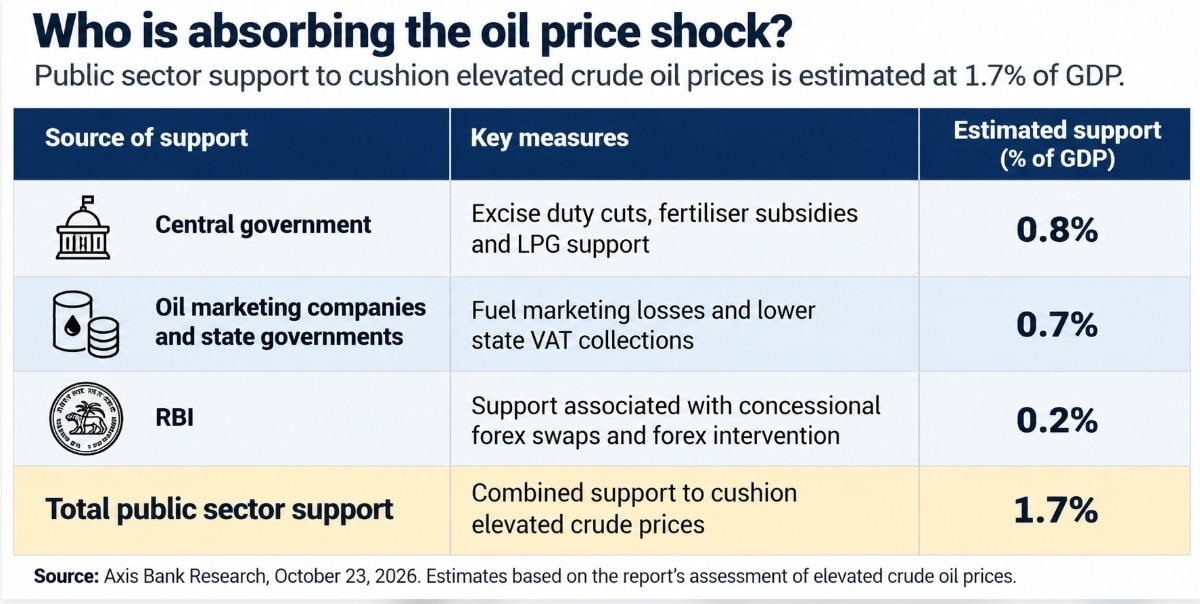
The Centre, state governments, public sector oil companies and the Reserve Bank of India (RBI) are collectively bearing a significant part of the burden of elevated crude oil prices to cushion the impact on consumers and the economy. However, the cost of this support is rising, raising questions about how long the government can absorb the oil shock without putting pressure on public finances.
According to an Axis Bank Research report dated October 23, the combined support from the Centre, states, public sector undertakings (PSUs) and the RBI is estimated at around 1.7% of gross domestic product (GDP), assuming average crude oil prices of $100 per barrel this year.

 Profits, performance and peer power: Business Today’s Most Powerful Women in Business celebrate leadership
 MPW: Indian women entrepreneurs are excelling despite challenges, says Nitin Gadkari
 ‘Legacy can earn you trust, but not preference,’ says Godrej Enterprises Group's Nyrika Holkar
 MPW: Experts share insights on investing in uncertain times
 Blinkit is Eternal’s proven bet. dark.ai is the next gamble
 LIVE: How Women Leaders Are Taking Legacy Businesses Into The Future | MPW Awards 2026
 LIVE: Can India Build Its Next Manufacturing Powerhouse? | MPW Awards 2026
 LIVE: India's Top Women Leaders Decode Money, Markets & Power | MPW Awards 2026
 Market Commentary | Top Sectors & Stocks to Invest In | Gaurang Shah’s Market Outlook
 Mercury Into Gold! Marathon Fusion's Alchemy Breakthrough: Is Gold's Value Under Threat?

 Jio Platforms IPO: Record Rs 4.90 lakh crore in bids, 1.35 cr applications; check allotment odds
 IndusInd Bank Q2 profit at Rs 1,242 crore; NII up 4% YoY
 2. JSW Steel, Jindal Steel Q2 results: Revenue, profit rise; margins tell different stories
 Infosys Q2 profit rises 6% YoY to Rs 7,823 crore; announces Rs 26 dividend per share
 Tata Motors Q2: Net profit at Rs 1,257 crore, revenue up 36%; shares update on Iveco deal
 Small-Cap funds get 44% of equity inflows despite high valuations: Should investors be worried?
 Mumbai real estate: Property registrations fall 25% YoY during Navratri 2026, lowest in last 3 years
 Potential cure for genetic disease? Scientists test DNA editing inside human body for first time
 US Green Card: Why Indian EB-2 applicants wait nearly 8 years longer than Chinese nationals
 US Green Card approval delay: Why EB-2 India applicants with 2014, 2015 dates remain in queue


